
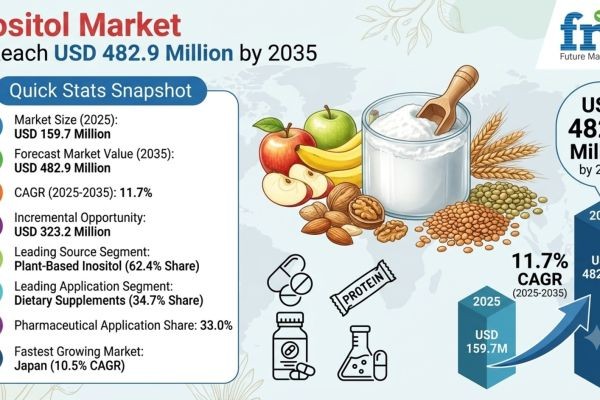
The global Inositol Market is poised for remarkable expansion, according to latest insights by future market insights. The market stood at USD 159.7 million in 2025 and is projected to reach USD 482.9 million by 2035. Over the forecast period from 2025 to 2035, the industry is anticipated to expand at a CAGR of 11.7%. Growth is being fueled by increasing consumer awareness regarding metabolic health, rising prevalence of polycystic ovary syndrome (PCOS), growing adoption of preventive healthcare solutions, and expanding use of inositol across pharmaceutical, nutraceutical, and functional food applications.
Key Inositol Market Projections
- Market Size (2025): USD 159.7 Million
- Forecast Market Value (2035): USD 482.9 Million
- CAGR (2025-2035): 11.7%
- Incremental Opportunity: USD 323.2 Million
- Leading Source Segment: Plant-Based Inositol (62.4% Share)
- Leading Application Segment: Dietary Supplements (34.7% Share)
- Pharmaceutical Application Share: 33.0%
- Fastest Growing Market: Japan (10.5% CAGR)
- Key Growth Driver: Rising Demand for Metabolic, Reproductive, and Mental Health Support
Request a Sample Report: https://www.futuremarketinsights.com/reports/sample/rep-gb-1290
Strategic Market Insights
The inositol market is evolving from a niche therapeutic ingredient category into a mainstream wellness and preventive healthcare segment. Increasing scientific evidence supporting the role of inositol in reproductive health, metabolic balance, insulin sensitivity, neurological wellness, and mental health management is encouraging wider adoption across healthcare and consumer wellness sectors.
Demand is growing rapidly among consumers seeking natural and plant-derived ingredients that support long-term wellness goals. As awareness surrounding conditions such as PCOS, diabetes, anxiety, depression, and metabolic disorders continues to rise, manufacturers are expanding product portfolios to address these health concerns through targeted formulations.
The industry is also witnessing strong momentum from preventive healthcare trends, with consumers increasingly adopting supplements as part of daily wellness routines. This shift is creating new opportunities for pharmaceutical companies, nutraceutical manufacturers, and functional ingredient suppliers.
Analyst Perspective
“The inositol market is moving toward plant based and supplement-led formats as consumers look for metabolic and reproductive health support. Manufacturers with clean-label positioning and reliable ingredient quality are likely to gain advantage as wellness-focused formulations expand,” said Nandini Roy Choudhury, Principal Consultant for Food and Beverage at FMI.
Competitive Landscape and Market Share Analysis
The global inositol market is moderately fragmented, characterized by the presence of pharmaceutical ingredient manufacturers, nutraceutical suppliers, specialty chemical producers, and dietary supplement companies.
Competition is increasingly focused on ingredient purity, plant-based sourcing, formulation innovation, clinical validation, and global distribution capabilities. Companies are investing heavily in research and development to enhance the bioavailability and efficacy of inositol formulations while expanding their presence in high-growth markets.
Strategic partnerships, acquisitions, and collaborations with healthcare providers and supplement brands continue to play a vital role in strengthening market positioning and expanding customer reach.
Leading Market Participants Include
- DSM NV
- Charles Bowman & Company
- T.J. Clark & Company
- Shandong Runde Biotechnology Co.
- Howtian
- Biological E Ltd.
- Ronas Chemicals
- Holland & Barrett
- Phoenix Herb
- Asiamerica Group, Inc.
Competition increasingly centers on product quality, clean-label positioning, clinical substantiation, and global supply chain integration.
Production vs. Consumption Economy Analysis
Production of inositol is supported by both plant-based extraction and synthetic manufacturing methods. Plant-based inositol continues to gain preference due to growing consumer demand for natural ingredients and sustainable sourcing practices.
Consumption is expanding across pharmaceutical, dietary supplement, beverage, feed, and wellness applications. Developed economies such as Japan, the United States, Germany, and the United Kingdom continue to represent major consumption centers due to high supplement adoption rates and advanced healthcare infrastructure.
Emerging markets are also presenting new opportunities as awareness of preventive healthcare and nutritional supplementation continues to increase.
Supply Chain and Value Chain Insights
The inositol value chain includes raw material sourcing, extraction or synthesis, purification, formulation development, packaging, distribution, and final application across pharmaceutical, nutraceutical, and food industries.
Manufacturers are increasingly focusing on improving extraction efficiency, quality consistency, and ingredient traceability to meet stringent regulatory standards and consumer expectations.
Advancements in production technologies are helping suppliers improve scalability while reducing manufacturing costs and enhancing product availability.
Strategic Procurement Analysis
Procurement strategies within the inositol market are increasingly influenced by source transparency, regulatory compliance, ingredient purity, formulation compatibility, and supply reliability.
Pharmaceutical and nutraceutical companies are prioritizing suppliers capable of providing clinically validated ingredients supported by comprehensive quality documentation and certification standards.
As consumer demand for clean-label and plant-based products continues to grow, procurement teams are increasingly favoring suppliers with sustainable sourcing practices and transparent manufacturing processes.
Country Opportunity Assessment
Japan
Japan is projected to remain the fastest-growing market through 2035, registering a CAGR of 10.5%. The country's aging population, advanced healthcare infrastructure, and strong demand for nutraceutical products continue to create significant growth opportunities.
United States
The United States is expected to expand at a CAGR of 9.6% during the forecast period. Increasing supplement adoption, growing awareness of preventive healthcare, and strong e-commerce penetration continue to support market expansion.
United Kingdom
The United Kingdom is forecast to grow at a CAGR of 8.8% through 2035. Rising awareness of mental wellness, reproductive health, and natural healthcare solutions is driving demand for inositol-based products.
Germany
Germany is projected to register a CAGR of 8.5% during the forecast period, supported by strong healthcare infrastructure, high supplement consumption, and increasing interest in clinically validated wellness products.
France
France is expected to grow at a CAGR of 8.3% through 2035. Expanding demand for organic, plant-based, and natural health supplements continues to support market development.
Technology and Innovation Outlook
Key innovations shaping the inositol industry include:
- Advanced plant-based extraction technologies
- Enhanced bioavailability formulations
- Pharmaceutical-grade purification systems
- Functional beverage integration
- Personalized nutrition formulations
- Clean-label supplement development
- Digital health and wellness platforms
- Clinical research and therapeutic application studies
Manufacturers continue investing in technologies that improve ingredient effectiveness, formulation flexibility, and consumer acceptance.
Segment Analysis
By Source
Plant-based inositol is expected to dominate the source segment with a 62.4% market share in 2025. Growing demand for natural ingredients, sustainable sourcing practices, and clean-label products continues to strengthen the segment's leadership position.
Synthetic inositol remains relevant in cost-sensitive applications where supply consistency and large-scale manufacturing efficiency are key considerations.
By Application
Dietary supplements are expected to account for 34.7% of total market demand in 2025. Rising consumer interest in preventive healthcare, reproductive wellness, metabolic health, and mental well-being continues to drive adoption.
The pharmaceutical industry is projected to maintain a significant 33.0% market share, supported by increasing therapeutic applications for PCOS, diabetes management, neurological health, and metabolic disorders.
Beverages, feed applications, and other specialized uses continue to contribute to overall market expansion.
Exclusive Discounts on Full Report: https://www.futuremarketinsights.com/reports/inositol-market
Future Industry Outlook
The Inositol Market is expected to benefit from increasing awareness of metabolic health, rising prevalence of reproductive health disorders, expanding demand for preventive healthcare products, and growing adoption of plant-based ingredients.
Although regulatory compliance requirements, production costs, and competition from synthetic alternatives remain important challenges, ongoing advancements in extraction technologies, formulation science, and clinical validation are expected to strengthen long-term market prospects.
Companies that focus on clean-label positioning, scientific substantiation, sustainable sourcing, and innovative delivery formats will be best positioned to capitalize on emerging opportunities through 2035.






