
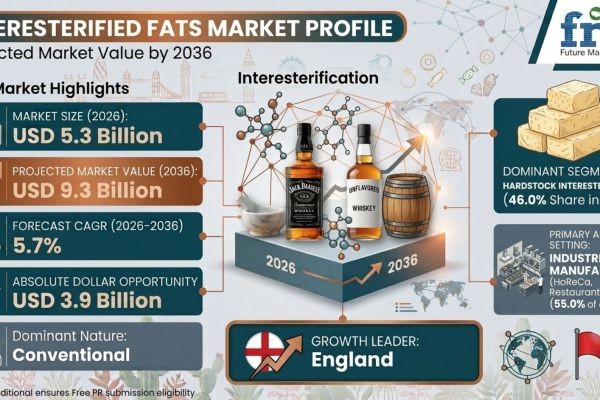
The global interesterified fats market is entering a new phase of mainstream expansion as food processors, industrial bakers, and pharmaceutical manufacturers increasingly prioritize clean-label structuring solutions, trans-fat-free configurations, and optimized melting behaviors. According to latest insights by future market insights, the market is projected to grow from USD 5.3 billion in 2026 to USD 9.3 billion by 2036, registering a robust 5.7% CAGR during the forecast period. The category is rapidly transitioning from a volume-driven commodity structure toward a specialized, value-driven specialty lipid framework supported by massive capacity expansions, strict regulatory safety compliance, and tightening performance specifications across high-volume commercial baking lines.
Request a Sample Report: https://www.futuremarketinsights.com/reports/sample/rep-gb-14255
Key Market Highlights at a Glance
- Market Size (2026): USD 5.3 Billion
- Forecast Market Size (2036): USD 9.3 Billion
- Forecast Period: 2026–2036
- CAGR (2026–2036):7%
- Absolute Dollar Opportunity: USD 3.9 Billion
- Leading Product Segment: Hardstock Interesterified Fats
- Hardstock Interesterified Fats Share (2026):0%
- Leading Processing Segment: Chemical Interesterification
- Chemical Interesterification Share (2026):0%
Why Is the Interesterified Fats Market Growing?
Several structural shifts across the global oil-refining and commercial food processing landscapes are driving sustained demand for interesterified structural fats.
Key Growth Drivers
- Widespread international regulatory compliance deadlines targeting the absolute removal of partially hydrogenated oils (trans-fats), positioning interesterification as the premier alternative technique for fat crystallization.
- Growing industrial food processing requirements for functional bakery fats, shortenings, and margarine bases exhibiting exceptional plasticity and sharp melting curves.
- Increasing utilization across the pharmaceutical sector for lipid-based drug delivery networks, capsule filling matrices, and controlled-release excipients.
- Scaled production capacity additions and advanced infrastructure investments linking major tropical oil crushing centers to high-consumption urban retail corridors.
- Ongoing process optimization of continuous chemical and lipase-catalyzed rearrangements, substantially lowering the total cost of ownership for commercial procurement teams.
- Rising consumer demand for premium, trans-fat-free spreadable table margarines and functional nutraceutical lipid blends.
"Producers that combine food processing cost competitiveness with food processing performance and compliance certification are likely to capture incremental volume as softstock interesterified fats procurement expands through 2036." Nandini Roy Choudhury, Principal Consultant at FMI
Which Product Segment Leads the Interesterified Fats Market?
Hardstock Interesterified Fats continue to dictate the product matrix by serving as a core structuring building block across mass industrial food manufacturing.
Product Segment Highlights
- Hardstock Interesterified Fats govern 46.0% of the entire product landscape in 2026.
- Deeply institutionalized as the premier trans-fat-free functional substitute for hydrogenated vegetable shortenings.
- Bakery Fats represent the primary volume engine due to high-throughput commercial processing lines.
- Softstock Interesterified Fats represent a secondary growth segment, advancing rapidly across spreadable table margarines and low-fat spreads.
Why Does Chemical Interesterification Maintain the Largest Share?
Chemical Interesterification remains the primary industrial technique chosen by bulk oil refiners due to its proven, long-term cost competitiveness and massive volumetric scale advantages.
Interesterification Process Highlights
- Chemical Interesterification commands a leading 62.0% process market share in 2026.
- Offers optimized continuous manufacturing setups that drastically reduce overheads for high-volume food formulators.
- Highly preferred across bulk channels due to its operational simplicity and predictable production yields.
- Enzymatic process configurations continue expanding within top-tier specialty segments demanding strict low-byproduct formations.
Why Does Food Processing Dominate the End-Use Landscape?
Industrial Food Processing plants operate as the ultimate anchor for volumetric output, accounting for nearly three-quarters of global compound lipid consumption.The bulk of this baseline industrial procurement is driven by structural recipe adjustments across high-volume bread, biscuit, pastry, and non-dairy dairy alternative operations.
End Use Application Highlights
- Food Processing structures command a dominant 72.0% of the global application landscape.
- Driven heavily by commercial bakeries adapting lines to meet evolving regional health compliance standards.
- Shortening Fats and Margarine Base Fats represent the highest-volume product pipelines within industrial settings.
- Direct-sales channels and long-term bulk procurement contracts represent the standard distribution framework linking refiners to food brands.
Sourcing Metrics: Palm Oil Fractions Lead the Raw Material Base
Fractionated Palm Oil forms the core foundation of the raw material matrix because it offers an abundant, naturally structured source of palmitic and oleic fatty acids.
By isolating distinct fractions like palm mid-fractions (PMF) and palm stearin, refiners obtain the exact lipid components required to build high-compatibility fats. To meet the precise melting profiles required by luxury confectionery and infant nutrition manufacturers, these palm oil fractions are frequently blended with exotic specialty fats, including refined shea butter, illipe butter, and sal fat.
Custom Research Available: https://www.futuremarketinsights.com/customization-available/rep-gb-14255
Market Dynamics
Market Drivers
The global legislative crackdown on partially hydrogenated fats is forcing modern food processing conglomerates to rapidly restructure their recipe formulas. Interesterified fats benefit directly from this environment, acting as an indispensable functional replacement that preserves standard product textures while providing complete safety compliance.
Market Restraints
Frequent feedstock input cost volatility, high initial refinery capital expenditure requirements, and supply chain concentration risks present major hurdles for expanding processing centers. In addition, navigating varying international food labeling laws regarding modified fats can disrupt cross-border distribution setups into price-sensitive regions.
Market Trends
Technical and distribution models continue to progress.
Major trends include:
- Commercial scaling of advanced continuous chemical processing lines to maximize output consistency.
- Growing utilization of highly advanced enzymatic systems using immobilized lipase enzymes to cut down processing byproducts.
- Increasing investment by leading lipid processors into regenerative agricultural sourcing networks for shea and palm feedstocks.
- Launch of advanced custom-formulated fat lines displaying tailored melting profiles for extreme tropical climates.
- Rising placement of private-label functional fat brands inside mass-market hypermarket discount channels.
Regional and Country Outlook
Country Growth Rates
- South Korea — 6.0% CAGR
- Japan — 5.9% CAGR
- United States — 5.8% CAGR
- European Union — 5.7% CAGR
- United Kingdom — 5.6% CAGR
South Korea operates as the primary global growth accelerator through 2036, advancing at a 6.0% CAGR. Premium consumer lifestyles, a massive expansion of organized retail networks, and continuous domestic manufacturing innovations within local confectionery.
Japan tracks close behind at a 5.9% CAGR, supported by an aging consumer demographic demanding functional lipid excipients, along with a deep focus on satisfying strict industrial JIS quality standards.
The United States represents a major market validation arena, growing at a 5.8% CAGR; mature retail landscapes feature extensive shelf allocations for trans-fat-free alternatives alongside strict retailer sustainability mandates that incentivize clean-label product development.
Across the European Union, a 5.7% market advance is heavily guided by strict regional packaging directives and deep corporate sustainability mandates that force producers to trace palm and exotic fats directly to source origins.
The United Kingdom expands at a 5.6% CAGR, navigating post-Brexit trade updates and local packaging regulations while relying heavily on long-term supplier qualification configurations.
Competitive Landscape
The global industry layout displays high consolidation across raw material procurement and bulk industrial supply, led by multinational agricultural processing giants, while highly agile consumer brands dominate specialized premium retail spaces.
Key Companies
Cargill, Inc., Bunge Limited, Wilmar International Limited, IOI Corporation Berhad, Fuji Oil Holdings Inc.
Competitive Benchmarking: Global Interesterified Fats Market
Corporate development paths moving forward are intensely focused on optimizing large-scale continuous chemical reactors, expanding localized delivery channels within high-growth Asian centers, and deploying next-generation enzymatically structured lipids that offer advanced melting textures.
Exclusive Discounts on Full Report: https://www.futuremarketinsights.com/reports/interesterified-fats-market
Frequently Asked Questions
How big is the interesterified fats market in 2026?
The global interesterified fats market is estimated to be valued at USD 5.3 billion in 2026.
What will be the size of the interesterified fats market in 2036?
The market size for the interesterified fats market is projected to reach USD 9.3 billion by 2036.
How much will the interesterified fats market grow between 2026 and 2036?
The interesterified fats market is expected to grow at a 5.7% CAGR between 2026 and 2036.
What are the key products in the interesterified fats market?
The key products in the interesterified fats market are Hardstock Interesterified Fats, Softstock Interesterified Fats, and Specialty Interesterified Fats.
Which interesterification process segment is expected to contribute a significant share in the interesterified fats market in 2026?
In terms of the interesterification process, the chemical interesterification segment is expected to command a 62.0% share in the interesterified fats market in 2026.
FMI Custom Research: Strategic Intelligence for Confident Decision-Making
In today's rapidly evolving business environment, leadership teams need more than market data they need clear, actionable intelligence tailored to their strategic objectives. FMI's Custom Research solutions are designed around the specific business questions organizations need answered, enabling executives to evaluate growth opportunities, validate investments, assess competitive dynamics, and reduce uncertainty before making critical decisions. By combining deep industry expertise, primary research, and proprietary market intelligence, FMI delivers insights that help organizations move from assumptions to evidence-based strategies with greater speed and confidence.
Key Executive Benefits
- Decision-Ready Insights tailored to business priorities
• Reduced Strategic Risk through validated market intelligence
• Market Entry Confidence with detailed competitive analysis
• Competitive Advantage supported by proprietary research
• Faster Growth Decisions through customized strategic insights
• Primary Market Validation from industry stakeholders
• Global Industry Expertise across diverse sectors
• Proven Track Record with thousands of consulting engagements
Business Impact
FMI helps organizations transform market complexity into strategic clarity, enabling leadership teams to identify growth opportunities faster, optimize resource allocation, strengthen competitive positioning, and make high-stakes business decisions with confidence.
To explore how FMI Custom Research can support your strategic priorities, please connect with our team at - sales@futuremarketinsights.com
Why Choose FMI: https://www.futuremarketinsights.com/why-fmi
Explore More Related Studies Published by FMI Research
Desiccated Coconut Market : https://www.futuremarketinsights.com/reports/desiccated-coconut-market
Feed Phytogenic Market : https://www.futuremarketinsights.com/reports/feed-phytogenic-market
Explore In-Depth Food & Beverage Market Insights : https://www.futuremarketinsights.com/industry-analysis/food-and-beverage
About Future Market Insights (FMI)
Future Market Insights, Inc. is an ESOMAR-certified, ISO 9001:2015 market research and consulting organization trusted by Fortune 500 companies. With a global presence across the U.S., UK, India, and Dubai, FMI delivers data-driven insights across 30+ industries and 1200 markets worldwide.
Contact Us
Future Market Insights Inc.
Christiana Corporate, 200 Continental Drive,
Suite 401, Newark, Delaware – 19713, USA
T: +1-347-918-3531
For Sales Enquiries: sales@futuremarketinsights.com
Website: https://www.futuremarketinsights.com






