
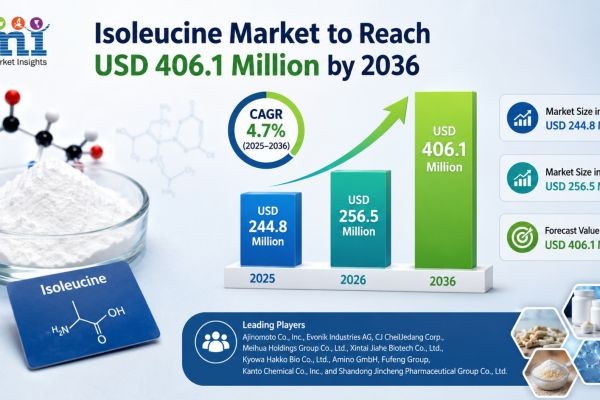
The global isoleucine market is experiencing structural expansion across industrial animal husbandry, consumer sports nutrition, and clinical parenteral medicine, according to latest insights by Future Market Insights. Produced primarily through bacterial fermentation (Corynebacterium glutamicum), L-isoleucine is an essential branched-chain amino acid (BCAA) critical for protein synthesis, muscle repair, energy regulation, and immune function.
The global market, valued at USD 244.8 million in 2025, is projected to reach USD 256.5 million in 2026. Advancing at a Compound Annual Growth Rate (CAGR) of 4.7% over the ten-year forecast period, total market valuation is anticipated to achieve USD 406.1 million by 2036, delivering an absolute incremental opportunity of USD 149.6 million.
Request a Sample Report: https://www.futuremarketinsights.com/reports/sample/rep-gb-9641
Market Performance Overview (2026–2036)
To map out the key physical forms, quality grades, primary end-use industries, and regional growth vectors guiding this USD 149.6 million market expansion, key segment allocations highlight where global commercial demand is concentrated:
- Powder Form Segment (67.5% share): Dominates physical format demand in 2026, favored for its high chemical stability, ease of bulk dry blending, and handling advantages across automated feed mills and supplement manufacturing facilities.
- Feed Grade Segment (46.3% share): Commands the grade category by volume, serving as an essential amino acid balancing agent in modern low-protein swine and poultry feed formulations to optimize lean muscle growth and feed conversion ratios (FCR).
- Dietary Supplements End-Use Segment (42.3% share): Represents the largest consumer health category, anchored by high demand for BCAA sports recovery powders, longevity-focused senior nutrition, and nootropic formulations.
- Pharmaceutical Grade Segment: Contributes high-margin value, driven by strict pharmacopoeia requirements for intravenous (IV) amino acid solutions and hospital parenteral nutrition infusions.
- India & China Regional Leadership: Lead national growth rates at 1% CAGR and 5.8% CAGR respectively through 2036, driven by rapid compound feed mill expansion, expanding domestic fermentation infrastructure, and rising sports nutrition consumption.
Technical Drivers and Formulation Shifts
The commercial scaling of L-isoleucine across animal nutrition, functional CPGs, and clinical healthcare is propelled by three primary industry catalysts:
Precision Animal Nutrition and Crude Protein Reduction
Livestock nutritionists are lowering overall crude protein levels in compound animal feeds to reduce nitrogen emissions and feed costs. Supplementing synthetic, feed-grade L-isoleucine alongside lysine, methionine, and threonine ensures balanced essential amino acid profiles without relying on excessive soybean meal.
Parenteral Nutrition and Clinical Disease Management
Hospital nutritional support protocols in mature healthcare markets are transitioning away from generic protein hydrolysates toward standardized, individual crystalline amino acid infusions. Highly purified, pyrogen-free pharmaceutical-grade isoleucine is essential for formulating total parenteral nutrition (TPN) solutions for post-surgical recovery, trauma, and liver disease management.
Functional Food & Beverage Fortification
Major food and beverage corporations (such as Nestlé and Abbott Laboratories) are incorporating BCAAs into adult medical beverages, ready-to-drink meal replacements, and sports recovery drinks to combat age-related sarcopenia (muscle wasting) and support athletic endurance.
Supply Chain Constraints & Sourcing Risks
Amino acid procurement directors and pharmaceutical manufacturers navigate specific operational hurdles:
- High Fermentation Supply Concentration: A significant portion of global microbial fermentation capacity for L-isoleucine is concentrated among Chinese manufacturers. This creates supply chain vulnerability to regional environmental audits, export tariff adjustments, and geopolitical trade barriers.
- Stringent Purity & Endotoxin Standards for Parenteral Grades: Producing pharmaceutical-grade isoleucine requires multi-stage crystallization, chromatographic purification, and strict bioburden control to meet USP/EP pharmacopoeial standards, creating high barriers to entry for standard feed-grade producers.
Regional Growth Profile
Regional demand reflects rapid compound feed scaling in emerging Asian markets alongside high-value clinical and sports nutrition adoption in Western economies:
- India (6.1% CAGR): The global growth frontrunner, driven by expanding commercial feed manufacturing capacity, government livestock modernization initiatives, and a booming domestic sports supplement sector.
- China (5.8% CAGR): Combines the world's largest fermentation production base with growing domestic demand for functional BCAA beverages and clinical nutrition products.
- Japan (5.3% CAGR): Driven by an aging population requiring specialized sarcopenia-prevention nutrition, established hospital parenteral procurement channels, and local fermentation leadership (Ajinomoto).
- Germany (4.7% CAGR) & United Kingdom (3.3% CAGR): Represent mature European markets governed by strict EFSA feed additive compliance and high demand for pharmaceutical-grade infusion inputs.
- United States (4.1% CAGR): Supported by steady compound livestock feed volumes, a mature sports supplement market, and extensive clinical trials evaluating amino acids for metabolic and muscle atrophy therapies.
Competitive Landscape
The global isoleucine landscape features a combination of integrated biotechnology conglomerates, specialized fine chemical producers, and global fermentation leaders.
Key market participants profiled in the report include Ajinomoto Co., Inc., Evonik Industries AG, CJ CheilJedang Corp., Meihua Holdings Group Co., Ltd., Xintai Jiahe Biotech Co., Ltd., Kyowa Hakko Bio Co., Ltd., Amino GmbH, Fufeng Group, Kanto Chemical Co., Inc., and Shandong Jincheng Pharmaceutical Group Co., Ltd. Leading players compete by optimizing microbial fermentation yields (Corynebacterium glutamicum), establishing dual-sourcing supply frameworks, and obtaining pharmaceutical GMP certifications.
Exclusive Discounts on Full Report: https://www.futuremarketinsights.com/reports/isoleucine-market
Frequently Asked Questions
What is the projected valuation of the global isoleucine market by 2036?
The global isoleucine market is projected to reach USD 406.1 million by 2036, expanding from an estimated baseline valuation of USD 256.5 million in 2026 at a CAGR of 4.7%.
Why does the Powder form command a 67.5% market share?
Powder leads the form category in 2026 because dry crystalline amino acids offer superior chemical stability, extended shelf life, cost-effective transport, and seamless blending in both animal feed mills and dietary supplement manufacturing plants.
What grade represents the highest volume of isoleucine sales?
Feed Grade holds a 46.3% share in 2026, as swine and poultry compound feed producers rely on synthetic L-isoleucine to balance essential amino acid ratios in low-protein animal diets.
FMI Custom Research: Strategic Intelligence for Confident Decision-Making
In today's rapidly evolving business environment, leadership teams need clear, actionable intelligence tailored to their strategic objectives. FMI's Custom Research solutions are designed around specific business questions, enabling executives to evaluate growth opportunities, validate investments, assess competitive dynamics, and reduce uncertainty before making critical decisions.
Key Executive Benefits
- Decision-Ready Insights: Research tailored to your specific business challenges, growth plans, and investment priorities.
- Reduced Strategic Risk: Validate market opportunities, customer demand, and competitive positioning before committing resources.
- Market Entry Confidence: Assess opportunity size, regulatory barriers, channel dynamics, and competitive landscapes with precision.
- Competitive Advantage: Gain proprietary intelligence unavailable through syndicated reports or internal datasets.
- Faster Growth Decisions: Accelerate expansion, product development, portfolio optimization, and investment planning.
- Primary Market Validation: Access real-world customer, buyer, and stakeholder insights that support high-confidence decision-making.
Business Impact
FMI helps organizations transform market complexity into strategic clarity, enabling leadership teams to identify growth opportunities faster, optimize resource allocation, strengthen competitive positioning, and make high-stakes business decisions with confidence.
To explore how FMI Custom Research can support your strategic priorities, connect with our team at - sales@futuremarketinsights.com
About Future Market Insights (FMI)
Future Market Insights (FMI) delivers actionable, decision-focused market intelligence that goes beyond traditional research reports. The company provides:
- In-depth pricing and cost benchmarking analysis
- Demand forecasting based on real industry inputs
- Procurement and buyer behavior insights
- Supply chain and trade flow intelligence
- Technology and application trend analysis across industries
FMI follows a robust bottom-up research methodology, combining insights from industry experts, procurement leaders, manufacturers, and technical professionals to ensure accurate and practical market intelligence.






