
The global child nutrition landscape is experiencing a significant shift as parents look for practical ways to integrate essential vegetable cues into daily child meals without causing mealtime friction. According to latest insights by future market insights, the global kids greens powder market is forecast to grow from USD 240.0 million in 2026 to USD 499.3 million by 2036, registering a strong compound annual growth rate (CAGR) of 7.6%. This expanding industry is moving decisively away from simple adult greens repackaging, evolving instead through pediatric-specific flavor masking, strict sugar controls, and highly organized direct-to-consumer (DTC) delivery networks.
Rather than being positioned as high-performance athletic supplements, these specialty powders are increasingly utilized as a reliable nutrient safety net for picky eaters. Sourcing workflows and retail listings are heavily dictated by formulation trust, age-appropriate dosage guidance, and pristine third-party allergen declarations.
Request a Sample Report: https://www.futuremarketinsights.com/reports/sample/rep-gb-33380
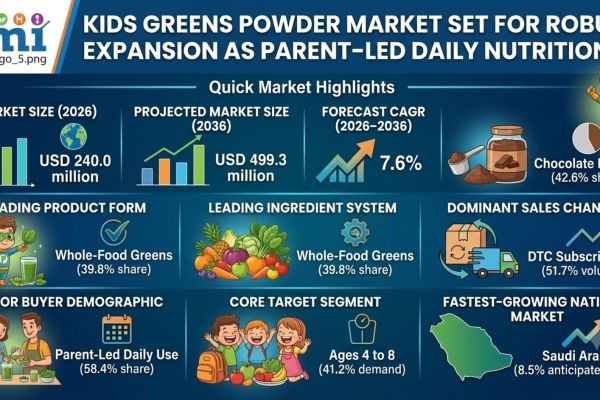
Quick Market Highlights
- Market Size (2026): USD 240.0 million
- Projected Market Size (2036): USD 499.3 million
- Forecast CAGR (2026–2036): 7.6%
- Leading Product Form: Chocolate Powder with a 42.6% market share
- Leading Ingredient System: Whole-Food Greens, commanding a 39.8% share
- Dominant Sales Channel: DTC Subscriptions, securing 51.7% of total volume
- Major Buyer Demographic: Parent-Led Daily Use, accounting for 58.4% share
- Core Target Segment: Ages 4 to 8, representing 41.2% of market demand
- Fastest-Growing National Market: Saudi Arabia, with an anticipated CAGR of 8.5%
Picky Eating Patterns and Clear Labels Support Category Momentum
The primary engine behind this market is the widespread parental challenge of children rejecting visible vegetables during family meals. Greens powders provide an invisible, stress-free method to bridge nutritional gaps. This dynamic is highly visible among elementary school children aged 4 to 8, a demographic where picky eating habits are most pronounced.
Regulatory updates regarding sugar intake are forcing brands to reconsider their formulas. For example, updated USDA Food and Nutrition Service guidelines mandating that school meals keep added sugars below 10% of weekly calories have intensified the spotlight on sugar levels. Consequently, parents are moving away from sugary gummies and sweet liquids toward zero-sugar or low-sugar functional powders that mix cleanly into breakfast smoothies, milk, or yogurt. However, raw material handling remains sensitive; regulatory investigations into imported botanicals, such as the FDA's mid-2026 Salmonella inquiries regarding imported moringa leaf powder, emphasize the non-negotiable importance of rigorous pathogen testing and lot tracking among ingredient suppliers.
Flavor Management Explains Product Form and Sourcing Priorities
Achieving high compliance among children requires advanced sensory masking, which explains why chocolate-flavored powders lead the product form segment with a 42.6% market share. Cocoa profiles naturally cover the earthy, bitter notes inherent in premium greens like wheatgrass, spirulina, and kale, allowing for a smooth mix into standard milk or plant-based alternatives.
Concurrently, whole-food greens lead the ingredient system segment with a 39.8% market share, driven by parental preference for highly recognizable, clean-label plant cues (such as broccoli and spinach) over complex synthetic vitamins. Higher-priced tiers are emerging around probiotic-enriched greens, where gut-health claims are paired with clinically validated, child-safe bacterial strains. To make daily preparation easier, brands are increasingly adopting single-serve stick packs to support school-day routines and eliminate measuring steps for busy households.
Custom Research Available: https://www.futuremarketinsights.com/customization-available/rep-gb-33380
DTC Subscriptions Maintain Dominance via Automated Refill Loops
Direct-to-consumer (DTC) subscription models hold a dominant 51.7% share of the sales channel mix. This leadership is sustained by the recurring nature of child wellness routines; parents prefer automated monthly refill plans and eco-friendly packaging systems that reduce ordering friction. Subscription brands, such as Hiya Health Products with its zero-sugar Kids Daily Greens + Superfoods line, leverage these direct digital channels to build parent communities, distribute usage guides, and bundle secondary child vitamins.
Outside digital channels, premium pharmacy retail chains act as vital brick-and-mortar trust hubs, particularly in international markets where health products face strict counter reviews and expert verification.
Country-Wise Growth Trajectories Reveal Strong Urban Markets
Global demand patterns reveal varying expansion rates across distinct national regulatory and retail ecosystems:
- Saudi Arabia (8.5% CAGR): Projected to reach USD 24.8 million by 2036 from USD 11.0 million in 2026. Growth is driven by high awareness around child overweight and obesity rates (with a 33.3% overweight prevalence reported in youth), the presence of premium pharmacy chains in Riyadh and Jeddah, and strict SFDA classification rules requiring complete safety files.
- United States (7.9% CAGR): Valued at USD 98.0 million in 2026 and scaling to USD 209.7 million by 2036. Expansion is supported by advanced DTC subscription infrastructure on the Pacific Coast, an established history of youth supplement usage (35.7%), and clean-label FDA positioning.
- Canada (7.6% CAGR): Moving from USD 18.0 million in 2026 to USD 37.4 million by 2036. Growth is anchored by strict Health Canada natural health product (NHP) licensing, required bilingual packaging compliance, and high baseline vitamin D adoption routines.
- United Kingdom (7.4% CAGR): Expanding from USD 20.0 million in 2026 to USD 40.9 million by 2036. Driven by a visible gap in child produce intake where only 9.0% of older youth meet the 5-a-day guide, alongside established parental familiarity with early childhood vitamin drops.
- Japan (6.9% CAGR): Starting at USD 13.0 million in 2026, driven by a strong consumer preference for highly compact single-use packaging formats and stringent organic certification marks that dictate ingredient trust.
Exclusive Discounts on Full Report: https://www.futuremarketinsights.com/reports/kids-greens-powder-market
Strategic Landscape Centers on Pediatric Optimization and Formulation Scale
The competitive matrix is divided between pediatric brand owners, large-scale private-label contract manufacturers, and adjacent whole-food supplement firms.
- Hiya Health Products & USANA Health Sciences: Hold leading positions by anchoring product design entirely around zero-sugar child palates, pediatrician referrals, and automated home subscription logistics.
- Matsun Nutrition, SMP Nutra, & Makers Nutrition: Compete through industrial powder-blending scale, advanced allergen-segregated lines, and providing startup brands with turnkey label documentation.
- Bactolac Pharmaceutical & NutraPak USA: Specialize in comprehensive high-volume contract runs, ensuring meticulous heavy metal screening, pathogen clearance, and customized packaging options like specialized stick packs.
- Amazing Grass, Organifi, Llama Naturals, & First Day: Leverage their existing whole-food brand equity to introduce child-specific spin-offs, utilizing natural fruit masking (such as berry and tropical flavors) to ease parent selection.
Executive Takeaways
- The global kids greens powder market is positioned for high-velocity growth, rising from USD 240.0 million in 2026 to USD 499.3 million by 2036 at a 7.6% CAGR.
- Chocolate flavor profiles lead the product forms with a 42.6% share, proving essential for masking potent botanical ingredients in milk and smoothies.
- Parents control the market purchase lifecycle, with parent-led daily use accounting for 58.4% of buying behavior due to dosing management.
- DTC automated subscription loops represent the primary commercial channel, commanding 51.7% of market volume.
- Sourcing requirements have pivoted completely toward comprehensive testing transparency, zero added sugars, and explicit child-safe age thresholds.
Why Choose FMI: https://www.futuremarketinsights.com/why-fmi
Explore More Related Studies Published by FMI Research
Quinoa Protein Hydrolysate Market : https://www.einpresswire.com/article/903144075/quinoa-protein-hydrolysate-market-to-reach-usd-530-0-million-by-2036-driven-by-high-solubility-plant-proteins-at-a-fmi
Cane Molasses Market : https://www.openpr.com/news/4516987/cane-molasses-market-transitions-from-commodity-byproduct
Explore In-Depth Food & Beverage Market Insights : https://www.futuremarketinsights.com/industry-analysis/food-and-beverage
About Future Market Insights (FMI)
Future Market Insights, Inc. (FMI) is an ESOMAR-certified, ISO 9001:2015 market research and consulting organization trusted by global enterprises and Fortune 500 companies. FMI delivers actionable market intelligence, competitive benchmarking, and strategic insights across more than 30 industries and 1,200 markets worldwide.
Contact Us
Future Market Insights Inc.
Christiana Corporate, 200 Continental Drive,
Suite 401, Newark, Delaware - 19713, USA
T: +1-347-918-3531
For Sales Enquiries: sales@futuremarketinsights.com
Website: https://www.futuremarketinsights.com






