
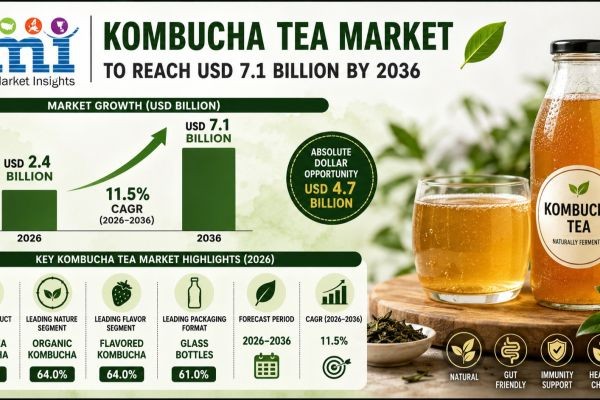
The global Kombucha Tea Market is entering a new phase of mainstream expansion as consumers increasingly prioritize digestive wellness, functional beverages, and lower-sugar alternatives to conventional soft drinks. According to Future Market Insights (FMI), the market is projected to grow from USD 2.4 billion in 2026 to USD 7.1 billion by 2036, registering a robust 11.5% CAGR during the forecast period. The category is rapidly evolving from a niche fermented beverage into a mainstream wellness drink supported by retail expansion, product innovation, and increasing consumer awareness of gut health.
The market is expected to create an absolute dollar opportunity of USD 4.7 billion between 2026 and 2036. Growth is being fueled by wider availability across supermarkets, convenience stores, cafés, foodservice channels, and e-commerce platforms, alongside continuous innovation in flavors, premium organic formulations, and emerging product formats such as hard kombucha and functional wellness shots.
Request a Sample Report: https://www.futuremarketinsights.com/reports/sample/rep-gb-14413
Key Kombucha Tea Market Highlights at a Glance
- Market Size (2026): USD 2.4 Billion
- Forecast Market Size (2036): USD 7.1 Billion
- Forecast Period: 2026–2036
- CAGR (2026–2036): 11.5%
- Absolute Dollar Opportunity: USD 4.7 Billion
- Leading Product Segment: Green Tea Kombucha
- Green Tea Kombucha Market Share (2026): 39.0%
- Leading Nature Segment: Organic Kombucha
- Organic Segment Share (2026): 64.0%
- Leading Flavor Segment: Flavored Kombucha
- Flavored Segment Share:0%
- Leading Packaging Format: Glass Bottles
- Glass Bottle Share:0%
- Leading Sales Channel: Modern Trade
- Modern Trade Share:0%
- Largest Consumer Group: Adults
- Adult Consumer Share:0%
- Fastest-Growing Country: United States
- USA CAGR:7%
- Report Pages: 333
Why Is the Kombucha Tea Market Growing?
Several structural shifts in the global beverage industry are driving sustained demand for kombucha tea.
Key Growth Drivers
- Rising consumer awareness of gut microbiome health and probiotic-rich beverages.
- Increasing preference for functional drinks that contain less sugar than traditional carbonated soft drinks.
- Rapid expansion of kombucha distribution into supermarkets, convenience stores, restaurants, cafés, fitness centers, and corporate cafeterias.
- Continuous flavor innovation featuring fruit, botanical, herbal, and spice-infused varieties.
- Growing popularity of premium organic beverages among health-conscious consumers.
- Category expansion into hard kombucha, kombucha wellness shots, and kombucha-based functional beverages.
As kombucha becomes increasingly accessible through mainstream retail channels, manufacturers are reaching consumers well beyond traditional natural food stores.
"Brands that combine authentic fermentation expertise with continuous flavor innovation and broad retail distribution are well positioned to lead the next phase of kombucha's evolution into a mainstream functional beverage category."
Which Product Segment Leads the Kombucha Tea Market?
Green Tea Kombucha continues to dominate the product landscape because it provides a mild flavor profile that appeals to both experienced kombucha consumers and first-time buyers.
The antioxidant reputation of green tea also reinforces kombucha's positioning as a premium functional beverage. Manufacturers frequently use green tea as the preferred fermentation base for fruit and botanical flavor combinations because it allows added flavors to remain prominent.
Product Segment Highlights
- Green Tea Kombucha leads with 0% market share in 2026.
- Mild taste supports broader consumer adoption.
- Strong antioxidant positioning enhances health perception.
- Preferred base for premium flavored kombucha products.
Why Does Organic Kombucha Hold a Strong Market Position?
Organic kombucha continues attracting premium consumers who prioritize clean-label ingredients, certified organic production, and minimally processed beverages.
Although conventional kombucha maintains significant market volume, organic products generate stronger value growth due to premium pricing and increasing demand for certified natural ingredients.
Nature Segment Highlights
- Organic Kombucha accounts for 0% of market demand.
- Premium pricing improves manufacturer margins.
- Consumer preference continues shifting toward certified organic beverages.
- Clean-label positioning strengthens purchasing decisions.
Why Are Flavored Kombucha Products Dominating Consumer Demand?
Flavor innovation has become one of the strongest competitive advantages within the kombucha industry.
Fruit, citrus, botanical, ginger, berry, turmeric, lavender, and tropical flavors help manufacturers attract consumers transitioning from sparkling water, craft sodas, and flavored juices.
Flavor Segment Highlights
- Flavored Kombucha represents 0% of total demand.
- Fruit and botanical flavors generate strong repeat purchases.
- Seasonal and limited-edition launches stimulate consumer engagement.
- Flavor diversity expands kombucha beyond health-focused consumers.
How Are Distribution Channels Expanding Market Reach?
Modern retail has significantly increased kombucha accessibility by moving products from specialty stores into everyday grocery shopping.
Foodservice, convenience stores, online subscriptions, cafés, gyms, and restaurants are also contributing to market expansion.
Custom Research Available: https://www.futuremarketinsights.com/customization-available/rep-gb-14413
Sales Channel Highlights
- Modern Trade contributes 0% of sales.
- Supermarkets improve mainstream product visibility.
- Foodservice channels increase consumption occasions.
- Online subscriptions support recurring purchases.
Market Dynamics
Market Drivers
Growing awareness of digestive wellness is increasing consumer demand for probiotic beverages. Kombucha benefits from this trend by offering naturally fermented products that align with broader health and wellness lifestyles.
Market Restraints
Cold-chain requirements remain one of the industry's primary operational challenges. Raw, unpasteurized kombucha requires refrigerated storage, increasing logistics costs and limiting expansion into markets with less developed cold-chain infrastructure.
Market Trends
Innovation continues reshaping the category.
Major trends include:
- Hard kombucha product launches.
- Functional wellness shots.
- Low-sugar formulations.
- Botanical ingredient combinations.
- Sustainable packaging.
- Premium organic positioning.
- Expansion into convenience retail and foodservice.
Regional and Country Outlook
Country Growth Rates
- United States — 7% CAGR
- South Korea — 7% CAGR
- European Union — 5% CAGR
- Japan — 4% CAGR
- United Kingdom — 3% CAGR
The United States remains the industry's fastest-growing market as functional beverages continue moving into mainstream grocery stores, convenience retailers, restaurants, and workplace cafeterias. Increasing consumer awareness regarding probiotics and digestive health continues supporting category expansion.
South Korea is witnessing comparable growth due to its well-established fermented food culture and rapidly expanding convenience store networks that encourage single-serve consumption.
Across the European Union, health-conscious consumers, premium organic certification, and functional food regulations continue encouraging kombucha adoption, particularly throughout Germany and Scandinavia.
Japan benefits from strong consumer familiarity with fermented foods, an aging population seeking functional nutrition, and highly efficient convenience store distribution networks.
The United Kingdom continues expanding through premium health retail channels while sustainability regulations encourage manufacturers to adopt recyclable packaging formats.
Competitive Landscape
Competition continues intensifying as established brands strengthen retail partnerships while emerging companies differentiate through premium ingredients, regional flavors, and innovative fermentation techniques.
Key Companies
- GT's Living Foods — Pioneer in raw fermented kombucha with extensive retail presence.
- Health-Ade Kombucha — Premium California-crafted brand with diverse flavor portfolio.
- KeVita (PepsiCo) — Large-scale distribution supported by PepsiCo's global beverage network.
- Brew Dr. Kombucha — Strong botanical flavor innovation.
- Humm Kombucha LLC — National distribution and broad flavor selection.
- Better Booch — Premium small-batch fermentation.
- Kosmic Kombucha — Australian regional expansion.
- Captain Kombucha — European market presence.
- Buchi Kombucha — Functional wellness positioning.
- Lo Bros Kombucha — Premium natural formulations.
- Tonica Kombucha — Regional fermented beverage specialist.
- Equinox Kombucha — UK-focused functional beverage portfolio.
The competitive landscape increasingly revolves around flavor innovation, organic certification, retail expansion, premium packaging, and product diversification into adjacent beverage categories.
Exclusive Discounts on Full Report: https://www.futuremarketinsights.com/reports/kombucha-tea-market
Frequently Asked Questions
What is the projected size of the Kombucha Tea Market by 2036?
The global Kombucha Tea Market is projected to reach USD 7.1 billion by 2036, growing from USD 2.4 billion in 2026.
What is the expected CAGR of the Kombucha Tea Market?
The Kombucha Tea Market is forecast to expand at a compound annual growth rate of 11.5% between 2026 and 2036.
Which product segment leads the Kombucha Tea Market?
Green Tea Kombucha is the leading product segment and is expected to account for 39.0% of the global market in 2026.
Which nature segment holds the largest market share?
Organic Kombucha is projected to lead the market with a 64.0% share because consumers increasingly prefer certified organic functional beverages.
Which flavor category dominates the market?
Flavored Kombucha represents 64.0% of global demand, supported by consumer preference for fruit, botanical, herbal, and spice-infused beverages.
Who are the major companies operating in the Kombucha Tea Market?
Leading market participants include GT's Living Foods, Health-Ade Kombucha, KeVita (PepsiCo), Brew Dr. Kombucha, Humm Kombucha LLC, Better Booch, Kosmic Kombucha, Captain Kombucha, Buchi Kombucha, Lo Bros Kombucha, Tonica Kombucha, and Equinox Kombucha.
Why Choose FMI: https://www.futuremarketinsights.com/why-fmi
Explore More Related Studies Published by FMI Research
Demand for Lead Zirconate Titanate (PZT) in USA : https://www.futuremarketinsights.com/reports/united-states-lead-zirconate-titanate-(pzt)-market
Demand for Brandy Flavor in USA : https://www.futuremarketinsights.com/reports/united-states-brandy-flavor-market
Explore In-Depth Food & Beverage Market Insights : https://www.futuremarketinsights.com/industry-analysis/food-and-beverage
About Future Market Insights
Future Market Insights (FMI) is a global provider of market intelligence, consulting, and syndicated research. The company delivers in-depth industry analysis, competitive intelligence, and strategic forecasts across diverse sectors, enabling businesses, investors, and decision-makers to make informed growth decisions based on data-driven insights.
Contact Us
Future Market Insights Inc.
Christiana Corporate, 200 Continental Drive,
Suite 401, Newark, Delaware - 19713, USA
T: +1-347-918-3531
For Sales Enquiries: sales@futuremarketinsights.com
Website: https://www.futuremarketinsights.com






