
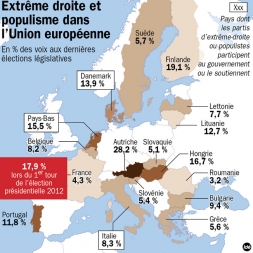
"По всей Европе, крайне правые партии находят поддержку все большего и большего количества сторонников (см. диаграмму)."
The Economist.

"Крайне правые обычно ассоциируется с лицом или группами лиц, которые имеют крайне националистические, ксенофобские, расистские, религиозные фундаменталистские или реакционные взгляды. Как правило, термин применяется по отношении к неофашистам, неонацистам, нативистам и антикоммунистам".
И это в Европе. Ну что ж - закат Европы неизбежен, как и падение...Пусть валится, слишком многим нагадила.... Жалеть отказать, валить...Так скорее очистится...СССР она не пожалела... Пора бы бумерангу вернуться...
ON MAY 22nd Europe came within 31,000 votes of electing its first far-right head of state since 1945. Norbert Hofer of the Freedom Party of Austria (FPÖ) only narrowly lost out to Alexander Van der Bellen, the former Green Party leader, in his country's presidential election. Such a near miss, by a politician who would previously have been dismissed as a fringe candidate, is a sign of the times. Across the continent right-wing populists are on the march. Some, like the FPÖ and the National Front in France, have ditched some of their more obviously extremist positions and project a more professional image. Others, like Jobbik in Hungary and Golden Dawn in Greece, are overtly racist. What they all have in common is a focus on national identity and strong leadership. They are Eurosceptic, anti-migrant (albeit in varying degrees) and led by charismatic rabble-rouser_ids. For such parties the combination of the eurozone crisis and the surge of refugees into Europe have created the perfect circumstances in which to rail against establishment politicians and other elites. Mr Hofer's strong showing in Austria is just the latest milestone in their advance. It is unlikely to be the last.Correction: The original version of the left-hand chart used incorrect figures for the Netherlands. This has now been changed. [http://www.economist.com/blogs/graphicdetail/2016/05/daily-chart-18]
Приблизительный расклад по странам ЕС можно посмотреть, например, анализируя результаты выборов: How Far Is Europe Swinging to the Right? By GREGOR AISCH, ADAM PEARCE and BRYANT ROUSSEAUMAY 22, 2016 [http://www.nytimes.com/interactive/2016/05/22/world/europe/europe-right-wing-austria-hungary.html?_r=0]


