
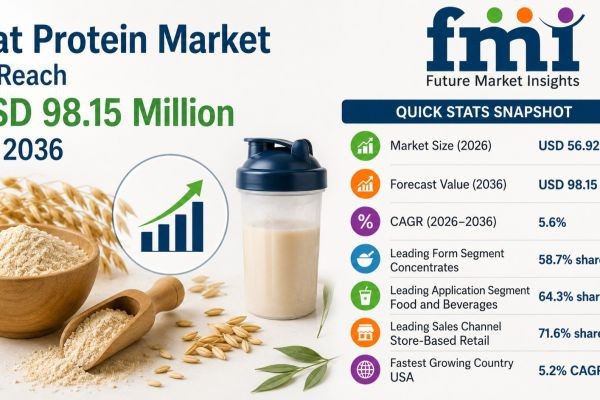
The global oat protein market is advancing steadily as food, beverage, and personal care formulators adopt oat-derived protein as a clean-label, hypoallergenic alternative to traditional soy and wheat proteins, according to latest insights by Future Market Insights. Benefiting from consumer familiarity with oat-based foods and approved heart-health claims associated with oat beta-glucan, oat protein is carving out a high-value niche in the plant protein landscape.
The global market, valued at USD 53.90 million in 2025, is projected to reach USD 56.92 million in 2026. Expanding at a Compound Annual Growth Rate (CAGR) of 5.6% over the ten-year forecast period, total market valuation is anticipated to hit USD 98.15 million by 2036, creating an absolute dollar growth opportunity of USD 41.23 million.
Get detailed market forecasts, competitive benchmarking, and pricing trends:
https://www.futuremarketinsights.com/reports/sample/rep-gb-14912
Market Performance Overview (2026–2036)
To map out the key physical forms, application sectors, and retail channels guiding this USD 41.23 million market scale-up, an analysis of leading segment allocations highlights where global demand is concentrated:
- Concentrates Form (58.7% share): Leads physical ingredient formats in 2026, offering a balanced combination of protein content (55%–70%) and cost efficiency suitable for high-volume food, beverage, and feed applications.
- Food & Beverages Application (64.3% share): Commands the application landscape, driven by high demand for protein-enriched oat bars, ready-to-drink (RTD) plant beverages, and functional breakfast cereals.
- Store-Based Retail Sales Channel (71.6% share): Dominates distribution, anchored by sales of finished oat protein products through supermarkets, hypermarkets, and natural health food specialty stores.
Technical Drivers and Formulation Innovation
The adoption of oat protein ingredients across food processing and cosmetics manufacturing is propelled by three primary industry catalysts:
Hypoallergenic and Soy/Gluten-Free Positioning
Unlike soy or wheat, oat protein is not classified as a major food allergen under US FDA or European Union labelling mandates. Pure, certified gluten-free oat protein concentrates allow food manufacturers to formulate protein bars and meal replacements targeting coeliac-aware and allergen-sensitive consumer segments.
Synergistic Compatibility with Oat Beta-Glucan
Oat protein ingredients naturally complement oat beta-glucan soluble fiber, allowing food brands to pair protein fortification with authorized heart-health and cholesterol-lowering claims. This dual nutritional narrative creates a unique positioning advantage over isolated pea or soy proteins.
Expansion in Personal Care and Cosmetics
Beyond food, natural cosmetic formulators are incorporating oat protein hydrolysates (such as Croda's Cropeptide W) into premium hair and skin care products. Oat protein's film-forming, moisture-retention, and skin barrier-repair properties make it a sought-after conditioning active for organic cosmetics.
Industrial Infrastructure & Production Challenges
Oat protein processors and corporate formulation teams face specific technical and supply-chain constraints:
- Extraction & Fractionation Costs: Concentrating oat protein to isolate levels (>80% protein) via wet fractionation or dry milling requires specialized processing infrastructure, leading to higher unit costs compared to commodity soy and pea proteins.
- Lower Relative Protein Density: Whole oat grains naturally contain lower baseline protein levels (12%–17%) than soy or peas, requiring higher raw grain throughput to yield equivalent ingredient volumes.
Regional Growth Outlook
The geographic analysis reflects steady, quality-driven growth across major Western plant-protein markets alongside growing adoption in urban Asian centers:
- United States (5.2% CAGR): The global growth frontrunner, driven by an expanding plant-based food sector, high demand for soy-free protein alternatives, and strong presence of major ingredient suppliers.
- Germany (5.0% CAGR): Spurring European growth, supported by a mature organic food market, strong consumer preference for Nordic/oat-based diets, and strict clean-label regulatory compliance.
- India (4.6% CAGR): Experiencing steady adoption as urban consumers seek plant-based nutritional supplements and functional foods through modern retail and e-commerce channels.
Competitive Landscape
The global oat protein market is in an early-growth, fragmented phase. Competition features a mix of global ingredient processors, specialty fractionators, and vertically integrated oat millers. Integrated processors (such as Fazer Mills and Lantmännen) hold structural advantages in raw oat grain access and purity control.
Leading companies profiled in the market include Roquette Frères, Cargill Inc., Archer Daniels Midland (ADM), Tate & Lyle PLC, Ingredion Incorporated, Givaudan SA, Croda International PLC, Lantmännen, BENEO GmbH, Avena Foods Limited, Fazer Mills, Oatly AB, Axiom Foods Inc., Glanbia PLC, and Kerry Group PLC. Key players are actively introducing high-solubility concentrates and application-specific grades for sports nutrition and protein bars.
Exclusive Discounts on Full Report: https://www.futuremarketinsights.com/reports/oat-protein-market
Frequently Asked Questions
What is the projected valuation of the global market by 2036?
The global oat protein market is projected to reach USD 98.15 million by 2036, expanding from an estimated baseline valuation of USD 56.92 million in 2026 at a CAGR of 5.6%.
Why does Concentrates lead the Form segment?
Concentrates hold a 58.7% share because they offer an optimal balance of functional performance, 55%–70% protein content, and cost efficiency for food, beverage, and supplement formulations.
What exclusions govern the boundaries of this market report?
The scope strictly covers concentrated oat protein ingredients (isolates and concentrates), explicitly excluding whole oats, rolled oats, oat flour, plain oat milk/beverages, and standalone oat beta-glucan fiber extracts.
Explore More Related Studies Published by FMI Research:
Veggie Chips Market : https://www.futuremarketinsights.com/reports/veggie-chips-market
Seafood Flavors Market : https://www.futuremarketinsights.com/reports/seafood-flavours-market
Saffron Beer Market : https://www.futuremarketinsights.com/reports/saffron-beer-market
About Future Market Insights (FMI)
Future Market Insights, Inc. is an ESOMAR-certified, ISO 9001:2015 market research and consulting organization trusted by Fortune 500 companies. With a global presence across the U.S., UK, India, and Dubai, FMI delivers data-driven insights across 30+ industries and 1200 markets worldwide.
Contact Us
Future Market Insights Inc.
Christiana Corporate, 200 Continental Drive,
Suite 401, Newark, Delaware – 19713, USA
T: +1-347-918-3531
For Sales Enquiries: sales@futuremarketinsights.com
Website: https://www.futuremarketinsights.com






