
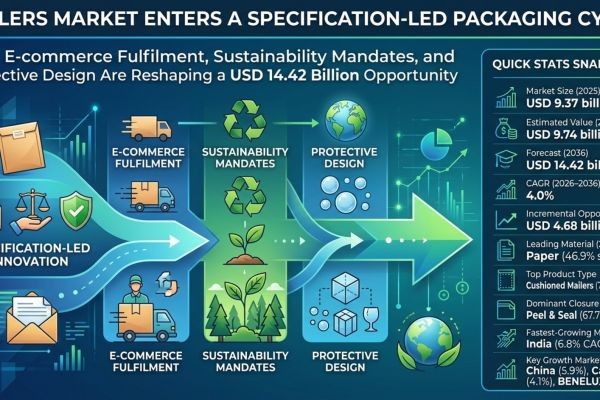
The global mailers market is undergoing a structural transition from volume-driven procurement to specification-led decision-making, where compliance, performance, and sustainability define competitive positioning. Once treated as a commoditized packaging format, mailers are now engineered solutions balancing protection, cost efficiency, and regulatory alignment. As e-commerce volumes scale and environmental mandates tighten across major economies, packaging buyers are re-evaluating material composition, cushioning performance, and recyclability elevating mailers into a strategic component of supply chain design.
Quick Stats Snapshot
• Market Size (2025): USD 9.37 billion
• Estimated Value (2026): USD 9.74 billion
• Forecast (2036): USD 14.42 billion
• CAGR (2026–2036): 4.0%
• Incremental Opportunity: USD 4.68 billion
• Leading Material (2026): Paper (46.9% share)
• Top Product Type: Cushioned Mailers (76.8% share)
• Dominant Closure Type: Peel & Seal (67.7% share)
• Fastest-Growing Market: India (6.8% CAGR)
• Key Growth Markets: China (5.9%), Canada (4.1%), BENELUX (4.8%)
Market Size and Forecast
The mailers market is projected to expand from USD 9.74 billion in 2026 to USD 14.42 billion by 2036, reflecting a steady CAGR of 4.0%. While growth appears moderate, it is structurally resilient, anchored in the expansion of parcel-based logistics and essential packaging demand across industries.
Importantly, value growth is increasingly outpacing volume growth. As regulatory frameworks push for higher recycled content and performance specifications, average selling prices are rising—shifting the market toward higher-value, compliance-ready solutions rather than low-cost commodity formats.
Growth Drivers: Why Mailers Are Becoming Strategic Packaging Assets
- E-commerce Fulfilment Expansion
Rising global parcel volumes across apparel, electronics, and personal care categories continue to drive demand for lightweight, protective packaging formats optimized for last-mile delivery. - Sustainability and Regulatory Compliance
Extended Producer Responsibility (EPR) regulations, plastic taxes, and recyclability mandates are accelerating the transition toward paper-based and recyclable mailer solutions. - Growth in Direct-to-Consumer Healthcare
Pharmaceutical distribution, telehealth fulfilment, and medical device shipping are increasing demand for tamper-evident and protective mailer formats. - Cost Optimization in Logistics
Mailers offer lower dimensional weight compared to corrugated boxes, reducing shipping costs and improving operational efficiency for high-volume shippers.
Key Challenges: Where Market Friction Persists
- Material Transition Complexity: Shifting from plastic to paper-based formats requires balancing durability, moisture resistance, and cushioning performance.
• Regulatory Uncertainty: Evolving global regulations create complexity in standardizing packaging specifications across regions.
• Recyclability Limitations: Multi-material cushioned mailers can complicate recycling processes, especially in markets with limited infrastructure.
• Performance vs Sustainability Trade-Offs: Achieving both high protection and environmental compliance remains a key engineering challenge.
Emerging Opportunities: Where Competitive Advantage Is Being Built
Paper-Based Cushioned Mailers
Advancements in paper honeycomb and fiber-based cushioning are enabling fully recyclable alternatives to traditional plastic bubble mailers.
Custom Branding and Consumer Experience
Mailers are increasingly used as brand touchpoints, with customization enhancing customer engagement in e-commerce deliveries.
Thermally Insulated Mailers
Growth in food delivery and pharmaceutical shipments is driving demand for temperature-stable mailer formats.
Lightweight High-Strength Materials
Innovation in material science is enabling thinner, stronger mailers that reduce material usage while maintaining protective performance.
Segmentation Insights
By Material
• Paper (46.9%) leads due to recyclability and regulatory alignment.
• Plastic remains relevant for durability and moisture resistance but faces increasing scrutiny.
By Product Type
• Cushioned mailers (76.8%) dominate, driven by demand for protective packaging in e-commerce and electronics shipping.
• Non-cushioned mailers serve documents and lightweight goods.
By Closure Type
• Peel & seal (67.7%) leads due to ease of use and secure closure in high-volume fulfilment environments.
• Self-seal formats remain relevant in specific industrial applications.
Regional Analysis: Growth Driven by Consumption and Compliance
Asia-Pacific: High-Growth Consumption Markets
• India (6.8% CAGR) leads global growth, supported by rapid e-commerce expansion and rising domestic consumption.
• China (5.9% CAGR) benefits from strong manufacturing output and electronics demand.
North America: Mature but Innovation-Driven
• The United States grows at 3.5%, driven by replacement demand, regulatory compliance, and premium packaging adoption.
• Canada (4.1%) shows steady growth supported by sustainability initiatives.
Europe: Regulation-Led Transformation
• Germany (3.2%) and the UK (3.0%) reflect stable demand shaped by stringent environmental regulations and packaging standards.
Emerging Markets: Expanding Logistics Infrastructure
• Latin America and Eastern Europe are witnessing increasing adoption driven by logistics modernization and retail expansion.
Competitive Landscape: Compliance and Innovation Define Leadership
The market is moderately fragmented, with leading players including Sealed Air Corp., Pregis LLC, ProAmpac, Intertape Polymer Group, Georgia-Pacific LLC, and PAC Worldwide Corporation.
Competitive advantage is shaped by:
• Ability to meet regulatory and sustainability standards
• Innovation in material design and cushioning performance
• Supply chain integration and customization capabilities
• Strong relationships with large e-commerce and logistics providers
Market consolidation is ongoing, with larger players acquiring regional firms to expand geographic reach and product portfolios.
Strategic Implications for Industry Stakeholders
- For E-commerce Companies: Packaging decisions directly impact shipping costs, customer experience, and sustainability compliance.
• For Packaging Manufacturers: Investment in recyclable and mono-material solutions is essential for long-term competitiveness.
• For Procurement Leaders: Supplier selection must balance cost efficiency, regulatory alignment, and performance reliability.
• For Investors: The market offers stable growth with upside potential driven by sustainability-driven pricing premiums.
Future Outlook: Sustainability Will Redefine Performance Standards
The next phase of growth in the mailers market will be defined by the ability to deliver sustainable packaging without compromising protection or cost efficiency. Paper-based innovations are expected to gain momentum, but widespread adoption will depend on matching the durability and versatility of plastic-based formats.
As regulatory pressure intensifies and e-commerce continues to expand, mailers will evolve into high-performance, compliance-ready packaging systems that integrate material science, design engineering, and logistics optimization.
Executive-Level Takeaways
- The mailers market is projected to reach USD 14.42 billion by 2036, driven by e-commerce and regulatory demand.
• Paper-based mailers are gaining share due to sustainability mandates and recyclability requirements.
• Cushioned mailers dominate, reflecting the need for protective packaging in parcel logistics.
• Regulatory compliance is shifting the market from cost-driven to specification-driven procurement.
• Asia-Pacific leads growth, while North America and Europe define regulatory frameworks.
• Innovation in recyclable cushioning and lightweight materials will shape future competitiveness.
Full Report View: https://www.futuremarketinsights.com/reports/mailers-market






