
The global nutritive sweetener market is undergoing a structural bifurcation, according to latest insights by Future Market Insights. While bulk commodity sweeteners like High-Fructose Corn Syrup (HFCS) face volume headwinds from sugar taxes and health-conscious reformulations in mature Western economies, emerging markets across South and Southeast Asia are driving steady caloric sweetener volume expansion. Concurrently, food and beverage brands are pivoting toward traceable, natural-source nutritive formats to meet clean-label mandates and adapt to the GLP-1 weight-loss era's compact, nutrient-dense formulation requirements.
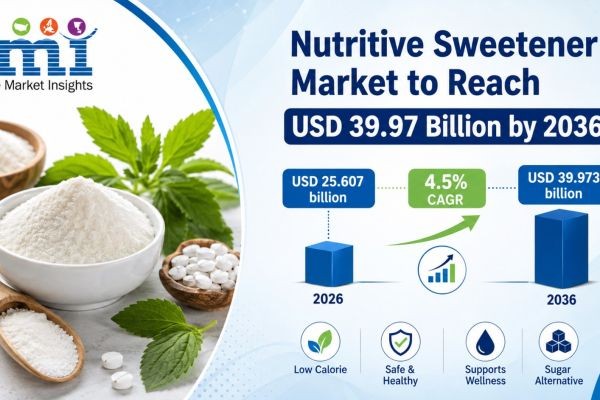
The global market, valued at USD 24.483 billion in 2025, is estimated to reach USD 25.607 billion in 2026. Advancing at a Compound Annual Growth Rate (CAGR) of 4.5% over the ten-year forecast period, total market valuation is projected to achieve USD 39.973 billion by 2036, delivering an absolute incremental opportunity of USD 14.366 billion.
Request a Sample Report: https://www.futuremarketinsights.com/reports/sample/rep-gb-6809
Market Performance Overview (2026–2036)
To map out the key caloric saccharide types, ingredient nature classifications, primary application sectors, and regional growth vectors guiding this USD 14.366 billion market scale-up, key segment allocations highlight where global commercial demand is concentrated:
- Fructose Product Type Segment (38.0% share): Commands market leadership in 2026, favored by beverage formulators for its superior sweetness intensity, high solubility, and clean flavor profile compared to standard sucrose and HFCS.
- Organic Nature Segment (35.0% share): Represents a fast-growing category driven by consumer health preferences, non-GMO certifications, and traceable agricultural supply chains.
- Household/Retail & Food Processing End-Use Segments: Dominate application demand across direct consumer usage, soft drinks, bakery, confectionery, and functional dairy formulations.
- Store-Based Retailing Distribution Segment (35.0% share): Leads channel distribution, as hypermarkets, supermarkets, and convenience stores serve as the primary access point for packaged retail sugars and specialty sweeteners.
- China & India Regional Growth Leadership: Lead national expansion rates at 9% CAGR and 5.5% CAGR respectively through 2036, driven by rapid urbanization, expanding middle-class packaged food consumption, and retail modernization.
Technical Drivers and Formulation Shifts
The commercial evolution of nutritive sweeteners across global CPG manufacturing is propelled by three primary industry catalysts:
The GLP-1 Medication Era and Compact Nutrition
The widespread adoption of GLP-1 weight-loss medications is altering consumer appetites and portion sizes. Food CPG formulators are pivoting toward "compact nutrition" and permissible indulgence using smaller quantities of high-purity nutritive sweeteners in smaller, nutrient-dense portions that maintain sensory satiety without delivering excessive empty calories.
Clean-Label Reformulation and Natural Sourcing
Consumers increasingly reject artificial chemical additives and synthetic high-intensity sweeteners. Food and beverage brands are reformulating with natural-source caloric carbohydrates (crystalline fructose, honey, organic sucrose, tapioca-derived glucose) that provide functional bulk, browning, and texture while maintaining a clean, recognizable label.
Sugar Taxes and Geographic Volume Shifts
Fiscal policies targeting high-sugar beverages in Europe, Latin America, and emerging Asian markets compress margins for traditional bulk HFCS and refined cane sugar. Major ingredient refiners are diversifying into multi-sweetener platforms combining lower-caloric nutritive carbohydrates with natural high-potency plant extracts (like Reb M stevia) to reduce sugar tax liabilities.
Industrial Constraints & Commodity Volatility
Nutritive sweetener refiners and CPG procurement managers navigate specific operational hurdles:
- Agricultural Commodity Price Exposure: Raw material costs for sucrose, HFCS, and glucose are directly tied to global sugarcane, sugar beet, and corn crop harvests. Geopolitical trade tariffs and regional weather disruptions trigger spot-market pricing volatility.
- Health Policy Headwinds in Mature Markets: Stringent front-of-pack warning labels, school nutrition restrictions, and public health campaigns targeting metabolic wellness restrict volume growth in North America and Western Europe, forcing CPGs to value-engineer formulations.
Regional Growth Profile
Regional demand reflects rapid middle-class CPG consumption expansion in Asia alongside value-driven clean-label reformulations in North America and Europe:
- China (5.9% CAGR) & India (5.5% CAGR): The global growth frontrunners, driven by massive domestic food processing expansion, rising disposable income, and expanding organized retail distribution.
- Germany (5.1% CAGR) & France (18.6% European share): Lead European demand through organic food leadership, clean-label CPG bakery/confectionery reformulations, and high-quality natural ingredient specifications.
- United States (4.2% CAGR): Driven by natural sweetener innovation, functional food development, and CPG adaptations to GLP-1 consumer eating habits.
- United Kingdom (3.7% CAGR) & Japan (3.3% CAGR): Focus on ingredient transparency, natural sugar reduction initiatives, and premium artisanal food positioning.
Competitive Landscape
The global nutritive sweetener landscape features a combination of multinational agricultural processing giants, specialized starch/sweetener refiners, and global ingredient distributors.
Key market participants profiled in the report include Tate & Lyle (holding ~34.0% market share), Cargill Inc., Showa Sangyo, Japan Corn Starch Co., COFCO International, Ingredion Incorporated, Archer Daniels Midland Company (ADM), Roquette Frères, and dsm-firmenich. Major players compete by securing sustainable/organic agricultural supply chains, developing specialty high-solubility fructose and glucose matrixes, and acquiring bio-based sweetener platforms.
Exclusive Discounts on Full Report: https://www.futuremarketinsights.com/reports/nutritive-sweetener-market
Frequently Asked Questions
What is the projected valuation of the global nutritive sweetener market by 2036?
The global nutritive sweetener market is projected to reach USD 39.973 billion by 2036, expanding from an estimated baseline valuation of USD 25.607 billion in 2026 at a CAGR of 4.5%.
Why does Fructose lead the product type category with a 38.0% market share?
Fructose leads product categories in 2026 because of its high natural sweetness intensity, clean flavor profile, and excellent solubility across carbonated beverages, sports drinks, and functional foods.
How are GLP-1 medications impacting nutritive sweetener formulations?
GLP-1 medications are accelerating a shift toward "compact nutrition," where formulators use smaller amounts of nutritive sweeteners in smaller, nutrient-dense food portions to deliver full sensory satisfaction at a lower caloric load per serving.
FMI Custom Research: Strategic Intelligence for Confident Decision-Making
In today's rapidly evolving business environment, leadership teams need clear, actionable intelligence tailored to their strategic objectives. FMI's Custom Research solutions are designed around specific business questions, enabling executives to evaluate growth opportunities, validate investments, assess competitive dynamics, and reduce uncertainty before making critical decisions.
Key Executive Benefits
- Decision-Ready Insights: Research tailored to your specific business challenges, growth plans, and investment priorities.
- Reduced Strategic Risk: Validate market opportunities, customer demand, and competitive positioning before committing resources.
- Market Entry Confidence: Assess opportunity size, regulatory barriers, channel dynamics, and competitive landscapes with precision.
- Competitive Advantage: Gain proprietary intelligence unavailable through syndicated reports or internal datasets.
- Faster Growth Decisions: Accelerate expansion, product development, portfolio optimization, and investment planning.
- Primary Market Validation: Access real-world customer, buyer, and stakeholder insights that support high-confidence decision-making.
Business Impact
FMI helps organizations transform market complexity into strategic clarity, enabling leadership teams to identify growth opportunities faster, optimize resource allocation, strengthen competitive positioning, and make high-stakes business decisions with confidence.
To explore how FMI Custom Research can support your strategic priorities, connect with our team at - sales@futuremarketinsights.com
About Future Market Insights (FMI)
Future Market Insights (FMI) delivers actionable, decision-focused market intelligence that goes beyond traditional research reports. The company provides:
- In-depth pricing and cost benchmarking analysis
- Demand forecasting based on real industry inputs
- Procurement and buyer behavior insights
- Supply chain and trade flow intelligence
- Technology and application trend analysis across industries
FMI follows a robust bottom-up research methodology, combining insights from industry experts, procurement leaders, manufacturers, and technical professionals to ensure accurate and practical market intelligence.






