
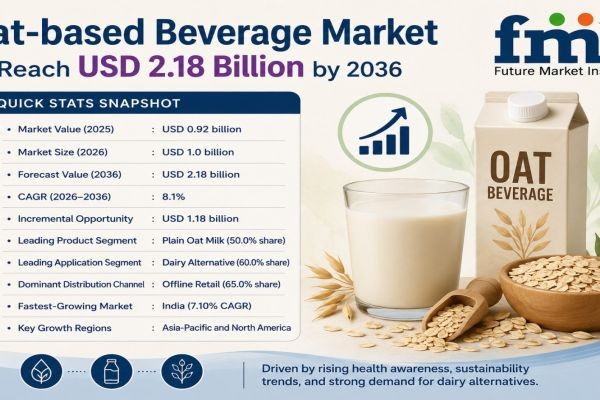
The global oat-based beverage market is undergoing a major structural evolution, transitioning from a niche plant-based category into a mainstream global dairy alternative segment, according to latest insights by future market insights. As consumers increasingly prioritize allergen-friendly options with superior functional performance, oat milk has aggressively captured real estate in both household refrigerators and commercial food service. The global market, valued at USD 0.92 billion in 2025, is projected to reach USD 1.00 billion by the end of 2026. Expanding at a fast Compound Annual Growth Rate (CAGR) of 8.1% over the ten-year forecast period, the industry is anticipated to reach a total valuation of USD 2.18 billion by 2036, creating a total absolute incremental opportunity of USD 1.18 billion.
Request a Sample Report: https://www.futuremarketinsights.com/reports/sample/rep-gb-19630
Market Performance Overview (2026–2036)
To understand the core configuration variables and transactional pathways guiding this USD 1.18 billion market scale-up, a detailed segment share analysis highlights where global consumption volume is concentrated:
- Plain Oat Milk Product Type (50.0% share): Outpaces alternative formats in 2026, functioning as the leading consumer standard due to its immense versatility across morning coffee pairings, cereals, cooking, and direct consumption.
- Dairy Alternative Application (60.0% share): Captures the largest application block, heavily supported by rising global lactose intolerance awareness and mainstream vegan lifestyle adoptions.
- Retail Consumer Segment (70.0% share): Commands the end-use framework, driven by escalating supermarket shelf availability and predictable, repeat household replenishment cycles.
- Offline Retail Distribution Channel (65.0% share): Operates as the dominant physical volume route via hypermarkets and supermarkets, while digital marketplaces and automated D2C subscriptions grow at double-digit rates.
Technical Drivers and Sourcing Advantages
The rapid scale-up of the oat-based beverage market into multi-channel food systems is propelled by distinct industrial catalysts:
Barista-Grade Microfoam Performance
A primary engine of market growth is the widespread adoption of barista-ready formulations across global coffee chains (such as Starbucks, Dunkin', and Costa Coffee) and over 80% of independent specialty cafés. Unlike almond or soy milk, oat milk features an exceptional fat-to-protein ratio that generates a stable, glossy microfoam capable of withstanding high steaming temperatures, securing reliable, multi-year food service bulk procurement agreements.
Private-Label Proliferation and Category Trial
The competitive landscape has shifted significantly due to the rapid growth of grocery private labels (such as Whole Foods 365, Trader Joe's, Costco Kirkland, and Aldi). Private-label SKUs have expanded their retail category share from under 5% in 2020 to over 25% by 2025. While this compresses the margins of pure-play branded names, it dramatically accelerates consumer category trial through lower, approachable price points, boosting overall market volume.
ESG-Aligned Sustainability Narratives
Oat production presents profound ecological advantages that fit directly into corporate ESG branding goals. Manufacturing one liter of oat milk requires approximately 10% of the water and 20% of the land demanded by traditional dairy milk. Industry innovators leverage these auditable sustainability metrics within their messaging to defend premium pricing and secure exclusive partnerships with eco-conscious retailers.
Industrial Infrastructure Challenges
Global processing lines and corporate supply chain directors must coordinate to overcome inherent structural friction points:
- Agricultural Feedstock Price Volatility: The market remains exposed to harvest yield variations and macro-economic cost shifts across core oat-cultivating belts in the Nordic and North American regions. Seasonal weather extremes can fluctuate raw crop input expenses by 10% to 30%, squeezing branded margins.
- Intense Retail Shelf-Space Competition: Pure-play brands face aggressive margin compression due to the simultaneous expansion of store private labels and large, multi-line food conglomerates, forcing leaders to constantly optimize their aseptic manufacturing capacities.
Custom Research Available: https://www.futuremarketinsights.com/customization-available/rep-gb-12362
Regional Growth Outlook
The geographic analysis reflects monumental growth velocity across expanding Asian cafe cultures alongside highly mature Western plant-based blocks:
- India (7.10% CAGR): The global growth frontrunner, driven by a massive urban shift toward plant-based daily nutrition, the rapid expansion of domestic specialty coffee chains (like Blue Tokai and Third Wave), and strict FSSAI plant-based labeling and claim substantiation standards.
- China (6.40% CAGR): Expanding rapidly via large-scale barista specifications across Luckin Coffee and Manner Coffee networks (collectively operating over 25,000 stores), alongside intense cross-border e-commerce brand scaling on Tmall Global.
- Japan (5.80% CAGR): Powered by dense convenience store expansions across 7-Eleven, FamilyMart, and Lawson networks, alongside rising domestic production entries from legacy brands like Kikkoman and Marusan-Ai.
- United States (5.60% CAGR): Sourcing high absolute volume footprints, shaped by intense brand competition between Oatly, Califia Farms, Planet Oat, and Chobani, balanced against double-digit private-label expansions.
- Germany (5.20% CAGR): Leading Western European volume scaling, propelled by deep private-label integrations across Rewe, Edeka, and Lidl chains and highly health-conscious consumer demographics.
Competitive Landscape
The global oat-based beverage environment features an established upper tier of branded pure-play pioneers alongside massive multinational food groups and highly assertive private-label store brands. Oatly AB controls the leading global branded revenue share with approximately 25% of the branded category, built on its historic Swedish origin, barista-grade formulation benchmarks, and early specialty café infrastructure investments.
Comprehensive multi-region functional portfolio depth, organic line variations, and broad retail footprints are driven by global market titans including Alpro (Danone), Califia Farms, and Quaker Oats Company (PepsiCo). Concurrently, prominent specialized players such as Pacific Foods of Oregon, Halsa Foods, Rude Health, Elmhurst 1925, Happy Planet Foods, and Pureharvest are locking in profitable high-margin niches by prioritizing minimal-ingredient clean labels and unique functional enhancements.
Exclusive Discounts on Full Report: https://www.futuremarketinsights.com/reports/oat-based-beverage-market
Frequently Asked Questions
What is the projected valuation of the global market by 2036?
The global oat-based beverage market is projected to reach USD 2.18 billion by 2036, expanding upward from an estimated baseline valuation of USD 1.00 billion in 2026 at a CAGR of 8.1%.
Why does Plain Oat Milk maintain a dominant 50.0% share?
Plain unflavored formulations ensure maximum application flexibility, allowing consumers and commercial baristas to use it seamlessly across specialty coffee blending, breakfast cereals, baking, and direct drinking.
What exclusions govern the physical boundaries of this market report?
The commercial scope strictly limits its focus to ready-to-drink liquid oat beverages, creamers, and functional mixes, explicitly excluding dry oat powder reconstitution bases, oat-based solid bakery/snack items, standard oat breakfast cereals, and multi-grain blends where oat is a minor component.
FMI Custom Research: Strategic Intelligence for Confident Decision-Making
In today's rapidly evolving business environment, leadership teams need more than market data they need clear, actionable intelligence tailored to their strategic objectives. FMI's Custom Research solutions are designed around the specific business questions organizations need answered, enabling executives to evaluate growth opportunities, validate investments, assess competitive dynamics, and reduce uncertainty before making critical decisions.
Key Executive Benefits
- Decision-Ready Insights tailored to business priorities
• Reduced Strategic Risk through validated market intelligence
• Market Entry Confidence with detailed competitive analysis
• Competitive Advantage supported by proprietary research
• Faster Growth Decisions through customized strategic insights
• Primary Market Validation from industry stakeholders
• Global Industry Expertise across diverse sectors
• Proven Track Record with thousands of consulting engagements
Business Impact
FMI helps organizations transform market complexity into strategic clarity, enabling leadership teams to identify growth opportunities faster, optimize resource allocation, strengthen competitive positioning, and make high-stakes business decisions with confidence.
To explore how FMI Custom Research can support your strategic priorities, please connect with our team at - sales@futuremarketinsights.com






