
The global paper packaging tapes market is transitioning from a commoditized consumables category into a specification-driven segment shaped by sustainability mandates, automation compatibility, and performance validation requirements. As companies move away from plastic-based sealing solutions, paper tapes are emerging as a critical component in recyclable packaging systems. Procurement decisions are no longer driven solely by price and availability but increasingly by certification standards, adhesive performance, and compatibility with high-speed fulfillment operations.
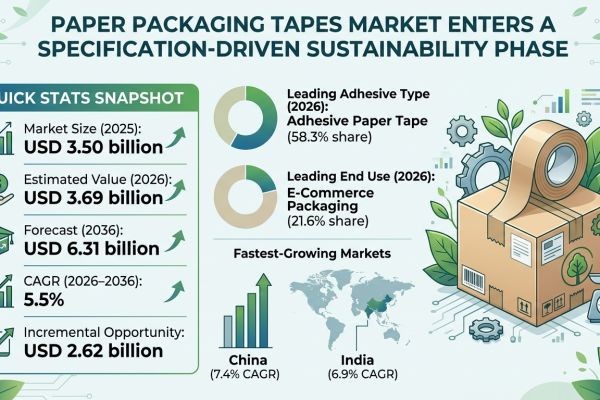
Quick Stats Snapshot
• Market Size (2025): USD 3.50 billion
• Estimated Value (2026): USD 3.69 billion
• Forecast (2036): USD 6.31 billion
• CAGR (2026–2036): 5.5%
• Incremental Opportunity: USD 2.62 billion
• Leading Adhesive Type (2026): Adhesive Paper Tape (58.3% share)
• Leading End Use (2026): E-Commerce Packaging (21.6% share)
• Fastest-Growing Markets: China (7.4% CAGR), India (6.9% CAGR)
Market Size and Forecast
The paper packaging tapes market is projected to grow from USD 3.69 billion in 2026 to USD 6.31 billion by 2036, expanding at a CAGR of 5.5%. Growth is steady and structurally driven, reflecting a shift toward sustainable packaging materials and increasing demand from e-commerce and logistics sectors.
Unlike traditional packaging consumables, demand is increasingly tied to compliance requirements and performance specifications. Buyers are prioritizing traceability, recyclability certifications, and consistent adhesive performance, reshaping supplier qualification processes and procurement cycles.
Growth Drivers: Why Paper-Based Tapes Are Gaining Strategic Importance
- Transition Away from Plastic-Based Packaging
Regulatory frameworks and corporate sustainability commitments are accelerating the replacement of polypropylene and vinyl tapes with paper-based alternatives. - Expansion of E-Commerce and Parcel Logistics
High-volume parcel shipping requires reliable, tamper-evident sealing solutions that integrate with automated packaging systems. - Sustainability and Recyclability Mandates
Paper tapes align with circular packaging goals, enabling easier recycling compared to mixed-material plastic tapes. - Advancements in Adhesive Technologies
Improved water-activated and hot-melt adhesive systems are enhancing durability, moisture resistance, and application efficiency.
Key Challenges: Performance and Cost Considerations
- Adhesive Performance Variability: Maintaining consistent bonding across different surfaces and environmental conditions remains a challenge.
• Moisture Sensitivity: Paper-based materials can be affected by humidity and extreme weather conditions during transit.
• Cost Pressures: Paper tapes may carry higher upfront costs compared to conventional plastic alternatives in price-sensitive markets.
• Automation Compatibility: Not all paper tape formats are fully optimized for high-speed automated packaging lines.
Emerging Opportunities: Where the Market Is Creating Value
Water-Activated Tape (WAT) Adoption
WAT systems are gaining traction due to superior sealing strength and tamper-evident properties, particularly in e-commerce packaging.
Sustainable Branding and Printability
Paper tapes offer high-quality print surfaces, enabling branding, messaging, and improved customer experience.
Integration with Automated Packaging Systems
Development of machine-compatible paper tapes is unlocking adoption in large-scale fulfillment centers.
Material Innovation and Coatings
Advances in coatings and barrier properties are improving resistance to moisture, temperature, and mechanical stress.
Segmentation Insights
By Adhesive Type
• Adhesive Paper Tape (58.3%) dominates due to strong bonding performance and ease of application.
• Non-adhesive (gummed) tapes are used in specialized applications requiring moisture activation.
By End Use
• E-Commerce Packaging (21.6%) leads due to high parcel volumes and sustainability requirements.
• Food & beverage and building & construction segments contribute steady demand.
• Cosmetics, automotive, and homecare sectors provide niche growth opportunities.
Regional Analysis: Sustainability Policies and Industrial Growth Shape Demand
Asia-Pacific: Manufacturing Scale and Rapid Adoption
• China (7.4% CAGR) leads growth, supported by large-scale manufacturing and government-led sustainability initiatives.
• India (6.9% CAGR) is expanding due to rising e-commerce penetration and infrastructure development.
Europe: Regulation-Driven Transition
Germany (6.3%) and broader Europe emphasize recyclable packaging compliance, accelerating the shift toward paper-based tapes.
North America: Steady Adoption Through E-Commerce Growth
The United States (5.2% CAGR) is driven by retail logistics and corporate sustainability commitments.
Latin America: Emerging Demand with Cost Sensitivity
Brazil (5.8%) reflects growing adoption balanced by price considerations in developing logistics networks.
Japan and Mature Markets: Stable Replacement Cycles
Japan (4.1%) demonstrates steady growth supported by established supply chains and quality standards.
Competitive Landscape: Performance, Certification, and Supply Reliability Matter
The market is moderately fragmented, with key players including Mondi Group, Nitto Denko, Tesa, Shurtape Technologies, Sekisui Chemical, NICHIBAN, Scapa Industrial, Jialong Adhesive Tape, Pro Tapes, Can-Do Tape, EcoEnclose, and Mexim Adhesive Tapes.
Competitive differentiation is driven by:
• Adhesive formulation expertise and performance consistency
• Recyclability certifications and compliance alignment
• Ability to supply at scale across global markets
• Customization and branding capabilities
Suppliers are increasingly competing on specification compliance rather than price alone, reflecting evolving procurement priorities.
Strategic Implications for Industry Stakeholders
- For E-Commerce Companies: Packaging materials are becoming a visible component of sustainability commitments and brand perception.
• For Procurement Leaders: Supplier selection must balance cost, performance, and compliance with environmental regulations.
• For Manufacturers: Investment in adhesive innovation and automation compatibility is critical for long-term competitiveness.
• For Investors: The market offers steady growth driven by regulatory and structural shifts rather than cyclical demand.
Future Outlook: Sustainability Will Redefine Specification Standards
The next decade will see paper packaging tapes evolve from a substitute product into a standard requirement across many packaging applications. As sustainability regulations tighten and recycling systems mature, paper-based sealing solutions are expected to gain wider acceptance.
However, long-term success will depend on the industry’s ability to match or exceed the performance of plastic-based alternatives while maintaining cost efficiency. Innovation in adhesives, coatings, and machine compatibility will determine the pace of adoption.
Executive-Level Takeaways
- The market is projected to reach USD 6.31 billion by 2036, driven by sustainability and e-commerce growth.
• Adhesive paper tapes dominate due to performance and recyclability advantages.
• E-commerce packaging is the primary demand driver across global markets.
• Regulatory pressure is accelerating the shift away from plastic-based tapes.
• Asia-Pacific leads growth, while Europe drives sustainability compliance.
• Product performance and certification will define competitive advantage.
Full Report View: https://www.futuremarketinsights.com/reports/paper-packaging-tapes-market






