
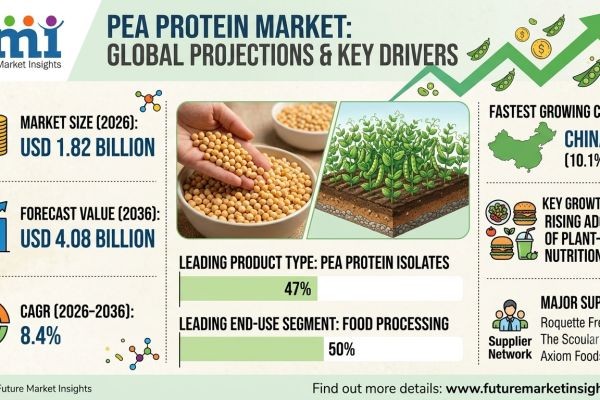
The global Pea Protein Market is poised for significant expansion, according to latest insights by Future Market Insights. The market is valued at USD 1.82 billion in 2026 and is projected to reach USD 4.08 billion by 2036. Over the forecast period from 2026 to 2036, demand is anticipated to expand at a CAGR of 8.4%.
Key Pea Protein Market Projections
- Market Size (2026): USD 1.82 Billion
• Forecast Market Value (2036): USD 4.08 Billion
• CAGR (2026 to 2036): 8.4%
• Leading Product Type: Pea Protein Isolates (47% Share)
• Leading End-Use Segment: Food Processing (50% Share)
• Fastest Growing Country: China (10.1% CAGR)
• Key Growth Driver: Rising Adoption of Plant-Based Nutrition
• Major Suppliers: Roquette Freres, The Scoular Company, Axiom Foods Inc.
Request a Sample Report: https://www.futuremarketinsights.com/reports/sample/rep-gb-697
Strategic Market Insights
Pea protein has evolved from a niche ingredient into a mainstream solution within the global food and beverage industry. Manufacturers are increasingly incorporating pea protein into formulations as consumers seek healthier, allergen-friendly, and environmentally sustainable protein sources.
The market continues to benefit from growing demand for plant-based foods, meat alternatives, nutritional supplements, and functional beverages. Pea protein's neutral taste profile, favorable amino acid composition, and versatility across applications make it an attractive ingredient for food manufacturers worldwide.
As clean-label trends reshape product development strategies, pea protein is becoming a preferred choice for brands looking to improve nutritional content while maintaining transparency and simplicity in ingredient declarations.
Analyst Perspective
“Pea protein is becoming a practical ingredient choice for manufacturers balancing nutrition, allergen concerns, and sustainability claims. Isolates will keep leading demand where purity and functionality matter, while textured formats can gain faster acceptance in plant-based meat and savory applications,” said Nandini Roy Choudhury, Principal Consultant for Food and Beverage at FMI.
Competitive Landscape and Market Share Analysis
The global pea protein market remains moderately consolidated, with leading manufacturers focusing on technological innovation, ingredient functionality, extraction efficiency, and global supply chain expansion.
Companies are investing in advanced protein extraction technologies, sustainable sourcing programs, and value-added product development to strengthen their competitive position. As demand for plant-based ingredients continues to accelerate, suppliers are expanding production capacities and enhancing quality control systems to meet evolving customer requirements.
Competition increasingly centers on protein purity, functionality, sustainability credentials, agricultural sourcing capabilities, and application-specific formulation support.
Leading Market Participants Include
- Roquette Freres
• The Scoular Company
• Burcon Nutrascience
• Cosucra Groupe Warcoing SA
• Shandong Jianyuan Group
• Nutri-Pea Ltd.
• Sotexpro SA
• Axiom Foods Inc.
• Ingredion Inc.
• Martin & Pleasance
• Fenchem Inc.
Production vs. Consumption Economy Analysis
Production capacity remains concentrated in regions with strong agricultural infrastructure and advanced protein processing capabilities. Europe, North America, and parts of Asia continue to lead global pea protein manufacturing due to established supply chains and technological expertise.
From a consumption perspective, China, the United States, Germany, and other developed economies represent key growth markets. Increasing demand for plant-based products, health-focused foods, and sustainable nutrition solutions continues to drive ingredient adoption across multiple food categories.
China is emerging as one of the most attractive opportunities globally as food manufacturers increase investment in nutritional enhancement and plant-based product innovation.
Supply Chain and Value Chain Insights
The pea protein value chain begins with pea cultivation and agricultural sourcing, followed by ingredient processing, protein extraction, purification, formulation, packaging, distribution, and end-use integration.
Ingredient suppliers continue to strengthen relationships with farmers, food processors, nutritional supplement manufacturers, and retail channels to improve supply reliability and quality consistency.
Digital procurement systems, quality assurance technologies, and integrated logistics networks are improving operational efficiency throughout the value chain.
Strategic Procurement Analysis
Procurement decisions increasingly focus on ingredient quality, protein concentration, functionality, traceability, sustainability credentials, and long-term supply security.
Food manufacturers prioritize suppliers capable of delivering consistent ingredient performance while supporting clean-label and sustainability objectives. Stable agricultural sourcing, advanced extraction technologies, and regulatory compliance have become critical differentiators in supplier selection.
As consumer expectations continue evolving, procurement strategies increasingly emphasize transparency, environmental responsibility, and product innovation.
Country Opportunity Assessment
China
China is projected to be the fastest-growing market, expanding at a CAGR of 10.1% through 2036. Rapid food industry development, rising nutritional awareness, and increasing adoption of plant-based ingredients continue to support strong market expansion.
United States
The United States is expected to register a CAGR of 5.9% during the forecast period. Demand is driven by sports nutrition growth, clean-label product reformulation, and growing consumer preference for plant-based protein alternatives.
Germany
Germany is forecast to grow at a CAGR of 8.0% through 2036. Environmental awareness, sustainability-focused consumer behavior, and supportive regulatory frameworks continue to accelerate demand for plant-derived protein ingredients.
Technology and Innovation Outlook
Key innovations shaping the pea protein industry include:
- Advanced protein extraction technologies
• Enhanced purification and isolation systems
• Functional ingredient optimization
• Textured protein development for meat alternatives
• Digital quality monitoring systems
• Sustainable crop sourcing programs
• Improved protein solubility solutions
• Clean-label formulation technologies
Manufacturers continue investing in process innovation to improve protein purity, functionality, taste profile, and production efficiency while reducing environmental impact.
Segment Analysis
By Product Type
Pea protein isolates are projected to dominate the market with a 47% share in 2026. Their high protein concentration, excellent functionality, and broad applicability across food and nutritional products make them the preferred choice among manufacturers.
Pea protein concentrates maintain demand in cost-sensitive formulations, while textured pea protein continues gaining traction in plant-based meat alternatives that require enhanced texture and mouthfeel characteristics. Hydrolyzed pea protein serves specialized nutritional and functional applications.
By End Use
Food processing is expected to account for 50% of total market demand, making it the largest end-use segment globally.
Applications span snacks, bakery products, dairy alternatives, beverages, and meat substitutes. Nutritional supplements and sports nutrition continue expanding as consumers increasingly seek convenient protein-rich products that support active lifestyles and wellness goals.
Exclusive Discounts on Full Report: https://www.futuremarketinsights.com/reports/pea-protein-market
Future Industry Outlook
The Pea Protein Market is expected to witness sustained growth through 2036, supported by rising plant-based food consumption, expanding clean-label product development, and increasing consumer focus on health and sustainability.
Growing applications across food processing, nutritional supplements, sports nutrition, and meat alternatives will continue creating opportunities for ingredient suppliers and manufacturers. While agricultural supply fluctuations and processing costs remain challenges, technological advancements and increasing consumer acceptance are expected to support long-term market expansion.
Companies capable of delivering high-quality ingredients, maintaining sourcing reliability, and investing in innovation will be well positioned to capitalize on future growth opportunities.






