
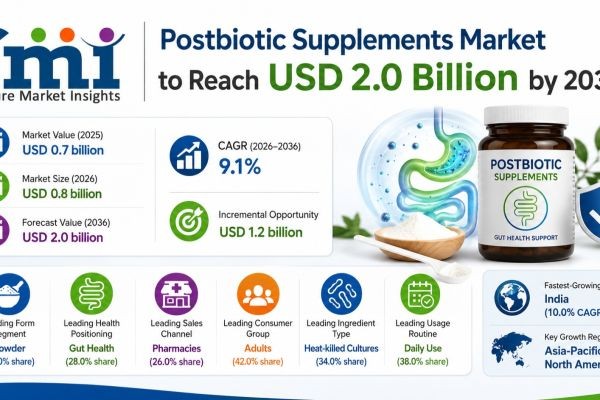
The global postbiotic supplements market is transitioning out of niche microbiome research into a highly structured, mainstream daily wellness category, according to latest insights by future market insights. As dietary supplement brands look to bypass the structural manufacturing, cold-chain logistics, and storage limitations of live-culture probiotics, non-living microbial alternatives have emerged as a high-growth formulation baseline. The global market, valued at USD 0.7 billion in 2025, is projected to reach USD 0.8 billion in 2026. Expanding at a fast Compound Annual Growth Rate (CAGR) of 9.1% over the ten-year forecast period, the industry is anticipated to cross a total valuation of USD 2.0 billion by 2036, yielding an absolute incremental opportunity of USD 1.2 billion.
Request a Sample Report: https://www.futuremarketinsights.com/reports/sample/rep-gb-11655
Market Performance Overview
To map out the key application configurations and primary distribution channels guiding this USD 1.2 billion expansion, an analysis of segment-specific market shares highlights where global volume is concentrated:
- Adults Consumer Group (42.0% share): Represents the primary target block in 2026 because daily immune support and routine digestive comfort align easily with mainstream adult replenishment patterns.
- Daily Use Routine (38.0% share): Commands the usage routine segment, providing predictable reorder schedules compared to occasional or condition-specific recovery interventions.
- Heat-Killed Cultures Ingredient Type (34.0% share): Functions as the dominant ingredient configuration, prized by contract manufacturing organizations for its complete handling ease and processing stability.
- Powder Form (30.0% share): Leads the delivery form segment due to its excellent dry-blend flexibility across bulk tubs, single-serve sachets, and direct-to-mouth stick packs.
- Gut Health Positioning (28.0% share): Outpaces alternative health claims, acting as the most direct, consumer-accepted benefit narrative at the retail point of purchase.
- Pharmacies Sales Channel (26.0% share): Leads the retail architecture, relying on professional pharmacist recommendation behavior to build consumer trust in emerging microbiome variations.
Technical Drivers and Formulation Advantages
The industrial migration toward shelf-stable postbiotic ingredients is propelled by distinct operational advantages:
Exceptional Structural Stability
Unlike traditional live probiotics, postbiotic ingredient systems such as cell fragments, fermentates, and heat-killed cultures are completely inert. They do not require refrigerated storage, can withstand high-shear industrial blending, and maintain an exact dosage concentration throughout their entire ambient shelf life, preventing premature product degradation.
Clean Blend Flexibility and Excipient Fit
Fine postbiotic powders provide formulation scientists with extensive freedom to pair active components alongside fibers, adaptogens, and complex micronutrients within a single scalable delivery matrix. This high flow behavior improves filling line accuracy across automated packaging equipment, minimizing manufacturing waste.
High Sourcing Clarity and Traceability
Top-tier ingredient suppliers are delivering highly standardized postbiotic fractions (such as postbiotic BPL1 configurations) backed by audited quality management files. This clinical transparency allows premium digital wellness platforms to secure clean-label certifications and detail precise mechanisms of action directly on their digital checkout portals.
Industrial Infrastructure Challenges
Brand development teams and contract manufacturing organizations must coordinate to overcome persistent execution barriers:
- The Consumer Education Friction Point: Because the distinction between pre-, pro-, and postbiotics is heavily technical, brands face continuous consumer hesitation unless they deploy simplified benefit messaging. Overly complex scientific jargon on product labels can cause high customer acquisition costs and delay repeat purchase velocities.
- Strict Audit and Claim Scrutiny: Evolving novel food frameworks across Europe and North America require deep clinical documentation to support structural health claims. Suppliers unable to provide robust lot-to-lot consistency and rigorous safety data portfolios face immediate exclusion from pharmacy channels.
Regional Growth Outlook
The geographic analysis indicates clear growth velocity across rapidly expanding South Asian retail networks and mature North American supplement spaces:
- India (10.0% CAGR): The global growth frontrunner, driven by an explosion in digital wellness commerce, expanding urban pharmacy structures, and high consumer trial willingness for functional daily supplements.
- China (9.6% CAGR): Expanding rapidly via function-led supplement choices, advanced digital health ecosystems, and widespread consumer familiarity with specialized wellness formulations.
- United States (8.8% CAGR): A highly mature, value-driven market where pharmacy trust, direct-to-consumer subscription models, and advanced clean-label reformulations sustain massive baseline volume requirements.
- Brazil (8.1% CAGR): Backed by structural scaling in urban health channels and rising middle-class consumer intent toward preventative digestive nutrition.
- Germany (7.4% CAGR): Characterized by measured, highly disciplined growth where strict European claim validation protocols and rigorous quality verification dictate supplier selection.
- South Korea (7.0% CAGR): Driven by an agile, innovation-focused consumer base that responds exceptionally fast to novel, convenient delivery formats like functional gummies.
- Japan (6.2% CAGR): A highly traditional, quality-centric market focusing heavily on manufacturing precision, long-term supplier loyalty, and long validation cycles rather than rapid portfolio expansion.
Competitive Landscape
The global postbiotic supplements environment is moderately fragmented, featuring an established upper tier of multinational ingredient processors alongside agile, specialized health solution providers. Archer Daniels Midland (ADM) operates as a leading market force, commanding an estimated 8.0% global market share through integrated production assets and extensive portfolio depth.
Comprehensive formulation support, broad multi-jurisdictional compliance expertise, and global distribution footprints are anchored by industry titans including ADM, dsm-firmenich, IFF Health, Lallemand Health Solutions, Kerry, Morinaga Milk, and Sabinsa. To maximize account retention and minimize switching behaviors, these market leaders are actively offering comprehensive turnkey manufacturing services, combining custom powder optimization with shelf-ready packaging formats.
Exclusive Discounts on Full Report: https://www.futuremarketinsights.com/reports/postbiotic-supplements-market
Frequently Asked Questions
What is the projected valuation of the global market by 2036?
The global postbiotic supplements market is projected to reach USD 2.0 billion by 2036, scaling upward from an estimated baseline valuation of USD 0.8 billion in 2026 at a CAGR of 9.1%.
How do postbiotic supplements differ from probiotics?
Postbiotic lines utilize non-living microbial structures, metabolites, or fermentates, whereas probiotic supplements depend entirely on live micro-organisms, which completely changes the product's storage requirements, shelf-life longevity, and formulation handling.
What exclusions govern the boundaries of this market report?
The scope strictly limits its focus to oral supplement applications, explicitly excluding live probiotic-only formulations, non-oral topical skincare cosmetics, and therapeutic prescription microbiome medicines.
FMI Custom Research: Strategic Intelligence for Confident Decision-Making
In today's rapidly evolving business environment, leadership teams need more than market data they need clear, actionable intelligence tailored to their strategic objectives. FMI's Custom Research solutions are designed around the specific business questions organizations need answered, enabling executives to evaluate growth opportunities, validate investments, assess competitive dynamics, and reduce uncertainty before making critical decisions.
Key Executive Benefits
- Decision-Ready Insights tailored to business priorities
• Reduced Strategic Risk through validated market intelligence
• Market Entry Confidence with detailed competitive analysis
• Competitive Advantage supported by proprietary research
• Faster Growth Decisions through customized strategic insights
• Primary Market Validation from industry stakeholders
• Global Industry Expertise across diverse sectors
• Proven Track Record with thousands of consulting engagements
Business Impact
FMI helps organizations transform market complexity into strategic clarity, enabling leadership teams to identify growth opportunities faster, optimize resource allocation, strengthen competitive positioning, and make high-stakes business decisions with confidence.
To explore how FMI Custom Research can support your strategic priorities, please connect with our team at - sales@futuremarketinsights.com






