
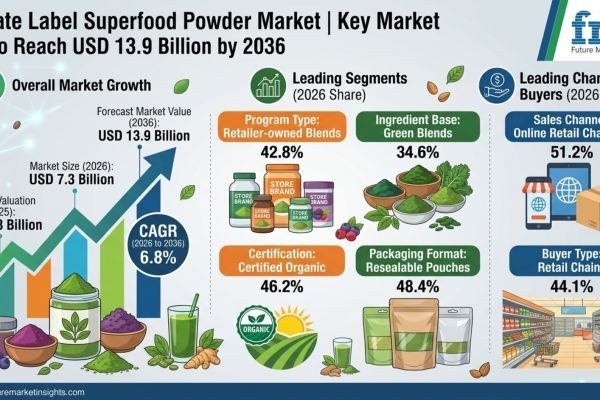
The global private label superfood powder market is expanding rapidly as major grocery, mass, and club retailers widen their wellness aisles with store-brand alternatives. Driven by rising consumer demand for affordable daily nutrition and an intentional push by retailers to control product margins, private-label lines are shifting from basic imitation SKUs into premium, specialized formulations. The market is projected to grow from USD 7.3 billion in 2026 to USD 13.9 billion by 2036, tracking a steady compound annual growth rate (CAGR) of 6.8%.
With online subscription models and direct-to-consumer (DTC) positioning facilitating recurring purchase behavior, retailers are moving away from single-product launches toward complete, color-coded wellness portfolios. By collaborating directly with turnkey contract manufacturers, brands are rapidly introducing targeted superfood lines spanning green blends, functional mushrooms, and adaptogenic roots without the overhead of independent formulation development.
Analyst Perspective
"Private label superfood powders are no longer simple me-too wellness SKUs. Buyers now ask who can control taste, label risk, allergen separation, and launch timing at the same time. The most useful supplier is often the one that makes retailer testing easier before a national rollout begins."
Request a Sample Report: https://www.futuremarketinsights.com/reports/sample/rep-gb-33375
Key Market Highlights
- Market Size (2026): USD 7.3 Billion
- Forecast Market Value (2036): USD 13.9 Billion
- CAGR (2026 to 2036): 6.8%
- Market Valuation (2025): USD 6.8 Billion
- Leading Program Type: Retailer-owned Blends (42.8% share in 2026)
- Leading Ingredient Base: Green Blends (34.6% share in 2026)
- Primary Certification: Certified Organic (46.2% share in 2026)
- Leading Packaging Format: Resealable Pouches (48.4% share in 2026)
- Leading Sales Channel: Online Retail Channels (51.2% share in 2026)
- Dominant Buyer Type: Retail Chains (44.1% share in 2026)
- Fastest-Growing Country Market: Saudi Arabia (8.7% CAGR through 2036)
Market Overview
The private label superfood powder market covers contract-manufactured and retailer-owned powder programs formulated with concentrated plant, fruit, vegetable, mushroom, algae, root, seed, fiber, or micronutrient ingredients. This sector tracks finished powder formulas sold under retailer, distributor, DTC, foodservice, or third-party brand-owner labels where the supplier provides blending, testing, packaging, or labeling services.
Scope explicitly excludes branded superfood powders sold strictly under a manufacturer's own name, single-ingredient commodity bulk powders, liquid smoothies, capsules, tablets, and functional gummies. Macro-indicators highlight a significant gap in daily nutrient intake such as reports showing that less than 10% of Americans consume recommended daily fiber levels which directly fuels demand for plant-source blends featuring clear fiber and micronutrient messaging.
Why Is the Private Label Superfood Powder Market Growing?
- Store-brand familiarity allows wellness powders to leverage established consumer trust in traditional grocery and retail brands.
- Contract manufacturing networks eliminate initial launch friction by offering ready-to-fill, shelf-stable formulas.
- Lower cost-per-serving metrics allow private labels to capture price-sensitive shoppers looking to replace premium-priced branded supplements.
- Resealable flexible pouches reduce overall shipping weight, making online fulfillment and recurring subscription logistics highly efficient.
- Versatile application options position superfood powders as simple, easy-to-understand lifestyle additions for daily smoothie blending.
Custom Research Available: https://www.futuremarketinsights.com/customization-available/rep-gb-33375
Formulation Hurdles & Regulatory Shifts
The primary hurdle for private-label powder programs revolves around strict batch consistency and rigorous contaminant testing. Ingredients like dense leafy greens, algae, and roots naturally carry higher risks for heavy metal and microbiological variances, forcing contract manufacturers to enforce stringent quality control checks before release.
Furthermore, shifting regulatory frameworks demand heightened supplier diligence. In the United States, updated regulatory paths direct facilities toward precise manufacturing compliance (shifting between standard food controls under 21 CFR Part 117 and dietary supplement requirements under 21 CFR Part 111). Concurrently, UK and European guidelines require operators to register and complete meticulous label checks for active botanicals or added caffeine, making comprehensive supplier documentation a primary buying requirement.
Segment Analysis
- By Program Type: Retailer-owned blends lead the market with a 42.8% share in 2026. Massive grocery, club, and pharmacy chains utilize these proprietary programs to capture maximum margin control while keeping shelf pricing competitive against national brands.
- By Ingredient Base: Green blends remain the dominant baseline, securing 34.6% of the market in 2026. Familiar ingredients like spinach, kale, and wheatgrass offer a direct, easily understood daily wellness message that translates to high customer retention.
- By Packaging Format: Resealable pouches command a 48.4% market share in 2026. Pouches minimize shelf and shipping footprints compared to rigid plastic canisters, directly reducing logistics overhead for high-volume retailers and e-commerce brands.
Regional Market Analysis
United States
The United States represents a mature, high-volume corridor, projected to achieve an 8.2% CAGR through 2036, growing from USD 360.0 million in 2026 to USD 791.7 million by 2036. Driven by an expansive store-brand environment and high dietary supplement usage, major club and mass retail networks utilize larger pouch formats to target families seeking affordable baseline nutrition.
Canada
The Canadian market is expanding at a 7.5% CAGR, expected to scale from USD 85.0 million in 2026 to USD 175.2 million by 2036. Demand is heavily anchored around natural health product channels and urban pharmacy corridors. Growth here relies on a brand's ability to maintain clear, compliant bilingual packaging and transparent organic or vegan certification records.
Germany
Germany's market is projected to reach USD 210.4 million by 2036, rising at a 7.2% CAGR. The landscape is heavily structured around prominent drugstore networks and dedicated organic food retailers. German consumers maintain strict standards regarding ingredient origin, prompting private labels to focus on lean, clean-label formulas backed by verified European certifications.
United Kingdom
Tracking a 7.6% CAGR through 2036, the United Kingdom market is heavily influenced by strict food supplement registration structures. Retailers find commercial success by aligning with contract partners who handle the burden of local food safety compliance, utilizing stick packs and trial kits to attract online marketplace shoppers.
Saudi Arabia
Saudi Arabia leads the global market in growth rate, registering an 8.7% CAGR through 2036. This swift expansion is driven by a modernizing retail infrastructure and premium pharmacy chains looking to capture affluent, health-conscious urban shoppers via high-quality, registered imported powders.
Competitive Landscape
The competitive field is anchored by scaled contract manufacturers capable of providing end-to-end services, from raw ingredient sourcing and custom flavor masking to final retail packaging. Suppliers differentiate themselves by their ability to pass rigid retailer audits, maintain strict allergen separation, and offer flexible minimum order quantities (MOQs). While large-scale manufacturers focus on high-volume national accounts, regional contract partners capture value by providing specialized local label compliance and agile turnaround times for emerging brands.
Key Companies
Bactolac Pharmaceutical, Inc., Vitaquest International LLC, Makers Nutrition LLC, SMP Nutra, NutraScience Labs, Supplement Factory Ltd., BfEsse SIA, Bee Health Limited, Healthspan Limited, Holland & Barrett Retail Limited, DM-drogerie markt GmbH + Co. KG, Amazonia Pty Ltd., and Organika Health Products Inc.
Key Industry Developments
- February 2026: Vitaquest International LLC expanded its specialized manufacturing capabilities by introducing an advanced probiotics suite, targeting the growing crossover segment where gut health and private-label greens powders intersect.
- October 2025: SMP Nutra highlighted its extensive custom formulation platform at SupplySide Global, showcasing a vast catalog of turnkey green superfood formulas integrating spirulina, chlorella, and digestive enzymes.
- June 2025: Vitaquest International LLC published comprehensive operational guidance detailing powdered supplement manufacturing steps to assist private-label buyers in optimizing flavor masking and product stability workflows before large-scale rollouts.
Exclusive Discounts on Full Report: https://www.futuremarketinsights.com/reports/private-label-superfood-powder-market
Strategic Outlook Through 2036
The long-term trajectory of the private label superfood powder market hinges on balancing cost efficiency with strict ingredient transparency. As store brands continue to capture market share from national labels, success will belong to retailers who build portfolios around verified certifications—such as organic, non-GMO, and clean-label allergen controls. Suppliers that seamlessly integrate meticulous laboratory testing with advanced flavor-masking technologies will remain the preferred partners for retailers seeking to establish a permanent presence in the daily wellness landscape.
Why Choose FMI: https://www.futuremarketinsights.com/why-fmi
Explore More Related Studies Published by FMI Research
Demand for Wheatgrass Products in the EU : https://www.einpresswire.com/article/903341754/eu-wheatgrass-products-market-to-reach-usd-25-93-billion-by-2036-globally-led-by-germany-with-now-foods-myprotein
Mineral Fortification Market : https://www.openpr.com/news/4529748/mineral-fortification-market-to-reach-usd-158-06-billion-by-2036
Monoprotein Market : https://www.openpr.com/news/4529750/monoprotein-market-to-reach-usd-5-34-billion-by-2036-as-pet-owners
Explore In-Depth Food & Beverage Market Insights : https://www.futuremarketinsights.com/industry-analysis/food-and-beverage
About Future Market Insights (FMI)
Future Market Insights, Inc. (FMI) is an ESOMAR-certified, ISO 9001:2015 market research and consulting organization trusted by global enterprises and Fortune 500 companies. FMI delivers actionable market intelligence, competitive benchmarking, and strategic insights across more than 30 industries and 1,200 markets worldwide.
Contact Us
Future Market Insights Inc.
Christiana Corporate, 200 Continental Drive,
Suite 401, Newark, Delaware - 19713, USA
T: +1-347-918-3531
For Sales Enquiries: sales@futuremarketinsights.com
Website: https://www.futuremarketinsights.com






