
Significant material and design adjustments are reshaping global shoe manufacturing, sparked by a rising operational and consumer imperative for optimized foot comfort, wear resistance, and lightweight performance metrics.
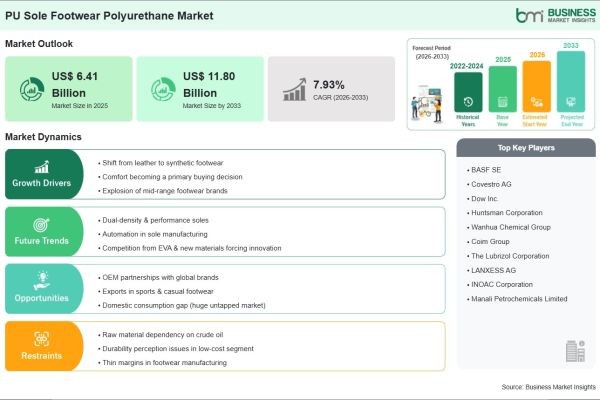
Based on market intelligence from Business Market Insights, the global PU Sole (Footwear Polyurethane) Market [https://www.businessmarketinsights.com/reports/pu-sole-footwear-polyurethane-market] is anticipated to reach US$ 11.8 billion by 2033, mounting from its 2025 value of US$ 6.41 billion at a projected CAGR of 7.93% from 2026 to 2033.
Recent breakthroughs in bio-based polyols, advanced dual-density injection molding, and highly sustainable chemical formulations are radically lowering the environmental footprint of shoe manufacturing. Global footwear brands and chemical conglomerates are aggressively investing in closed-loop recycling and lightweight PU architectures to deliver superior shock absorption while meeting increasingly stringent global sustainability mandates.
Download Sample Report : https://www.businessmarketinsights.com/sample/BMIPUB00034236
What Is PU Sole (Footwear Polyurethane)?
Polyurethane (PU) is a highly versatile synthetic polymer extensively utilized in the footwear industry to manufacture midsoles, outsoles, and insoles. It is chemically synthesized through the reactive blending of liquid polyols and diisocyanates (such as MDI or TDI) under precise temperature conditions. When molded, this chemical reaction creates a microcellular foam or solid elastomer that forms the shoe sole.
PU soles offer a unique, unparalleled combination of lightweight construction, exceptional shock absorption, and high flexibility. Unlike traditional vulcanized rubber or EVA (Ethylene Vinyl Acetate), footwear polyurethane maintains superior resistance to abrasion, extreme temperatures, and harsh industrial chemicals, making it the premier material choice for everything from premium running shoes to heavy-duty occupational safety boots.
Market Drivers
A primary driver propelling the PU Sole Market is the explosive global growth of the sports and athleisure sectors. As modern consumers increasingly blend activewear with daily lifestyles, the demand for athletic footwear that provides maximum energy return and joint cushioning has skyrocketed. PU midsoles are critical in high-performance running and cross-training shoes, directly fueling massive volume demand from tier-one global sports brands.
Furthermore, stringent occupational safety regulations across the manufacturing, construction, and mining industries serve as a massive growth catalyst. Industrial workers require heavy-duty safety footwear that can withstand oil spills, chemical exposure, and electrical hazards while remaining comfortable during 12-hour shifts. PU outsoles excel in these exact parameters, driving heavy adoption in the specialized workwear and safety boot segments.
Additionally, the manufacturing efficiency of polyurethane makes it highly attractive to footwear producers. Liquid PU can be directly injected into complex molds, bonding instantly to the shoe upper without the need for toxic adhesives or prolonged curing times. This direct-injection process vastly reduces material waste, accelerates production lines, and lowers overall labor costs for mass-market footwear manufacturers.
Market Segmentation
By Raw Material
- Methylene Diphenyl Diisocyanate (MDI)
- Toluene Diphenyl Diisocyanate (TDI)
- Polyols
By Sole Type
- Insole
- Mid-sole
- Outsole
By Footwear Type
- Sports & Athletics
- Casual & Fashion
- Work & Safety
- Formal Footwear
- Slippers & Sandals
The MDI raw material segment commands the dominant share of global market revenue due to its safer handling profile compared to TDI and its superior mechanical properties in creating highly resilient foams. Concurrently, the sports and athletics application segment is logging exceptionally fast compound annual growth, fueled by rising global health consciousness and the continuous release of highly engineered, premium-priced athletic footwear.
Regional Insights
- Asia-Pacific represents the absolute largest market and manufacturing hub for PU soles globally. This dominance is heavily driven by the unparalleled concentration of massive footwear manufacturing facilities across China, Vietnam, Indonesia, and India, coupled with rising domestic consumer spending on branded footwear.
- Europe commands a highly robust market position, strongly defined by rigorous occupational safety standards driving the workwear segment, alongside a massive consumer shift toward sustainable, bio-based footwear produced by premium European fashion and sports houses.
- North America is demonstrating steady, high-value growth, anchored by a deeply entrenched athleisure culture, high per-capita spending on performance sports footwear, and heavy R&D investments by major US-based sporting goods conglomerates.
- Middle East & Africa and South & Central America are emerging as strategic growth pockets, supported by rapid urbanization, an expanding middle class, and the gradual modernization of regional footwear manufacturing capabilities.
Top Players in the PU Sole (Footwear Polyurethane) Industry
The global marketplace features concentrated competition among massive, multinational chemical science corporations. Key industry participants continuously channel capital into formulating eco-friendly, bio-renewable polyols and highly efficient injection molding systems.
- BASF SE
- Covestro AG
- Huntsman International LLC
- The Dow Chemical Company
- Wanhua Chemical Group Co., Ltd.
- LANXESS AG
- Coim Group
- Asahi Kasei Corporation
- The Lubrizol Corporation
- Kao Corporation
These chemical market leaders frequently forge strategic development partnerships with major global footwear brands to custom-engineer proprietary foam formulations that deliver unique cushioning properties.
Technological Innovations
Technological innovations in Bio-Based Polyurethanes are profoundly upgrading the market's sustainability profile. Historically heavily reliant on petrochemicals, major chemical companies are now commercializing polyols derived from renewable biomass, such as castor oil or post-consumer organic waste. These bio-PU formulations deliver the exact same mechanical durability and rebound properties as traditional plastics but drastically reduce the carbon footprint of the finished shoe, aligning with global climate goals.
Furthermore, the industry is witnessing a significant shift toward Advanced Dual-Density Direct Injection technology. Modern manufacturing equipment can now inject two different densities of polyurethane into the same mold simultaneously. This allows a shoe to feature a tough, high-density PU outer layer for maximum abrasion resistance, seamlessly bonded to a soft, low-density PU inner core for supreme comfort, completely eliminating the need for heavy glues and secondary assembly steps.
Additionally, the integration of 3D Printing and Additive Manufacturing with PU materials is revolutionizing bespoke footwear. While mass production still relies on injection molding, 3D printing allows for the rapid prototyping of highly complex, lattice-structured PU midsoles that are computationally designed to map the exact pressure points of an individual user's foot, opening the door for mass-customized orthopedic and athletic shoes.
Future Market Outlook
The long-term trajectory for the PU Sole Footwear Polyurethane Industry remains exceptionally stable and highly lucrative. As global populations urbanize and the line between athletic and everyday footwear continues to blur, the demand for lightweight, high-rebound shoe components will ensure massive, continuous volume demand for advanced PU formulations.
The upcoming maturation of chemical recycling technologies will push the polyurethane industry into an entirely new phase of circular manufacturing. Future processes will allow old PU shoe soles to be chemically depolymerized back into raw polyols and isocyanates, completely closing the loop on footwear waste. Companies that continuously pioneer bio-based raw materials, refine high-speed automated injection molding, and master chemical recycling will maintain a commanding lead in the global footwear materials ecosystem.
Frequently Asked Questions (FAQs)
What makes PU soles better than traditional rubber soles?
Polyurethane soles are significantly lighter than traditional solid rubber, making the shoe much less fatiguing to wear over long periods. Additionally, PU can be formulated as a microcellular foam, providing vastly superior shock absorption and cushioning. While heavy rubber is highly durable, PU offers an optimal balance of excellent abrasion resistance while remaining incredibly light and flexible.
What is the difference between MDI and TDI in footwear manufacturing?
MDI (Methylene Diphenyl Diisocyanate) and TDI (Toluene Diphenyl Diisocyanate) are the two primary chemical building blocks used to create PU. MDI is the dominant choice in modern footwear because it is less volatile, safer for factory workers to handle, and produces highly resilient, flexible foams ideal for midsoles. TDI is generally used for specific, low-density foam applications but faces stricter regulatory handling limits due to its toxicity.
Are polyurethane shoe soles prone to "hydrolysis"?
Historically, ester-based PU soles could suffer from hydrolysis—a chemical breakdown caused by prolonged exposure to moisture and heat, which causes old shoes to crumble. However, modern chemical advancements have largely solved this issue. Most high-quality footwear now utilizes ether-based PU or advanced anti-hydrolysis additives, making modern PU soles highly resistant to water degradation and dramatically extending the shelf life of the footwear.
Is footwear polyurethane environmentally friendly?
While traditional PU is derived from fossil fuels and is not naturally biodegradable, the industry is making massive strides in sustainability. The rapid development of bio-based polyols (derived from plants) and the implementation of advanced chemical recycling facilities are transforming PU into a much more eco-friendly material compared to heavily processed vulcanized rubbers or PVC.
Browse More Reports:
https://www.businessmarketinsights.com/reports/quantum-sensors-market
https://www.businessmarketinsights.com/reports/railway-wiring-harness-market
https://www.businessmarketinsights.com/reports/refrigeration-coolers-market
About Us
Business Market Insights is a market research platform that provides a subscription service for industry and company reports. Our research team has extensive professional expertise in domains such as Electronics & Semiconductor; Aerospace & Defense; Automotive & Transportation; Energy & Power; Healthcare; Manufacturing & Construction; Food & Beverages; Chemicals & Materials; and Technology, Media, & Telecommunications.
Contact Us
If you have any questions about this report or would like further information, please contact us:
Contact person: Ankit Mathur
Email: sales@businessmarketinsights.com
Phone: +16467917070






