
The global rotational molding machine market is evolving from a niche polymer processing segment into a strategically important manufacturing capability, driven by the need for lightweight, durable, and cost-efficient hollow plastic components. As industries such as automotive, water infrastructure, and material handling scale production, rotational molding equipment is being re-evaluated not just as machinery, but as a productivity and energy optimization system. The shift toward automated multi-arm configurations, IoT-enabled monitoring, and multi-material processing is redefining how manufacturers approach capital equipment investment in polymer processing.
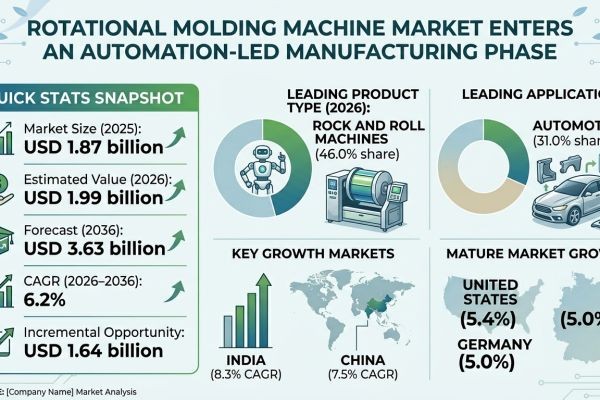
Quick Stats Snapshot
• Market Size (2025): USD 1.87 billion
• Estimated Value (2026): USD 1.99 billion
• Forecast (2036): USD 3.63 billion
• CAGR (2026–2036): 6.2%
• Incremental Opportunity: USD 1.64 billion
• Leading Product Type (2026): Rock and Roll Machines (46.0% share)
• Leading Application: Automotive (31.0% share)
• Key Growth Markets: India (8.3% CAGR), China (7.5% CAGR)
• Mature Market Growth: United States (5.4%), Germany (5.0%)
Market Size and Forecast
The rotational molding machine market is projected to grow from USD 1.99 billion in 2026 to USD 3.63 billion by 2036, reflecting a steady CAGR of 6.2%. Growth is being driven by increased adoption of rotational molding across applications that require large, hollow, and structurally efficient plastic components.
Unlike high-volume molding technologies such as injection or blow molding, rotational molding offers unique advantages in producing complex geometries with uniform wall thickness and minimal material waste. As a result, demand is expanding steadily, particularly in applications where design flexibility and tooling efficiency outweigh cycle time constraints.
Growth Drivers: Why Rotational Molding Is Gaining Strategic Importance
- Automotive Lightweighting and Component Integration
Automotive applications account for 31% of demand, driven by the need for lightweight fuel tanks, air ducts, and underbody components that improve fuel efficiency and reduce emissions. - Expansion of Water Storage and Infrastructure Systems
Rising demand for water tanks and storage solutions in emerging economies is accelerating adoption of large-format rotational molding machines. - Manufacturing Cost Optimization
Rotational molding minimizes material waste and reduces tooling costs, making it attractive for manufacturers seeking efficient production of complex hollow parts. - Shift Toward Automation and Multi-Arm Systems
Transition from manual and single-arm machines to automated carousel and multi-arm systems is improving throughput, consistency, and energy efficiency.
Key Challenges: Balancing Efficiency with Capital Investment
- High Initial Equipment Costs: Capital expenditure requirements limit adoption among small and mid-scale manufacturers.
• Cycle Time Limitations: Longer production cycles compared to other molding technologies can restrict high-volume applications.
• Energy Consumption Pressures: Rising energy costs are forcing manufacturers to prioritize machines with optimized thermal efficiency.
• Technology Fragmentation: Variability in machine configurations and control systems creates integration challenges across production environments.
Emerging Opportunities: Where Competitive Advantage Is Shifting
Advanced Automation and Process Control
Integration of IoT-enabled monitoring, predictive maintenance, and real-time cycle optimization is transforming machines into connected manufacturing systems.
Multi-Material and Composite Processing
Demand is rising for machines capable of handling advanced polymers and multi-layer structures, expanding application possibilities.
Energy-Efficient Machine Design
Innovations in heating systems, insulation, and cooling cycles are reducing per-part energy consumption and improving operational economics.
Aftermarket Services and Retrofit Solutions
Lifecycle service models, including upgrades and digital monitoring, are emerging as key revenue streams for machine manufacturers.
Segmentation Insights
By Product Type
• Rock and Roll Machines (46%) dominate due to suitability for large cylindrical components such as water tanks.
• Carousel and shuttle machines are gaining traction for higher-volume and automated production environments.
• Swing arm machines serve niche and flexible production requirements.
By Application
• Automotive (31%) leads due to lightweighting initiatives and component integration.
• Material handling and water storage represent strong secondary segments.
• Agriculture and recreational products contribute to diversified demand.
Regional Analysis: Industrial Expansion Meets Technology Adoption
Asia-Pacific: Growth Engine of Manufacturing Expansion
• India (8.3% CAGR): Driven by water tank manufacturing and agricultural equipment demand.
• China (7.5% CAGR): Growth supported by automotive production and export-oriented manufacturing.
North America: Automation and Reshoring Trends
The United States (5.4% CAGR) is witnessing increased adoption due to reshoring of manufacturing and demand for advanced, automated systems.
Europe: Engineering Precision and Automotive Demand
Germany (5.0%) and the United Kingdom (4.9%) emphasize high-quality manufacturing and integration of advanced control systems.
Other Markets
Canada (5.1%) and Japan (4.6%) show steady growth driven by specialty applications and material handling solutions.
Competitive Landscape: Engineering Capability Defines Market Leadership
The rotational molding machine market is moderately concentrated, with key players including Persico Group, Rotoline Machinery, Ferry Industries Inc., Orex Rotomoulding, Fixopan Rotomoulding Machines, Reinhardt Roto-Machines, Rotomachinery Group, Polivinil Rotomachinery, Shree Momai Rotocast Pvt. Ltd., and Caccia Engineering S.p.A.
Competitive differentiation is driven by:
• Advanced machine design and automation capabilities
• Energy efficiency and thermal control optimization
• Ability to support multi-material processing
• Strong aftermarket service and lifecycle support
High entry barriers exist due to the technical expertise required and the importance of proven performance in industrial applications.
Strategic Implications for Industry Stakeholders
- For Manufacturers: Investment in automated, energy-efficient machines is critical for maintaining competitiveness and reducing operating costs.
• For Automotive OEMs: Rotational molding offers a scalable pathway for lightweight component production and design flexibility.
• For Investors: The market presents steady, technology-driven growth with opportunities in automation and service models.
• For Equipment Suppliers: Differentiation will depend on integrating digital capabilities and improving lifecycle value.
Future Outlook: Efficiency and Flexibility Will Define Success
The future of the rotational molding machine market will be shaped by the ability to balance efficiency, flexibility, and cost. As manufacturers demand more adaptable production systems, machine builders will need to deliver solutions that support diverse materials, complex geometries, and variable production volumes.
Automation, energy optimization, and digital integration will become standard expectations rather than premium features. At the same time, expanding applications in automotive, infrastructure, and industrial manufacturing will continue to reinforce the relevance of rotational molding as a versatile production technology.
Executive-Level Takeaways
- The market is projected to reach USD 3.63 billion by 2036, supported by steady industrial demand.
• Automation and multi-arm systems are redefining equipment specifications.
• Automotive remains the dominant application, driven by lightweighting initiatives.
• Asia-Pacific leads growth, while North America and Europe drive technological advancement.
• Energy efficiency and digital integration are emerging as key competitive differentiators.
• Aftermarket services and lifecycle solutions are becoming critical revenue streams.
Full Report View: https://www.futuremarketinsights.com/reports/rotational-molding-machine-market






