
The sodium reduction ingredient market is witnessing robust growth as food and beverage manufacturers increasingly adopt innovative sodium-reduction solutions to meet regulatory requirements and evolving consumer health preferences, according to latest insights by future market insights.
Request a Sample Report : https://www.futuremarketinsights.com/reports/sample/rep-gb-470
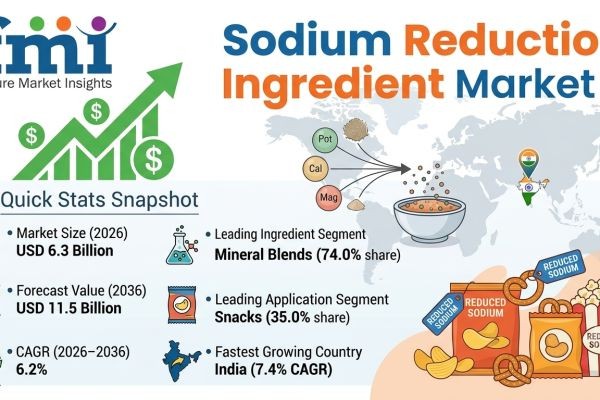
Quick Stats Snapshot
- Market Size (2026): USD 6.3 Billion
• Forecast Value (2036): USD 11.5 Billion
• CAGR (2026–2036): 6.2%
• Leading Ingredient Segment: Mineral Blends (74.0% share)
• Leading Application Segment: Snacks (35.0% share)
• Fastest Growing Country: India (7.9% CAGR)
Market Size and Forecast: Health Regulations Drive Industry Expansion
The global sodium reduction ingredient market is projected to grow from USD 6.3 billion in 2026 to USD 11.5 billion by 2036, registering a CAGR of 6.2%. The market is evolving from a niche ingredient category into a strategic reformulation sector as governments and health organizations continue promoting sodium reduction initiatives.
Food manufacturers are increasingly investing in integrated sodium-reduction systems that combine mineral salts, flavor modulators, amino acids, and yeast extracts to maintain taste while reducing sodium content.
Key Growth Drivers: Reformulation Becomes Industry Priority
- Government Sodium Reduction Initiatives
Regulatory agencies worldwide are introducing sodium reduction targets, encouraging food manufacturers to reformulate processed food products.
- Growing Consumer Health Awareness
Increasing awareness of hypertension and cardiovascular health is driving demand for lower-sodium food products.
- Advancements in Taste Modulation Technologies
Innovative flavor enhancement systems are enabling significant sodium reduction without compromising taste acceptance.
- Expansion of Processed Food Consumption
Growing demand for packaged snacks, convenience foods, and ready-to-eat meals is increasing the need for sodium reduction ingredients.
Market Challenges: Balancing Taste and Functionality
Despite strong growth prospects, several challenges continue to affect the industry:
- Taste and sensory limitations associated with sodium reduction
• Metallic aftertaste concerns in potassium chloride-based solutions
• Technical challenges in preservation and texture management
• Clean-label formulation complexities
• Higher costs of advanced flavor modulation systems
Segmentation Insights: Mineral Blends and Snacks Lead Market Demand
By Ingredient Type
- Mineral blends account for 74.0% of market share in 2026
• Potassium chloride remains the most widely used sodium replacement ingredient
• Yeast extracts and amino acids are gaining popularity for clean-label reformulation
By Application
- Snacks dominate with 35.0% market share
• Bakery and confectionery remain major application areas
• Meat products, dairy, sauces, and dressings continue generating significant demand
Regional Analysis: Asia Pacific Emerges as Growth Engine
Key growth markets include:
- India (7.9% CAGR): Rising packaged food consumption and increasing health awareness
• China (6.5% CAGR): Expanding convenience food production and sodium reduction initiatives
• Brazil (6.0% CAGR): Accelerating food reformulation efforts across major categories
• United Kingdom (5.6% CAGR): Strong clean-label and public health-driven demand
The United States continues to benefit from FDA sodium reduction targets and retailer-led reformulation programs.
Exclusive Discounts on Full Report : https://www.futuremarketinsights.com/reports/sodium-reduction-ingredient-market
Competitive Landscape: Integrated Reformulation Solutions Gain Importance
The competitive landscape is increasingly focused on providing comprehensive sodium-reduction platforms rather than standalone ingredients.
Key players include:
- Kerry Group
• Cargill
• IFF (International Flavors & Fragrances)
• DSM-Firmenich
• Givaudan
• Jungbunzlauer
• Ajinomoto Group
• Kirin Holdings
• J&K Ingredients
• Sensient Technologies
Manufacturers are investing in flavor modulation technologies, digital formulation tools, clean-label innovations, and application-specific support to strengthen competitive positioning.
Future Outlook: Advanced Taste Modulation to Define Next-Generation Growth
Over the next decade, the sodium reduction ingredient industry is expected to benefit from rising regulatory pressure, increasing health consciousness, and technological advancements in flavor science. Integrated solutions combining mineral salts, yeast extracts, and taste modulators are likely to become the preferred approach for food manufacturers seeking effective sodium reduction without sacrificing consumer acceptance.
Executive Takeaways
- The market is projected to reach USD 11.5 billion by 2036
• Mineral blends hold 74.0% of ingredient market share
• Snacks account for 35.0% of application demand
• India leads global growth with a 7.9% CAGR
• Government sodium reduction targets continue driving reformulation efforts
• Taste modulation technologies are creating new growth opportunities






