
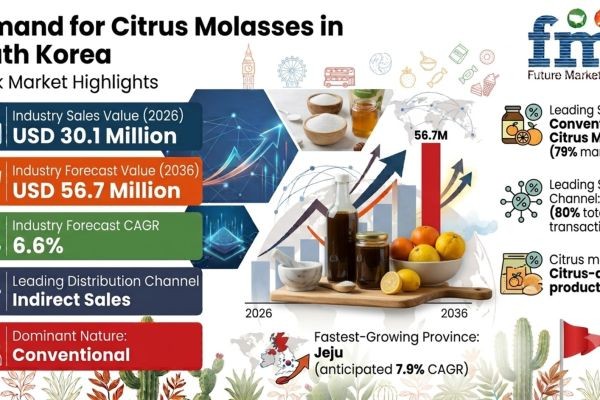
The South Korea Citrus Molasses Market industrial landscape for specialty agricultural byproducts in East Asia is undergoing a notable transformation, according to latest insights by future market insights. The demand for citrus molasses in South Korea is projected to experience a strong and consistent upward trajectory over the next ten years. Valued at an estimated USD 30.1 million in 2026, the market is forecast to reach USD 56.7 million by 2036. This growth represents a compound annual growth rate (CAGR) of 6.6% from 2026 to 2036. This performance underscores a broader macroeconomic shift within South Korea’s manufacturing sectors, where food processors, livestock feed compounders, and industrial biochemical producers are actively seeking out sustainable, sugar-rich, and bio-active substrates to replace conventional refined inputs.
Rather than being a speculative spike, this growth is characterized by an incremental, year-over-year expansion in corporate procurement volumes. The South Korean market is heavily dependent on imported agricultural materials due to native geographic constraints on large-scale sugarcane or sugar beet cultivation. Consequently, industrial buyers are turning their attention toward secondary extraction streams, particularly the nutrient-dense syrups derived from global and domestic citrus processing industries. As sustainability standards tighten and local manufacturers look to balance cost-efficiency with high performance, citrus molasses has transitioned from a localized byproduct into a strategically sought-after industrial commodity.
Request a Sample Report: https://www.futuremarketinsights.com/reports/sample/rep-gb-31225
Quick Market Highlights
- Industry Sales Value (2026): USD 30.1 Million
- Industry Forecast Value (2036): USD 56.7 Million
- Industry Forecast CAGR (2026 to 2036): 6.6%
- Leading Product Segment: Conventional Citrus Molasses, holding a 79% market share
- Leading Sales Channel: Business-to-Business (B2B), accounting for 80% of total transactions
- Fastest-Growing Regional Province: Jeju, leading the nation with an anticipated 7.9% CAGR
- Primary Industrial Applications: Animal Feed, Food and Beverage Formulations, Pulp Production, and Biofuel Manufacturing
- Dominant Global Supply Entities: Lemon Concentrate S.L., Louis Dreyfus Company B.V., Citrusuco S.A., Citromax Group, and Sucocitrico Cutrale Ltd.
Socioeconomic Drivers Fueling the Rise of Citrus-Derived Syrups
The surging demand for citrus molasses in South Korea is deeply connected to structural changes within the nation's domestic supply chains. Historically, South Korean manufacturing has integrated standard molasses varieties into baking syrups, culinary sauces, confectionery treats, and massive industrial fermentation processes. However, volatile global commodity pricing and an intense consumer shift toward functional, clean-label ingredients have pushed industrial formulators to explore fruit-based alternatives. Citrus molasses possesses high residual sugar contents combined with unique citrus polyphenols, natural antioxidants, and essential organic acids, making it highly valuable across multiple sectors.
In the food and beverage industry, a major driver is the ongoing consumer push for wholesome, naturally derived ingredients. South Korean consumers are exceptionally health-conscious and increasingly look past artificial additives or heavy high-fructose corn syrups. Food brands are utilizing the natural color, sweetening power, and distinct flavor profile of citrus molasses to formulate premium jams, specialty glazes, baked goods, and functional beverages.
Concurrently, the agricultural sector provides an equally powerful demand engine. South Korea's livestock and aquaculture industries require highly palatable, calorie-dense ingredients to improve feed intake across animal populations. Citrus molasses improves the flavor profile of mixed feed rations while delivering readily available carbohydrates, which directly supports the growth of specialized feed blends for dairy cattle, swine, poultry, and expanding fish farming networks.
Custom Research Available: https://www.futuremarketinsights.com/customization-available/rep-gb-31225
Analyzing Key Segments: Conventional vs Organic and B2B Dominance
When evaluating the market structure by nature, conventional citrus molasses remains the clear leader, capturing 79% of the total market share. The overwhelming preference for conventional material is tied directly to manufacturing economics. Conventional variants offer a highly reliable supply volume and an attractive price-to-performance ratio, making them the default choice for large-scale production runs in the commercial food processing and animal feed sectors.
Even so, the organic citrus molasses segment is generating significant traction, albeit from a smaller volume baseline. Driven by zero-chemical, sustainable agricultural trends, organic citrus molasses appeals directly to high-end food manufacturers targeting health-focused niches. While organic procurement faces bottlenecks due to stricter international testing and higher certification protocols, it remains a high-margin sector poised for sustained long-term growth as consumer awareness regarding sustainability increases.
In terms of sales channels, Business-to-Business (B2B) transactions command an undisputed 80% of the market. This distribution profile highlights the industrial nature of the product. Citrus molasses is primarily moved in bulk quantities tankers, industrial drums, and large-scale containers—directly to corporate manufacturing plants. Buying in bulk enables South Korean processors to maximize economies of scale, guarantee batch-to-batch consistency, and protect themselves against short-term price spikes.
While B2B remains dominant, the Business-to-Consumer (B2C) retail channel is experiencing steady growth. Health food retail chains and specialized supermarkets are introducing consumer-packaged citrus molasses as a direct alternative to honey or refined agave syrups, capitalizing on consumer interests in home baking and specialized wellness diets.
Provincial Breakdowns Highlight Jeju Island’s Core Importance
The geographical distribution of demand reveals distinct centers of industrial and agricultural activity across South Korea.
Jeju Province stands at the absolute vanguard of the market, projecting the highest regional growth rate with an expected 7.9% CAGR through 2036. Jeju is world-renowned for its native citrus cultivation, particularly its signature premium mandarins and Jeju oranges. Because the island hosts the highest concentration of domestic citrus processing facilities, local waste-valorization systems are highly advanced. Local manufacturers are leveraging this regional abundance to transform citrus peels and processing juices into high-value molasses, feeding directly into regional tourism products, artisanal health foods, and premium beverage lines.
South Gyeongsang follows with a strong 6.9% CAGR. This region possesses a robust, highly developed food processing corridor and a large population density, ensuring a steady, volume-heavy requirement for sweetening agents and bulk industrial syrups across its confectionery and beverage processing plants.
South Jeolla is tracking a stable 6.2% CAGR over the next decade. The province's expansion is driven by a balanced combination of agricultural feed manufacturing plants and growing public-private investments in regional food production hubs.
North Jeolla represents a more conservative but steady 5.2% CAGR. The demand here is tied tightly to its evolving food manufacturing sectors and traditional agricultural base, where companies are gradually upgrading their production lines to accommodate modern, natural sweetening alternatives.
Supply Chain Volatility and Strategic Industrial Pressures
Despite exceptionally bright demand fundamentals, South Korea’s citrus molasses market faces real structural friction. The most pressing challenge is the severe limitation of domestic raw material supply. Because South Korea's commercial citrus farming is heavily localized to Jeju, native yields fluctuate unpredictably based on seasonal weather patterns, typhoons, and changing agricultural acreage. To maintain production stability, South Korean processors must rely heavily on international import channels.
This dependency exposes domestic enterprises to global supply chain shocks, oceanic shipping container backlogs, and raw material price volatility in major citrus-producing nations like Brazil and Spain. Furthermore, citrus molasses faces intense shelf-space competition from deeply entrenched, ultra-low-cost alternatives like corn-derived high-fructose syrups and conventional sugarcane molasses. For suppliers to thrive, they must balance competitive volumetric pricing with ironclad quality certifications, clear chemical traceability, and reliable shipping timelines.
Competitive Landscape Focused on Traceability and Analytical Metrics
The business environment in South Korea is becoming intensely competitive, centering on certified technical metrics rather than mere volume production. Global supply giants are forming exclusive domestic distribution partnerships to ensure direct access to South Korea’s major feed mills and corporate food conglomerates.
Leading global entities like Lemon Concentrate S.L. maintain a powerful market foothold by distributing deeply detailed technical brochures that explicitly map out sugar profiles, precise viscosity ratings, and clear application playbooks for both human nutrition and animal feed lines. Similarly, Louis Dreyfus Company B.V. leverages its vast international logistics network to market highly traceable citrus byproducts, assuring corporate buyers of long-term supply security. Citrosuco S.A. commands significant market share by offering massive industrial volumes characterized by highly standardized Brix values and optimized acid ratios tailored for complex food formulations. Meanwhile, the specialized literature from Citromax Group and Sucocitrico Cutrale Ltd. focuses on structural material consistency and robust analytical data regarding macro-nutritional profiles, allowing South Korean procurement managers to achieve predictable production yields across every single manufacturing run.
Exclusive Discounts on Full Report: https://www.futuremarketinsights.com/reports/demand-for-citrus-molasses-in-south-korea
Future Outlook: Supply Chain Diversification Counterbalances Commodity Challenges
Looking toward 2036, South Korea’s citrus molasses marketplace is positioned for highly resilient, value-driven development, though operators must navigate several structural challenges. The primary obstacle remains the inherent price volatility of global agricultural commodities. Because raw material availability depends on citrus crop yields in major international cultivation hubs, international trade shocks, climate fluctuations, and maritime freight variations can directly squeeze procurement budgets for mid-sized South Korean manufacturers. Furthermore, intensive competition from low-cost alternative sweeteners, such as high-fructose corn syrup (HFCS) and basic sugarcane molasses, requires suppliers to continuously highlight the unique bioactive advantages of citrus-derived syrups.
To secure future market share, forward-thinking operators are actively focusing on supply chain diversification, establishing long-term, multi-regional purchasing contracts to shield themselves from localized crop failures. The market is also preparing for a significant wave of technical innovation, with manufacturing facilities upgrading their concentration and filtration setups to offer highly customized, tailored molasses blends. As South Korea's food and agricultural sectors continue to mature under strict environmental and wellness standards, the long-term demand for citrus molasses remains exceptionally bright, validating its status as an indispensable, sustainable standard across modern East Asian manufacturing.
Why Choose FMI: https://www.futuremarketinsights.com/why-fmi
Explore More Related Studies Published by FMI Research
L-Carnitine Feed Additive Market : https://www.einpresswire.com/article/903343375/l-carnitine-feed-additive-market-to-reach-usd-2-35-billion-by-2036-on-rising-feed-efficiency-demand-by-fmi-report
Anti-Stress Feed Supplements Market : https://www.openpr.com/news/4526663/anti-stress-feed-supplements-market-to-reach-usd-1-473-16
Postnatal Nutrition Market : https://www.openpr.com/news/4528157/postnatal-nutrition-market-to-reach-usd-1-771-29-million-by-2036
Explore In-Depth Food & Beverage Market Insights : https://www.futuremarketinsights.com/industry-analysis/food-and-beverage
About Future Market Insights (FMI)
Future Market Insights, Inc. (FMI) is an ESOMAR-certified, ISO 9001:2015 market research and consulting organization trusted by global enterprises and Fortune 500 companies. FMI delivers actionable market intelligence, competitive benchmarking, and strategic insights across more than 30 industries and 1,200 markets worldwide.
Contact Us
Future Market Insights Inc.
Christiana Corporate, 200 Continental Drive,
Suite 401, Newark, Delaware - 19713, USA
T: +1-347-918-3531
For Sales Enquiries: sales@futuremarketinsights.com
Website: https://www.futuremarketinsights.com






