
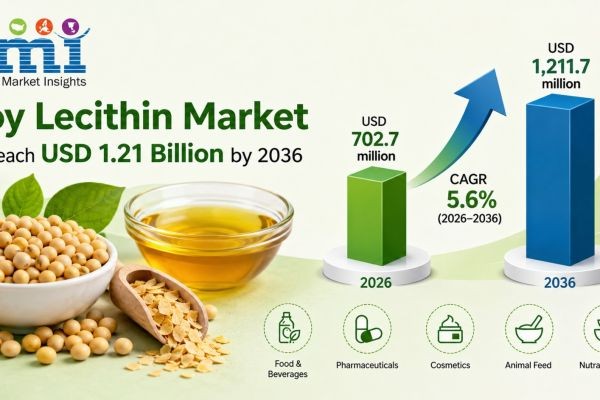
The global soy lecithin market is entering a "Consolidation and Clean-Label Convergence" phase, according to latest insights by Future Market Insights. Upstream oilseed processor mergers are concentrating raw material supply, while downstream food, beverage, and pharmaceutical CPG manufacturers demand traceable, non-GMO, and EUDR-compliant (EU Deforestation Regulation) lecithin grades that command significant pricing premiums over commodity emulsifiers.
The global market, valued at USD 665.4 million in 2025, is estimated to reach USD 702.7 million in 2026. Advancing at a Compound Annual Growth Rate (CAGR) of 5.6% over the ten-year forecast period, total market valuation is projected to achieve USD 1,211.7 million by 2036, delivering an absolute incremental opportunity of USD 509.0 million.
Request a Sample Report: https://www.futuremarketinsights.com/reports/sample/rep-gb-1350
Market Performance Overview (2026–2036)
To map out the primary product types, core functional properties, end-user industry channels, and regional growth vectors guiding this USD 509.0 million market scale-up, key segment allocations highlight where global commercial demand is concentrated:
- Food Type Segment (30.2% share): Commands the leading product category in 2026, driven by extensive utilization in bakery, confectionery (chocolate viscosity control), dairy alternatives, and processed food emulsification.
- Emulsifiers Function Segment (25.5% share): Represents the primary functional application, anchored by oil-water phase stabilization requirements across food processing, infant nutrition, and pharmaceutical formulations.
- Food End-User Segment (38.7% share): Dominates end-use channels over feed, pharmaceutical, paint, and plastics industries, supported by the rapid clean-label replacement of synthetic chemical emulsifiers with plant-derived phospholipids.
- China & India Regional Growth Leadership: Lead national expansion rates at 6% CAGR and 7.0% CAGR respectively through 2036, driven by massive domestic soybean crushing capacity additions, CPG food processing expansion, and liposomal pharmaceutical excipient demand.
Technical Drivers and Supply Chain Consolidation
The commercial expansion of soy lecithin across mass food processing and pharmaceutical excipient lines is propelled by three primary industry catalysts:
Clean-Label Substitution of Synthetic Emulsifiers
Food manufacturers are actively reformulating processed foods to remove artificial emulsifiers (such as mono- and diglycerides or polysorbates). Plant-derived soy lecithin offers a natural, highly functional phospholipid complex that stabilizes emulsions, modifies viscosity, and improves dough machinability while keeping ingredient lists clean.
Upstream Oilseed Crusher Consolidation
Major M&A transactions among agricultural processing giants such as Bunge's merger with Viterra and Bunge's acquisition of IFF's soy lecithin/protein processing assets are concentrating lecithin origination among fewer suppliers. Mid-tier food manufacturers must navigate increased procurement dependency by securing multi-origin supply contracts.
EUDR Compliance and Non-GMO Premiums
With the enforcement of EUDR deforestation-free sourcing mandates and rising demand for Non-GMO Project Verified ingredients in North America and Europe, identity-preserved (IP) soy lecithin grades command $15\text{--}40\%$ price premiums over conventional commodity lecithin.
Industrial Constraints & Raw Material Volatility
Soy lecithin refiners and commercial procurement teams navigate specific operational hurdles:
- Soybean Crushing Yields and Feedstock Volatility: Lecithin is extracted as a natural co-product during soybean oil refining ($\sim 1\text{--}3\%$ yield by oil weight). Global soybean spot prices, regional crushing margins, and meal/oil demand fluctuations directly impact crude lecithin feedstock availability and pricing.
- Allergen Labeling Mandates: Regulatory requirements (such as EU Regulation 1169/2011) mandate clear soy allergen declarations on CPG packaging, prompting some niche natural food brands to evaluate alternative sunflower or rapeseed lecithin formulations where pricing permits.
Regional Growth Profile
Regional demand reflects clean-label reformulation in mature Western markets alongside rapid soybean processing and food-tech expansion in Asia and South America:
- China (7.6% CAGR): The global growth frontrunner, leveraging its status as the world's largest soybean importer to expand domestic lecithin extraction, infant formula fortification, and liposomal API drug delivery manufacturing.
- India (7.0% CAGR): Spurring rapid volume growth through domestic soybean crushing expansions in Madhya Pradesh and Maharashtra (supported by ADM/Bayer sustainable farming initiatives) and local pharmaceutical excipient processing.
- Germany (6.4% CAGR) & France (5.9% CAGR): Leading European market demand, driven by strict non-GMO certification, clean-label CPG bakery/chocolate reformulations, and EUDR compliance requirements.
- United States (4.8% CAGR): Driven by plant-based meat and dairy alternative proliferation, FDA GRAS ingredient status, and Midwest integrated crushing-to-refining operations (Cargill, ADM, Bunge).
- Brazil (4.2% CAGR): Anchored by massive origin soybean processing in Mato Grosso and Pará states, exporting EUDR-compliant certified lecithin to European and Asian food processors.
Competitive Landscape
The global soy lecithin landscape is characterized by integrated ABCD oilseed crushing conglomerates at the upstream level and specialized phospholipid refiners at the downstream level.
Key market participants profiled in the report include Cargill Inc (holding ~18% US market share), Archer Daniels Midland Company (ADM), Bunge Global SA, LASENOR EMUL, DuPont de Nemours, Lecico GmbH, Wilmar International, Ruchi Soya Industries Ltd (Patanjali Foods), and Ceresking Ecology and Technology Co. Ltd. Major players compete by securing identity-preserved non-GMO soybean acreage, offering specialized de-oiled/hydrolyzed lecithin powders, and obtaining pharmaceutical GMP certifications.
Exclusive Discounts on Full Report: https://www.futuremarketinsights.com/reports/soy-lecithin-market
Frequently Asked Questions
What is the projected valuation of the global soy lecithin market by 2036?
The global soy lecithin market is projected to reach USD 1,211.7 million by 2036, expanding from an estimated baseline valuation of USD 702.7 million in 2026 at a CAGR of 5.6%.
Why does the Food Type segment command a 30.2% market share?
The food type segment leads product categories in 2026 because of soy lecithin's indispensable role as an emulsifier, release aid, and texture modifier across bakery, chocolate, confectionery, dairy alternatives, and processed foods.
What functional property dominates soy lecithin applications?
Emulsification holds a 25.5% market share of total functional demand in 2026, as food and pharmaceutical manufacturers rely on lecithin's natural amphiphilic phospholipids to stabilize oil-in-water and water-in-oil mixtures.
FMI Custom Research: Strategic Intelligence for Confident Decision-Making
In today's rapidly evolving business environment, leadership teams need clear, actionable intelligence tailored to their strategic objectives. FMI's Custom Research solutions are designed around specific business questions, enabling executives to evaluate growth opportunities, validate investments, assess competitive dynamics, and reduce uncertainty before making critical decisions.
Key Executive Benefits
- Decision-Ready Insights: Research tailored to your specific business challenges, growth plans, and investment priorities.
- Reduced Strategic Risk: Validate market opportunities, customer demand, and competitive positioning before committing resources.
- Market Entry Confidence: Assess opportunity size, regulatory barriers, channel dynamics, and competitive landscapes with precision.
- Competitive Advantage: Gain proprietary intelligence unavailable through syndicated reports or internal datasets.
- Faster Growth Decisions: Accelerate expansion, product development, portfolio optimization, and investment planning.
- Primary Market Validation: Access real-world customer, buyer, and stakeholder insights that support high-confidence decision-making.
Business Impact
FMI helps organizations transform market complexity into strategic clarity, enabling leadership teams to identify growth opportunities faster, optimize resource allocation, strengthen competitive positioning, and make high-stakes business decisions with confidence.
To explore how FMI Custom Research can support your strategic priorities, connect with our team at - sales@futuremarketinsights.com
About Future Market Insights (FMI)
Future Market Insights (FMI) delivers actionable, decision-focused market intelligence that goes beyond traditional research reports. The company provides:
- In-depth pricing and cost benchmarking analysis
- Demand forecasting based on real industry inputs
- Procurement and buyer behavior insights
- Supply chain and trade flow intelligence
- Technology and application trend analysis across industries
FMI follows a robust bottom-up research methodology, combining insights from industry experts, procurement leaders, manufacturers, and technical professionals to ensure accurate and practical market intelligence.






