
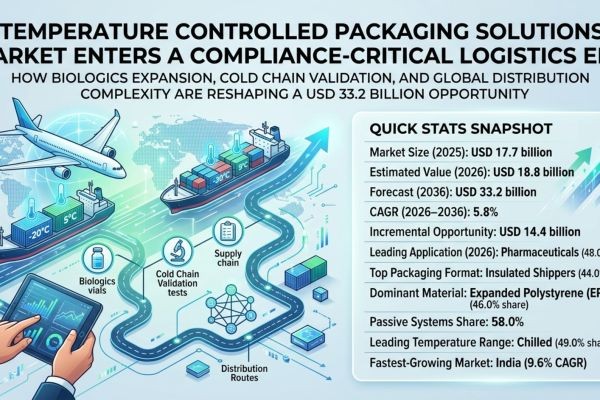
The global temperature controlled packaging solutions market is transitioning from a cost-driven logistics function to a compliance-critical infrastructure layer within pharmaceutical and food supply chains. As biologics, vaccines, and temperature-sensitive formulations scale globally, packaging is no longer a passive container it is an engineered system responsible for maintaining product integrity across increasingly complex distribution networks. Regulatory scrutiny, longer transit routes, and the rise of decentralized delivery models are forcing companies to rethink how thermal protection is designed, validated, and deployed.
Quick Stats Snapshot
• Market Size (2025): USD 17.7 billion
• Estimated Value (2026): USD 18.8 billion
• Forecast (2036): USD 33.2 billion
• CAGR (2026–2036): 5.8%
• Incremental Opportunity: USD 14.4 billion
• Leading Application (2026): Pharmaceuticals (48.0% share)
• Top Packaging Format: Insulated Shippers (44.0% share)
• Dominant Material: Expanded Polystyrene (EPS) (46.0% share)
• Passive Systems Share: 58.0%
• Leading Temperature Range: Chilled (49.0% share)
• Fastest-Growing Market: India (9.6% CAGR)
Market Size and Forecast
The temperature controlled packaging solutions market is projected to expand from USD 18.8 billion in 2026 to USD 33.2 billion by 2036, reflecting a steady CAGR of 5.8%. This growth is underpinned by structural changes in pharmaceutical logistics, where maintaining precise temperature ranges is directly linked to regulatory compliance and product viability.
Rather than rapid expansion, the market reflects disciplined, necessity-driven growth. Increasing reliance on validated packaging systems especially for shipments exceeding 72 to 96 hours—is redefining procurement priorities. The shift is less about scaling volume and more about ensuring thermal reliability across global supply chains.
Growth Drivers: Why Thermal Packaging Is Becoming Mission-Critical
- Expansion of Biologics and Vaccine Distribution
Pharmaceuticals account for 48% of total demand, driven by the sensitivity of biologics and vaccines to temperature fluctuations. Even minor deviations can result in product rejection and regulatory penalties. - Regulatory Enforcement and Compliance Standards
Stricter implementation of Good Distribution Practices (GDP) is forcing companies to replace unverified cooling methods with validated, performance-tested packaging systems. - Growth of Global Cold Chain Logistics
Long-haul international shipments and decentralized clinical trials require packaging systems capable of maintaining stable internal temperatures without intervention. - Rise of Passive Thermal Systems
Passive systems, accounting for 58% share, are increasingly preferred due to their cost efficiency and independence from external power sources.
Key Challenges: Where Operational Complexity Persists
- Thermal Reliability vs Cost Trade-Off: Advanced packaging systems significantly increase upfront costs, particularly for low-margin shipments.
• Integration with Legacy Systems: Limited compatibility with existing warehouse and tracking systems slows adoption of reusable and smart packaging formats.
• Material Limitations: EPS remains dominant, but sustainability concerns and thermal limitations require integration with phase change materials (PCM).
• Reverse Logistics Constraints: Reusable systems depend heavily on efficient recovery and redeployment cycles, which remain underdeveloped in many regions.
Emerging Opportunities: Where Strategic Value Is Being Created
Telemetry-Enabled Smart Packaging
Integration of real-time temperature monitoring and cellular tracking is enabling higher visibility and compliance assurance, particularly for high-value therapies.
Sustainable Material Innovation
Development of compostable and recyclable insulation materials is addressing mounting environmental concerns, especially in healthcare waste management.
Closed-Loop Logistics Systems
End-to-end recovery, sanitization, and redeployment programs are emerging as a competitive differentiator for logistics providers.
Advanced Phase Change Materials (PCM)
Next-generation PCM solutions are improving thermal stability for extended-duration shipments, particularly in extreme climates.
Segmentation Insights
By Application
• Pharmaceuticals (48%) dominate due to strict temperature control requirements and high product sensitivity.
• Food logistics and e-commerce grocery create secondary demand, particularly for perishable goods.
• Vaccines represent a high-value, compliance-driven segment with stringent thermal requirements.
By Packaging Format
• Insulated shippers (44%) lead due to compatibility with parcel-based delivery models.
• Containers and pallet shippers are used for bulk and long-haul transport.
• Modular formats enable standardized packing and reduce operational variability.
By Material
• EPS (46%) remains dominant due to cost efficiency and structural durability.
• PU foam and fiber insulation are used selectively based on performance requirements.
• PCM materials are increasingly integrated for extended thermal control.
Regional Analysis: Compliance, Scale, and Infrastructure Define Growth
North America: Compliance-Driven Market Leadership
The United States leads with a CAGR of 6.8%, driven by strict regulatory oversight and high biologics volume. Packaging systems are treated as critical compliance infrastructure.
Europe: Regulation and Cross-Border Complexity
Germany (6.2%) and the United Kingdom (4.3%) emphasize extended-duration thermal performance due to cross-border logistics challenges and regulatory enforcement.
Asia-Pacific: Manufacturing and Export Expansion
• India (9.6% CAGR): Fastest-growing market, driven by pharmaceutical exports and automation in packaging lines.
• China (8.8% CAGR): Growth supported by investment in biologics and cold chain infrastructure.
• Japan (5.9% CAGR): Focus on compact, high-efficiency thermal solutions for urban healthcare delivery.
Latin America: Vaccine Distribution and Infrastructure Growth
Brazil (7.2%) leads regional growth, supported by expansion in immunization programs and healthcare logistics.
Competitive Landscape: Validation and Reliability Define Leadership
The market is moderately consolidated, with key players including Sonoco ThermoSafe, Cold Chain Technologies, Sealed Air, Softbox Systems, Pelican BioThermal, va-Q-tec, and Sofrigam.
Competitive advantage is determined by:
• Proven thermal validation and testing capabilities
• Ability to support long-duration shipments (72–96+ hours)
• Integration of phase change materials and advanced insulation
• Scalable manufacturing and global distribution networks
High entry barriers persist due to stringent validation requirements and the risk associated with unproven systems.
Strategic Implications for Industry Stakeholders
- For Pharmaceutical Companies: Packaging selection directly impacts regulatory compliance, product integrity, and financial risk.
• For Logistics Providers: Investment in validated, reusable thermal systems is becoming essential for long-term competitiveness.
• For Procurement Leaders: Decision-making must balance cost, reliability, and compliance assurance.
• For Material Innovators: Sustainable insulation solutions represent a critical innovation frontier.
Future Outlook: Reliability Will Define Market Leadership
The next phase of growth in temperature controlled packaging will be defined by reliability under real-world conditions. As shipment durations extend and product sensitivity increases, packaging systems must deliver consistent performance across diverse environments.
Sustainability will gain importance, but only solutions that maintain strict thermal integrity will achieve widespread adoption. The convergence of smart monitoring, reusable systems, and advanced materials is expected to redefine cold chain logistics over the next decade.
Executive-Level Takeaways
- The market is projected to reach USD 33.2 billion by 2036, driven by pharmaceutical demand and compliance requirements.
• Thermal reliability not cost is the primary decision driver in packaging selection.
• Insulated shippers dominate due to alignment with decentralized and parcel-based logistics models.
• EPS remains dominant, but sustainability pressures will accelerate material innovation.
• Asia-Pacific leads growth, while North America and Europe define regulatory standards.
• Smart packaging and closed-loop systems represent the next wave of competitive differentiation.
Full Report View: https://www.futuremarketinsights.com/reports/temperature-controlled-packaging-solutions-market






