
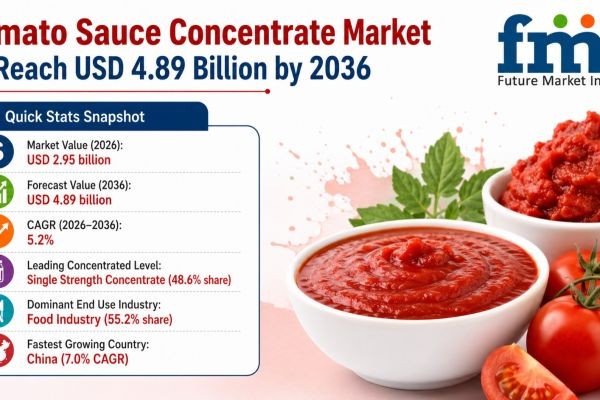
The global tomato sauce concentrate market is undergoing steady structural expansion, evolving as a fundamental B2B ingredient category across the industrial food processing and foodservice sectors, according to latest insights by future market insights. As convenience food production, quick-service restaurant (QSR) networks, and global Mediterranean dining trends scale, industrial demand for standardized, shelf-stable tomato bases has surged. The global market, valued at USD 2.80 billion in 2025, is projected to reach USD 2.95 billion in 2026. Progressing at a Compound Annual Growth Rate (CAGR) of 5.20% over the ten-year forecast period, the total industry valuation is anticipated to achieve USD 4.89 billion by 2036, opening an absolute incremental opportunity of USD 1.94 billion.
Request a Sample Report: https://www.futuremarketinsights.com/reports/sample/rep-gb-25687
Market Performance Overview (2026–2036)
To understand the core concentration levels and primary transactional pathways guiding this USD 1.94 billion market scale-up, a detailed segment share analysis highlights where commercial value is concentrated:
- Single Strength Concentrate (48.6% level share): Dominates the concentration framework in 2026, serving as the foundational base-grade ingredient (8 to 12 Brix) for mass-market ketchup, pizza sauce, and packaged soup manufacturing where water ratio adjustment occurs during final blending.
- Food Industry End Use (55.2% industry share): Commands the end-use sector, driven by large-scale commercial processors utilizing bulk tomato concentrate for ready-to-eat meals, canned soups, and bottled condiments.
- Direct Sales Distribution Channel (42.3% channel share): Leads the distribution architecture, anchored by annual B2B contract negotiations between industrial food conglomerates and primary tomato processing plants.
Technical Drivers and Sourcing Catalysts
The rapid alignment of the global tomato sauce concentrate sector into automated food production lines is propelled by distinct industrial and supply chain catalysts:
Industrial Kitchen Workflows and Brix Standardization
Food manufacturers and QSR chains require raw ingredient consistency in viscosity, pH, color, and sugar solids (Brix). Concentrated tomato bases allow factory formulators to maintain uniform taste profiles batch-to-batch while significantly lowering transit and storage costs compared to handling raw fresh tomatoes.
Mitigation of Cold-Chain Requirements in Emerging Markets
In developing food processing hubs, sourcing single-strength, double-strength (22 to 28 Brix), or triple-strength (36 to 40 Brix) concentrates eliminates the need for expensive cold-chain logistics required for fresh fruit. Processing facilities can store ambient bulk aseptic totes for extended periods without ingredient degradation.
Multi-Region Sourcing to Hedge Agricultural Risk
Global processing tomato supply remains heavily concentrated in California, Mediterranean Europe (Italy, Spain, Portugal), and the Xinjiang region in China. Severe heatwaves, water scarcity, and climate-driven crop yield fluctuations compel procurement directors to hedge supply risks by establishing multi-region origin contracts and forward pricing agreements.
Industrial Infrastructure Challenges
Global tomato processors and procurement directors face distinct operational friction points:
- Energy-Intensive Evaporation Operations: Dehydrating raw pulp to high Brix levels requires heavy thermal energy usage. Rising energy tariffs pressure processing margins, forcing plants to invest in mechanical vapor recompression (MVR) and energy-efficient evaporation systems.
- Seasonal Harvest Compression: Because processing tomatoes are harvested during narrow annual windows, primary processing plants must run at maximum throughput during harvest season, creating intense seasonal inventory and working capital requirements.
Regional Growth Outlook
The geographic analysis highlights rapid volume growth in developing Asian food manufacturing corridors alongside steady, value-focused demand across mature OECD markets:
- China (7.00% CAGR): The global growth frontrunner, driven by massive domestic processing capacity in Xinjiang, expanding urban fast-food chains, and surging domestic packaged food manufacturing.
- India (6.50% CAGR): Spurring rapid expansion via urbanization, rising adoption of ready-to-cook cooking bases, and expanding modern retail and QSR networks.
- Germany (6.00% CAGR): Leading European market activity under strict regulatory and hygienic standards, focusing on high-Brix, organic, and clean-label concentrate imports.
- France (5.50% CAGR): Driven by steady industrial demand for high-quality, traceable European-origin tomato bases used in retail canned goods and gourmet sauces.
- United Kingdom (4.90% CAGR): Supported by ready-meal manufacturing, convenience food expansion, and private-label grocery developments.
- United States (4.40% CAGR): Maintaining a dominant baseline market footprint, anchored by California's processing infrastructure and stable B2B demand from national ketchup and pizza sauce brands.
- Brazil (3.90% CAGR): Showing steady development supported by expanding regional processed food capacity and retail condiment demand.
Competitive Landscape
The global tomato sauce concentrate landscape features a combination of vertically integrated agricultural processors and multinational food ingredient houses. High-throughput extraction, global distribution scale, and B2B contract dominance are held by industry leaders including ConAgra Brands, Del Monte Foods, Kraft Heinz Company, Symrise AG, GNT Group, AGRANA Group, Kagome Co., Ltd., Campbell Soup Company, Hunt's, Red Gold, and Mutti S.p.A.
Regional processors and technical supply specialists such as Chitale Agro, ARIZONA CITRUS PRODUCTS, Shimla Hills Offerings Pvt. Ltd., and AMOREAL are capturing value by delivering specialized non-GMO, organic certified, and custom-Brix formulations for niche food manufacturers.
Exclusive Discounts on Full Report: https://www.futuremarketinsights.com/reports/tomato-sauce-concentrate-market
Frequently Asked Questions
What is the projected valuation of the global market by 2036?
The global tomato sauce concentrate market is projected to reach USD 4.89 billion by 2036, expanding from an estimated baseline valuation of USD 2.95 billion in 2026 at a CAGR of 5.20%.
Why does Single Strength Concentrate lead the market share?
Single strength concentrate holds 48.6% of the market because its 8 to 12 Brix soluble solids level provides an ideal, highly flexible base for high-volume industrial ketchup, soup, and pizza sauce formulations.
What exclusions govern the physical boundaries of this market report?
The scope strictly limits its focus to industrially processed tomato sauce concentrates, explicitly excluding fresh tomatoes, sun-dried tomatoes, canned whole or diced tomatoes, retail consumer tomato paste in tubes/small cans (unless classified as concentrate by Brix level), and tomato-based drinks like juice.
FMI Custom Research: Strategic Intelligence for Confident Decision-Making
In today's rapidly evolving business environment, leadership teams need more than market data they need clear, actionable intelligence tailored to their strategic objectives. FMI's Custom Research solutions are designed around the specific business questions organizations need answered, enabling executives to evaluate growth opportunities, validate investments, assess competitive dynamics.
Key Executive Benefits
- Decision-Ready Insights tailored to business priorities
- Reduced Strategic Risk through validated market intelligence
- Market Entry Confidence with detailed competitive analysis
- Competitive Advantage supported by proprietary research
- Faster Growth Decisions through customized strategic insights
- Primary Market Validation from industry stakeholders
- Global Industry Expertise across diverse sectors
- Proven Track Record with thousands of consulting engagements
Business Impact
FMI helps organizations transform market complexity into strategic clarity, enabling leadership teams to identify growth opportunities faster, optimize resource allocation, strengthen competitive positioning, and make high-stakes business decisions with confidence.
To explore how FMI Custom Research can support your strategic priorities, please connect with our team at - sales@futuremarketinsights.com






