
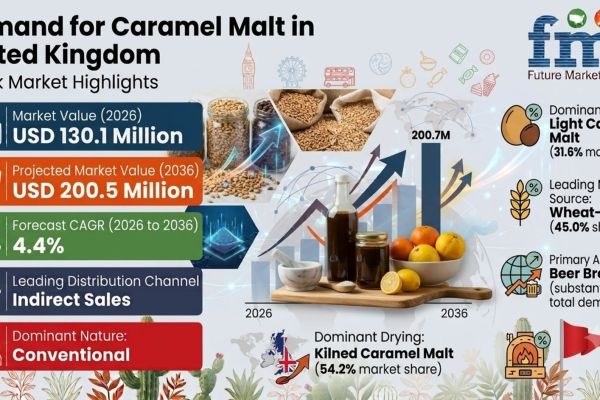
The United Kingdom Caramel Malt Market industrial landscape for specialty brewing grains and natural texturizing ingredients across the British Isles is undergoing a significant transformation, according to latest insights by future market insights. Driven by a nationwide push toward premium independent brewing, artisanal food processing, and a widespread shift away from synthetic colorants, the demand for caramel malt in the United Kingdom is charting a highly lucrative trajectory. Economic projections indicate that the market is poised to grow from a valuation of USD 130.1 million in 2026 to an impressive USD 200.5 million by 2036. This expansion reflects a robust compound annual growth rate (CAGR) of 4.4% over the ten-year forecast period.
Rather than acting as a simple bulk commodity, caramel malt a specialty grain processed under controlled conditions to crystallize internal starches into unfermentable sugars has evolved into an indispensable raw material. Its expansion is closely tied to its multi-functional utility as a natural flavoring agent, color standardizer, and mouthfeel enhancer. As consumers increasingly demand transparent, high-quality, and clean-label formulations, purchasing teams are actively optimizing their raw material supply chains. Market participants are prioritizing long-term contracts with trusted maltsters who can guarantee batch-to-batch consistency and documented quality metrics.
Request a Sample Report: https://www.futuremarketinsights.com/reports/sample/rep-gb-31138
Quick Market Highlights
- Market Value (2026): USD 130.1 Million
- Projected Market Value (2036): USD 200.5 Million
- Forecast CAGR (2026 to 2036): 4.4%
- Dominant Color Segment: Light Caramel Malt with a 31.6% market share
- Leading Material Source: Wheat-based caramel malt, commanding a 45.0% share
- Primary Application Sector: Beer Brewing, capturing a substantial 56% of total demand
- Dominant Drying Method: Kilned Caramel Malt, leading with a 54.2% market share
- Top Competing Global & Domestic Maltsters: Bairds Malt Limited, Weyermann, Castle Malting, Thomas Fawcett Malting, Great Western Malting
The Microbrewery Boom and Flavor Differentiation Fuel Market Growth
The sustained upward momentum of the United Kingdom’s caramel malt sector is fundamentally anchored by its widespread application across the beverage sector. Historically, caramel malt was primarily utilized by regional heritage breweries to construct traditional British ales, porters, and stouts. However, the continuous proliferation of microbreweries, regional brewpubs, and independent craft operations has vastly expanded the ingredient's application envelope. Contemporary brewers rely on complex malt bills intentionally blending light, medium, and dark caramel malt variants to achieve highly specific sensory profiles, ranging from delicate toffee and candy-like notes to intense roasted and burnt sugar expressions.
Concurrently, the manufacturing landscape is experiencing an influx of non-beer applications as industrial food formulators discover the raw material's versatility. In the commercial baking and confectionery sectors, caramel malt functions as an ideal clean-label alternative to artificial brown dyes and corn-derived syrups. Food processors systematically integrate finely ground malt flours and extracts into specialty artisan breads, premium cookies, savory table sauces, and rich dairy desserts like yogurts and ice creams. This allows them to achieve deep golden-to-amber visual tones and complex caramel flavor notes while maintaining consumer-friendly ingredient declarations that align with modern retail transparency initiatives.
Custom Research Available: https://www.futuremarketinsights.com/customization-available/rep-gb-31138
Kilned Processing and Bulk Wheat Sourcing Dominate Production Lines
An inspection of material categorization reveals that kilned caramel malt remains the foundational standard for commercial buyers, holding a commanding 54.2% market share. The primary driver behind this dominance is process versatility. Kilning allows maltsters to apply precise, highly controlled thermal curves to moist green malt, encouraging enzymatic saccharification before gently drying the grain. This method yields a highly uniform sugar crystal structure that imparts a reliable, mild sweetness and brilliant clarity to finished liquids, outperforming intensive roasting techniques that are typically reserved for specialized, ultra-dark beer styles.
From a raw material standpoint, wheat has emerged as the leading source segment, accounting for 45.0% of the total market in 2026. Wheat-derived caramel malts are highly favored for their unique protein matrix, which directly enhances foam stability and head retention in commercial beers while imparting a silky, rounded mouthfeel to non-alcoholic functional beverages. Structurally, the marketplace is heavily driven by industrial B2B supply agreements, with microbreweries and large-scale manufacturing conglomerates executing bulk, palletized, or silo-loaded grain purchases. Meanwhile, light caramel malt variants dominate the color taxonomy, selected by formulators for their ability to add a subtle candy-like sweetness without over-coloring delicate beer and food recipes.
Regional Analysis Highlights England as the Primary Hub of Malt Consumption
The geographical distribution of caramel malt utilization across the United Kingdom highlights distinct regional industrial clusters that dictate purchasing velocity over the forecast period.
England stands out as the absolute engine of market growth, maintaining the highest projected expansion rate with a 4.9% CAGR. As the largest population center and the historical home of traditional English bitter and pale ale production, the country hosts a dense network of commercial breweries, high-capacity bakeries, and industrial sauce processing plants. English manufacturers are heavily driving innovation in seasonal and limited-edition product releases, generating consistent, high-volume procurement patterns for specialty grains.
Scotland follows with a strong projected CAGR of 4.3% through 2036. The Scottish marketplace is deeply influenced by a robust heritage of independent craft brewing and industrial distilling operations. Local brewers actively seek out specialized caramel malts to formulate rich, heavy Scottish ales and contemporary craft lagers, while regional food producers utilize malt extracts to enrich traditional shortbreads and regional baked goods.
Wales showcases a reliable growth path with an anticipated CAGR of 4.0%. The Welsh market is propelled by a thriving network of artisanal food producers and independent microbreweries focused on local sourcing and regional traceability. Welsh operators favor clean-label ingredients to meet the rising consumer appetite for high-quality, sustainably produced goods.
Northern Ireland represents a stable, developing market segment, expanding at a calculated CAGR of 3.5%. Growth is primarily generated by steady expansions within regional dairy cooperatives, industrial bakeries, and a growing independent brewpub scene across major urban corridors, where caramel malt is valued for its texturizing and sweetening properties.
Competitive Landscape Centers on Strict Technical Specifications and Material Traceability
Because consistency is absolutely vital to the automated processing lines of modern breweries and food manufacturing plants, competitive dynamics among leading maltsters center strictly on measurable performance metrics rather than simple volume discounting. Technical procurement teams analyze detailed supplier documentation to closely monitor specific parameters, including European Brewery Convention (EBC) color ratings, moisture percentages, friability, and overall extract potential.
Bairds Malt Limited maintains a leading position within the domestic UK supply chain, offering an expansive portfolio of locally sourced malt grades supported by robust analytical data sheets outlining precise flavor and color contributions. Weyermann stands out as a dominant international supplier, providing highly specialized caramel malt variants backed by meticulous lot-by-lot specification sheets that allow brewers to plan intricate recipe formulations with mathematical certainty.
Similarly, Castle Malting focuses its competitive efforts on delivering exceptional grain modification and uniform kernel sizing, giving plant engineers predictable mash tun performance. Thomas Fawcett Malting remains highly revered for its traditional malting expertise, providing premium roasted and kilned profiles with documented extract metrics that appeal directly to top-tier craft brewers and craft distillers. Meanwhile, Great Western Malting maintains a reliable distribution network, anchoring its market footprint with specialized consumer guides and strict quality assurance certifications that streamline compliance for multi-facility commercial operations.
Exclusive Discounts on Full Report: https://www.futuremarketinsights.com/reports/united-kingdom-caramel-malt-market
Future Outlook: Quality Assurance Mitigates Commodity Volatility
Looking toward 2036, the United Kingdom’s caramel malt marketplace is positioned for highly resilient, steady development, though suppliers and buyers must actively navigate specific structural headwinds. The primary obstacle involves the raw material cost volatility of malting barley and wheat. Global harvest fluctuations, erratic weather patterns, shifting agricultural subsidy policies, and maritime transport inflation can inject significant unpredictability into procurement budgets, particularly for independent microbreweries operating on restricted margins. Furthermore, changing consumer wellness trends that lean toward ultra-light, low-carbohydrate, or gluten-free alternatives require maltsters to continually innovate and diversify their grain offerings.
To insulate themselves from these market pressures, forward-thinking UK brewers and food manufacturers are increasingly forming strategic, long-term sourcing partnerships with regional agricultural cooperatives, prioritizing local supply resilience and reduced transport carbon footprints. Simultaneously, processing facilities are refining their roasting and kilning setups to offer highly customized, tailored malt profiles designed for modern, low-alcohol and functional beverage formulations. As the British food and beverage sectors continue to solidify around premiumization, authenticity, and natural ingredient profiles, the long-term demand for high-quality caramel malt remains exceptionally bright, ensuring its status as a foundational element of UK industrial food design.
Why Choose FMI: https://www.futuremarketinsights.com/why-fmi
Explore More Related Studies Published by FMI Research
Collagen-Rich Bone Broth Powder Market : https://www.einpresswire.com/article/903342967/collagen-rich-bone-broth-powder-market-to-reach-usd-3-37-billion-by-2036-on-rising-clinical-nutrition-demand
Dog Food Topper Market : https://www.openpr.com/news/4528161/dog-food-topper-market-to-reach-usd-14-53-billion-by-2036-as-pet
Premixed Cocktail Shots Market : https://www.openpr.com/news/4528165/premixed-cocktail-shots-market-to-reach-usd-8-494-89-million
Explore In-Depth Food & Beverage Market Insights : https://www.futuremarketinsights.com/industry-analysis/food-and-beverage
About Future Market Insights (FMI)
Future Market Insights, Inc. (FMI) is an ESOMAR-certified, ISO 9001:2015 market research and consulting organization trusted by global enterprises and Fortune 500 companies. FMI delivers actionable market intelligence, competitive benchmarking, and strategic insights across more than 30 industries and 1,200 markets worldwide.
Contact Us
Future Market Insights Inc.
Christiana Corporate, 200 Continental Drive,
Suite 401, Newark, Delaware - 19713, USA
T: +1-347-918-3531
For Sales Enquiries: sales@futuremarketinsights.com
Website: https://www.futuremarketinsights.com






