
The United Kingdom's pea grits market is gathering significant momentum as food manufacturers seek out functional, non-allergenic, and clean-label alternatives to traditional grain and soy ingredients. Driven by an accelerating shift toward plant-based nutrition, high-fiber diets, and local sustainability sourcing, the market is projected to expand from USD 133.7 million in 2026 to USD 241.9 million by 2036, recording a compound annual growth rate (CAGR) of 6.1%. Rather than functioning merely as an economical bulk filler, pea grits have stepped into the spotlight as an essential ingredient for texture modification and protein enrichment across multiple manufacturing sectors.
While the market offers impressive upside potential, industry participants must navigate localized execution risks particularly surrounding raw pulse pricing volatility and the technical challenges of scaling extrusion-grade legume milled fractions to match shifting contract manufacturing demands.
Request a Sample Report: https://www.futuremarketinsights.com/reports/sample/rep-gb-31128
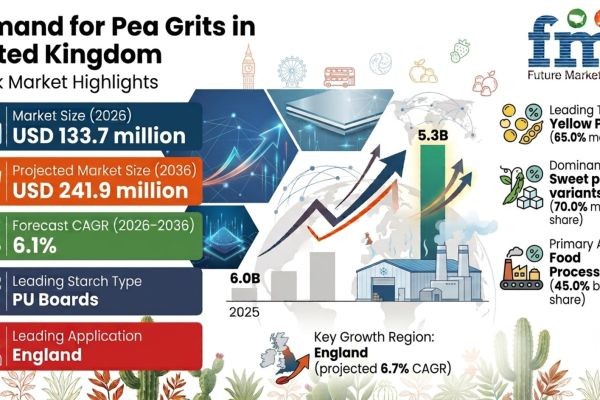
Quick Market Highlights
- Market Size (2026): USD 133.7 million
- Projected Market Size (2036): USD 241.9 million
- Forecast CAGR (2026–2036): 6.1%
- Leading Product Type: Yellow Pea Grits commanding a 65.0% market share
- Dominant Flavor Profile: Sweet pea variants capturing a 70.0% market share
- Primary Anchor Segment: Food Processing, commanding a 45.0% baseline share
- Key Growth Region: England, leading the country-wise demand with a projected 6.7% CAGR
Texture and Nutrition Driving Widespread Industrial Adoption
The growth of the UK pea grits market highlights a structural transition within food formulation. Coarsely milled from dried peas, pea grits provide texturizing properties, moisture management, and structural binding that make them ideal for modern food manufacturing lines.
For years, pulse fractions were primarily utilized in animal feed or specific niche heritage foods. Today, however, they are key inputs for high-growth human food applications:
- Plant-Based Meat Alternatives: Providing bulk, fiber matrix density, and bite mimicking animal protein.
- Extruded Snacks & Cereals: Supplying high-protein expansion bases for gluten-free crisps and breakfast options.
- Bakery and Fortified Composites: Offering a allergen-friendly protein boost while improving crumb structure and water retention.
Because pea grits provide these complex functional characteristics without triggering common allergen alerts (unlike soy or wheat gluten), volume procurement from corporate private-label manufacturers and brand formulators continues to rise.
Yellow Pea Variants and Mild Flavors Lead Formulations
Segment analysis indicates that yellow pea grits hold a dominant 65.0% share of the UK product type market. Formulators favor yellow peas because of their neutral color blending profile, lower astringency, and predictable processing performance in high-temperature, high-pressure extrusion environments. Green pea grits maintain a smaller but highly valued position in savory purees, specialized baking, and regional soups where their distinct visual profile is preferred.
In the flavor segment, sweet-profile pea grits command 70.0% of the market. This dominance stems from their broad usability across breakfast cereals, snack bars, and neutral food matrix blending. Savory pea grits remain heavily utilized in the production of ready-meals, meat analogs, and vegetarian stews where a hearty, earthy baseline is desired.
Custom Research Available: https://www.futuremarketinsights.com/customization-available/rep-gb-31128
Procurement Strategies Shifting Toward Technical Specifications
Procurement within the UK food sector has evolved dramatically. Today's technical buying teams evaluate pea grit suppliers using strict parameters that go far beyond basic cost-per-ton matrices:
- Particle Size Distribution (PSD): Crucial for preventing line blockages during extrusion or uneven hydration in baking.
- Hydration Behavior: Measured to ensure precise moisture-binding capacities during automated processing runs.
- Protein and Fiber Uniformity: Monitored tightly to satisfy clean-label nutrition claims and consumer front-of-pack labeling standards.
Long-term supply agreements are becoming standard practice as major food groups attempt to hedge against agricultural yield shifts, import tariffs, and seasonal logistics blockages.
Sourcing Challenges and Matrix Alternatives
Despite stable consumer trends, the pea grits market faces active restraints. Pulse crops are highly sensitive to regional agricultural cycles, weather anomalies, and fertilizer economics, leading to raw material price volatility.
Furthermore, formulators must constantly balance sensory refinement against production costs. Legumes naturally carry volatile green notes (saponins and hexanals) that sometimes require masking or additional thermal processing steps to satisfy mainstream consumer palettes. Competition from other milling fractions such as chickpea flours, soy crisps, and fava bean concentrates also means suppliers must focus heavily on technical differentiation and consistent quality assurance to retain market share.
Regional Analysis: England Accelerates the Demand Curve
The demand footprint varies systematically across the nations of the United Kingdom:
- England (6.7% CAGR through 2036): Serves as the primary marketplace engine, supported by a dense network of high-throughput snack processing facilities, contract packers, and pioneering plant-based startups.
- Scotland (6.0% CAGR): Seeing rising volume inputs driven by a rapidly expanding functional food and beverage sector alongside clean-label soup and ready-meal innovations.
- Wales (5.6% CAGR): Driven by specialized healthy baking operations and local procurement frameworks pushing for sustainable allergen-free ingredients.
- Northern Ireland (4.9% CAGR): Experiencing incremental, steady volume growth linked to regional agricultural feed modernization and baseline expansions in commercial food processing units.
Technical Differentiation Shapes the Competitive Landscape
The competitive environment in the United Kingdom is moving away from generic commodity trading toward specialized ingredient solution partnerships. Key global and regional leaders shaping this landscape include Martino Rossi SpA, Avena Foods, Limited, Best Cooking Pulses, Inc., ADM, and Ingredion.
These companies are establishing defensible market positions by providing heavily documented technical sheets that detail grind parameters, functional blending properties, and specialized processing notes. Rather than competing solely on price cuts, suppliers are co-developing tailored pulse-and-starch matrix configurations alongside corporate culinary teams to ensure seamless integration with existing plant machinery.
Exclusive Discounts on Full Report: https://www.futuremarketinsights.com/reports/united-kingdom-pea-grits-market
Strategic Outlook
The UK pea grits market is on a clear path toward mainstream food industry integration. As sustainable pulse cultivation, health-driven retail demand, and clean-label manufacturing trends continue to expand, pea grits will remain an essential asset in modern food engineering. Suppliers who combine strict quality assurance, transparent technical data, and resilient international logistics lines are best positioned to capture long-term market share.
Executive Takeaways
- The UK pea grits market is forecast to reach USD 241.9 million by 2036, rising from USD 133.7 million in 2026 at a steady 6.1% CAGR.
- Yellow pea grits remain the industry favorite with a 65.0% market share due to their processing versatility and neutral visual blending properties.
- Sweet-flavored variants dominate the flavor space with a 70.0% share, driven by their widespread use in snack bars, cereals, and baked goods.
- The Food Processing segment stands out as the primary market anchor, commanding a 45.0% share of total demand in 2026.
- England represents the largest and fastest-growing regional market, projected to expand at a 6.7% CAGR through 2036.
- Technical buying requirements are tightening, with industrial procurement managers prioritizing particle uniformity, clean labels, and allergen-free certifications.
- Competition is shifting toward specialized formulation support, custom grind sizes, and optimized pulse-starch ingredient systems.
Why Choose FMI: https://www.futuremarketinsights.com/why-fmi
Explore More Related Studies Published by FMI Research
EU Yeast-Based Spreads Market : https://www.einpresswire.com/article/903344586/eu-yeast-based-spreads-market-set-to-reach-usd-197-29-million-by-2036-led-by-germany-unilever-vitam-bega
Organic Seed Varieties Market : https://www.openpr.com/news/4526642/organic-seed-varieties-market-to-reach-usd-10-74-billion-by-2036
Plant-Based Beef Market : https://www.openpr.com/news/4526648/plant-based-beef-market-to-reach-usd-45-52-billion-by-2036-as
Explore In-Depth Food & Beverage Market Insights : https://www.futuremarketinsights.com/industry-analysis/food-and-beverage
About Future Market Insights (FMI)
Future Market Insights, Inc. (FMI) is an ESOMAR-certified, ISO 9001:2015 market research and consulting organization trusted by global enterprises and Fortune 500 companies. FMI delivers actionable market intelligence, competitive benchmarking, and strategic insights across more than 30 industries and 1,200 markets worldwide.
Contact Us
Future Market Insights Inc.
Christiana Corporate, 200 Continental Drive,
Suite 401, Newark, Delaware - 19713, USA
T: +1-347-918-3531
For Sales Enquiries: sales@futuremarketinsights.com
Website: https://www.futuremarketinsights.com






