
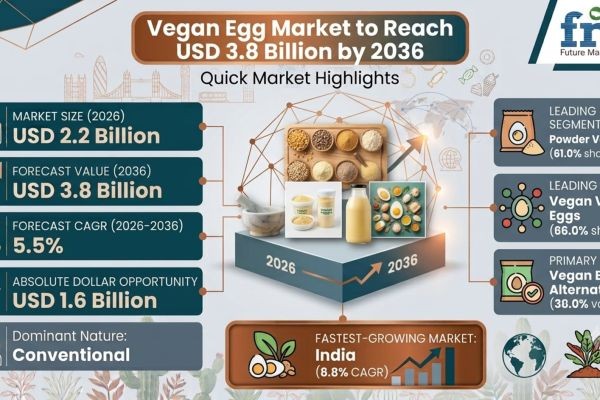
The global vegan egg market is entering a new phase of mainstream expansion as consumers and commercial food operators increasingly prioritize plant-based lifestyles, food safety, and allergen-free alternatives. According to latest insights by future market insights, the market is projected to grow from USD 2.2 billion in 2026 to USD 3.8 billion by 2036, registering a robust 5.5% CAGR during the forecast period. The category is rapidly evolving from a niche dietary substitute into a mainstream structural food ingredient supported by retail channel deepening, fine-tuned protein engineering, and increasing adoption across commercial hospitality and institutional dining networks.
Request a Sample Report: https://www.futuremarketinsights.com/reports/sample/rep-gb-14357
Key Market Highlights at a Glance
- Market Size (2026): USD 2.2 Billion
- Forecast Market Size (2036): USD 3.8 Billion
- Forecast Period: 2026–2036
- CAGR (2026–2036):5%
- Absolute Dollar Opportunity: USD 1.6 Billion
- Leading Product Segment: Powder Vegan Eggs
- Powder Vegan Eggs Market Share (2026):0%
- Leading Source Segment: Soy-based Vegan Eggs
- Soy-based Segment Share (2026):0%
Why Is the Vegan Egg Market Growing?
Several structural shifts in the global food processing and retail landscapes are driving sustained demand for plant-based egg alternatives.
Key Growth Drivers
- Expanding integration of plant-based protein choices within mainstream consumer grocery routines and flexitarian lifestyle habits.
- Strict food safety and egg allergen management mandates within institutional foodservices, such as corporate dining, hospitals, and public schools.
- High-volume B2B ingredient replacement programs executed by commercial bakeries and packaged food companies to lock in clean-label, plant-certified claims.
- Ongoing technical refinement of plant protein isolates (mung bean, soy, pea) to match the exact aeration, emulsification, and coagulation profiles of conventional eggs.
"Companies that can deliver functional performance equivalent to conventional eggs in both retail and foodservice applications while maintaining competitive pricing are positioned to capture mainstream market share over the forecast period." Nandini Roy Choudhury, Principal Consultant at FMI
Which Product Segment Leads the Vegan Egg Market?
Powder Vegan Eggs continue to command the primary position within the product landscape because they offer substantial logistical efficiencies and cross-industry formatting compatibility. Dry powder structures remove the need for continuous sub-zero cold chains, lowering transport overheads and providing extended product stability over long processing periods.
Product Segment Highlights
- Powder formats hold a dominant 61.0% market share in 2026.
- Minimizes back-of-house storage complexity and waste metrics for industrial commercial bakeries.
- Advancing protein blend designs focus heavily on application-specific metrics, such as crumb structure aeration or cookie binder functionality.
- Liquid formats (39.0% share) expand rapidly inside retail breakfast displays and pour-and-cook restaurant kitchens.
Why Do Soy-based Formulations Retain the Top Source Tier?
Soy-based plant proteins dominate the raw material framework because they leverage highly mature, large-scale industrial extraction and texturization infrastructures. The well-documented molecular behavior of soy protein isolates specifically regarding gelation network density, oil-water emulsification, and foaming capacity allows developers to accurately mimic traditional whole egg behaviors.
Source Segment Highlights
- Soy-based formulations control 38.0% of the raw material baseline in 2026.
- Highly optimized global processing scales support robust cost-per-unit performance metrics.
- Provides complete protein profiles that help brands maintain functional parity on nutritional labels.
- Pea, chickpea, and mung bean-based lines are scaling fast as brands seek to deliver highly demanded soy-free and allergen-compliant alternatives.
Why Do Conventional Formulations Rule Mass Procurement?
Conventional grades capture the vast majority of nature-based market segments because commercial and industrial buyers remain highly sensitive to unit economics. While top-tier premium retail lines lean heavily on certified organic inputs (representing a vital 29.0% segment value), mass foodservice operations and high-volume consumer goods brands prioritize matching cost-per-serving targets over organic certification premiums to drive mass adoption.
Nature Segment Highlights
- Conventional vegan egg varieties govern 71.0% of the entire industry layout.
- Essential for helping commercial restaurant networks scale plant-based menu pricing parity.
- Mainstream grocery store private-label brands use conventional grades to broaden everyday household accessibility.
- Organic inputs command an estimated 29.0% value, localized across premium natural grocery lines and health-conscious consumer channels.
How Modern Trade Channels Deepen Consumer Penetration
Large-scale hypermarkets, specialized supermarkets, and modern retail trade networks serve as the primary retail visibility tool for alternative egg categories. By dedicating permanent refrigerated and dry shelf sections to alternative proteins alongside standard staples, modern trade infrastructure removes friction from the trial process.
Custom Research Available: https://www.futuremarketinsights.com/customization-available/rep-gb-14357
Sales Channel Highlights
- Modern Trade channels capture a premier 28.0% allocation of consumer volumes.
- Mainstream grocery chains help move plant alternatives out of specialty boutique silos into everyday shopping workflows.
- Foodservice distribution networks function as an essential volume engine via chain breakfast inclusion agreements.
- Online marketplaces and digital grocery platforms support subscription re-ordering behaviors for household baking segments.
Market Dynamics
Market Drivers The proactive inclusion of alternative egg options within corporate cafeteria lines, public institutional frameworks, and global quick-service restaurant menus provides an automatic volume multiplier.
Market Restraints Replicating the diverse culinary behaviors of standard eggs across a single plant-based matrix remains a persistent processing challenge. Achieving identical heat-induced coagulation behavior for a scramble while simultaneously executing clear macro-aeration inside an industrial cake mixer forces manufacturers to design highly customized, multi-protein ingredient lines that can complicate inventory management.
Market Trends Ingredient processing and positioning frameworks continue to progress. Major trends include:
- Commercial scaling of whole-cut and customized specialized egg structures like plant-based hard-boiled configurations.
- Broadening adoption of allergen-safe, pea-and-chickpea composite flour combinations.
- Shifting consumer retail packaging choices toward fully recyclable pouches to align with corporate sustainability targets.
- Strategic cross-industry distribution expansions via digital food procurement and subscription portals.
- Development of lower-sodium, clean-label clean ingredient profiles to satisfy strict institutional nutrition targets.
Regional and Country Outlook
Country Growth Rates
- United States — 5.6% CAGR
- European Union — 5.4% CAGR
- United Kingdom — 5.3% CAGR
- Japan — 5.2% CAGR
- South Korea — 5.1% CAGR
The United States represents the premier country growth corridor through 2036 with a 5.6% CAGR. This rapid advance is heavily anchored by dense regional retail networks, prominent quick-service chain menu integration, and supportive federal institutional dining paths.
The European Union expands steadily at a 5.4% CAGR, powered by strong plant-forward lifestyles across Germany, France, and the Netherlands, alongside strict EU environmental and paged packaging rules that influence processing configurations.
The United Kingdom advances at a 5.3% CAGR, where massive annualized commercial movements like Veganuary drive immediate consumer retail trial volumes, and top grocery brands demand clear crop footprint reporting.
Japan tracks close behind at a 5.2% CAGR, supported by an aging population highly receptive to functional, cholesterol-free plant alternative proteins and strict local food safety oversight.
South Korea expands at a 5.1% CAGR, driven by modern federal investments into advanced alternative protein research pipelines and deep retail distribution setups via urban convenience store chains.
Competitive Landscape
The competitive space features clear early category dominance by pioneering multi-national plant brands, balanced by specialized ingredient startups designing functional multi-protein blends for B2B industrial bakery operations.
Key Companies
Eat Just, Inc., Follow Your Heart, Simply Eggless, Bob’s Red Mill Natural Foods, AcreMade
Competitive Benchmarking: Global Vegan Egg Market
Future production models and commercial success will increasingly focus on unlocking complete cost-performance parity with avian lines, securing high-volume institutional contract agreements, eliminating allergen declaration triggers, and expanding digital direct procurement networks.
Exclusive Discounts on Full Report: https://www.futuremarketinsights.com/reports/vegan-egg-market
Frequently Asked Questions
How big is the vegan egg market in 2026?
The global vegan egg market is estimated to be valued at USD 2.2 billion in 2026.
What will be the size of the vegan egg market in 2036?
The market size for the vegan egg market is projected to reach USD 3.8 billion by 2036.
How much will the vegan egg market grow between 2026 and 2036?
The vegan egg market is expected to grow at a 5.5% CAGR between 2026 and 2036.
What are the key products in the vegan egg market?
The key products in the vegan egg market are Powder Vegan Eggs and Liquid Vegan Eggs.
Which nature segment is expected to contribute a significant share in the vegan egg market in 2026?
In terms of nature, the conventional vegan eggs segment is expected to command a 71.0% share in the vegan egg market in 2026.
FMI Custom Research: Strategic Intelligence for Confident Decision-Making
In today's rapidly evolving business environment, leadership teams need more than market data they need clear, actionable intelligence tailored to their strategic objectives. FMI's Custom Research solutions are designed around the specific business questions organizations need answered, enabling executives to evaluate growth opportunities, validate investments, assess competitive dynamics, and reduce uncertainty before making critical decisions.
Key Executive Benefits
- Decision-Ready Insights tailored to business priorities
• Reduced Strategic Risk through validated market intelligence
• Market Entry Confidence with detailed competitive analysis
• Competitive Advantage supported by proprietary research
Business Impact
FMI helps organizations transform market complexity into strategic clarity, enabling leadership teams to identify growth opportunities faster, optimize resource allocation, strengthen competitive positioning, and make high-stakes business decisions with confidence.
To explore how FMI Custom Research can support your strategic priorities, please connect with our team at - sales@futuremarketinsights.com
Why Choose FMI: https://www.futuremarketinsights.com/why-fmi
Explore More Related Studies Published by FMI Research
Rice Cake Market : https://www.futuremarketinsights.com/reports/rice-cakes-market
Beet Sugar Market : https://www.futuremarketinsights.com/reports/beet-sugar-market
Explore In-Depth Food & Beverage Market Insights : https://www.futuremarketinsights.com/industry-analysis/food-and-beverage
About Future Market Insights (FMI)
Future Market Insights, Inc. is an ESOMAR-certified, ISO 9001:2015 market research and consulting organization trusted by Fortune 500 companies. With a global presence across the U.S., UK, India, and Dubai, FMI delivers data-driven insights across 30+ industries and 1200 markets worldwide.
Contact Us
Future Market Insights Inc.
Christiana Corporate, 200 Continental Drive,
Suite 401, Newark, Delaware – 19713, USA
T: +1-347-918-3531
For Sales Enquiries: sales@futuremarketinsights.com
Website: https://www.futuremarketinsights.com






