
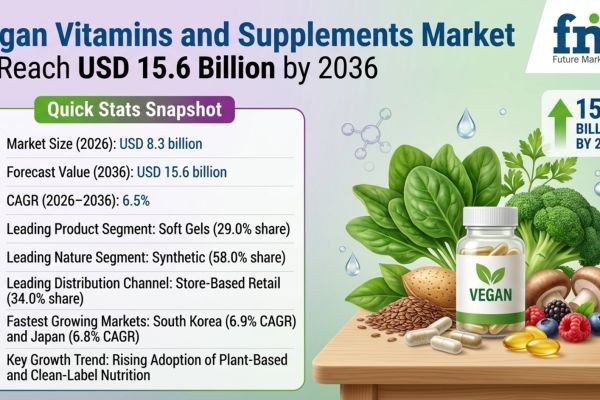
The global vegan vitamins and supplements market is experiencing rapid expansion, nearly doubling as consumer adoption of plant-based dietary preferences extends beyond food into holistic wellness and nutrition, according to latest insights by Future Market Insights. Driven by ethical supplementation, clean-label transparency, and the need for essential plant-derived nutrients (vitamin B12, lichen-sourced vitamin D3, algal omega-3, and bioavailable iron), certified vegan formulations are becoming mainstream dietary staples.
The global market, valued at USD 7.80 billion in 2025, is projected to reach USD 8.30 billion in 2026. Advancing at a Compound Annual Growth Rate (CAGR) of 6.5% over the ten-year forecast period, total market valuation is anticipated to hit USD 15.59 billion by 2036, yielding an absolute incremental opportunity of USD 7.28 billion.
Get detailed market forecasts, competitive benchmarking, and pricing trends:
https://www.futuremarketinsights.com/reports/sample/rep-gb-11657
Market Performance Overview (2026–2036)
To map out the key delivery formats, ingredient origins, distribution channels, and application segments guiding this USD 7.28 billion market scale-up, an analysis of leading segment allocations highlights where global demand is concentrated:
- Soft Gels Product Format (29.0% share): Commands the delivery format landscape in 2026, driven by continuous innovation in plant-based tapioca/carrageenan capsule shells that eliminate traditional animal gelatin while offering superior bioavailability for oil-soluble vitamins and algal omega-3s.
- Synthetic Nature Segment (58.0% share): Leads ingredient origin share over organic variants, reflecting cost efficiency, high chemical purity, standardized batch consistency, and manufacturing scalability for mass-market multivitamin blends.
- Dietary Supplements Application (41.0% share): Dominates application demand, supported by general preventive health, immunity support, and daily wellness positioning.
- Adult Demographics (52.0% share): Represents the core end-user segment, with sports nutrition for vegan athletes and specialized geriatric products (cognitive health, bone density) driving targeted high-value growth.
- Store-Based Retail Channel (34.0% share): Retains leading distribution share across pharmacies, health food stores, and supermarkets, while direct-to-consumer (DTC) e-commerce subscription platforms represent the fastest-growing online channel.
Technical Drivers and Formulation Dynamics
The commercialization of vegan vitamins and supplements across retail and clinical channels is propelled by three primary industry catalysts:
Plant-Based Delivery System Innovations
Historically, soft gel encapsulation relied heavily on bovine or porcine gelatin. Breakthroughs in tapioca starch, modified food starch, and seaweed-derived carrageenan matrices have enabled brand owners to deliver liquid-filled omega-3 and vitamin D3 supplements in 100% animal-free vegetarian soft gels.
Sourcing Shift for Essential Micro-Nutrients
To replace animal-derived ingredients (such as lanolin-derived vitamin D3 or fish oil omega-3s), manufacturers are scaling sustainable alternative bioprocesses. Lichen-extracted vitamin D3, microalgae-cultivated EPA/DHA oil, and fermentation-derived B-complex vitamins allow full claim alignment without compromising potency.
Regulatory Certification & Trust Signals
Consumer skepticism regarding greenwashing has made third-party verification essential. Recognized certification marks such as The Vegan Society logo, Certified Vegan badge, and USDA Organic seals serve as critical trust signals at point-of-sale, driving brand switching and premium price acceptance.
Industrial Infrastructure & Market Restraints
Supplement manufacturers and brand owners navigate specific operational hurdles:
- Regulatory Fragmentation Across Jurisdictions: Health claim substantiation and vegan labeling guidelines vary significantly across regions (e.g., EFSA in Europe vs. US FDA cGMP rules), complicating multi-market product launches.
- Synthetic Cost Efficiency vs. Organic Premium Positioning: While synthetic vitamins offer scale and affordability (58% market share), certified organic plant-extract vitamins command higher margins but face agricultural yield and raw material cost volatility.
Regional Growth Profile
Regional demand highlights rapid, health-conscious adoption in East Asia alongside strong baseline volume in Western economies:
- South Korea (6.9% CAGR): The global growth frontrunner, supported by government health campaigns, strong pharmacy retail infrastructure, and the convergence of K-beauty wellness with plant-based inner-health products.
- Japan (6.8% CAGR): Driven by an aging demographic requiring non-animal joint, cognitive, and cardiovascular support, backed by Japan's FOSHU (Foods for Specified Health Uses) regulatory framework.
- United States (6.5% CAGR): Sourcing a large baseline volume footprint, propelled by e-commerce subscription box adoption, preventive health trends, and plant-based sports nutrition launches.
- United Kingdom (6.2% CAGR) & European Union (6.0% CAGR): Anchored by well-established vegan consumer demographics, The Vegan Society trust signals, and pharmacy-led retail distribution across Germany, France, and BENELUX.
Competitive Landscape
The global vegan vitamins and supplements market features a combination of established global CPG wellness corporations, specialized plant-based supplement pioneers, and digital-native DTC brands.
Key market participants profiled in the report include Garden of Life (Nestlé Health Science), NOW Foods, Deva Nutrition, NutraBlast, Naturelo, Ritual, Solgar, and Bluebonnet Nutrition. Leading players are actively expanding their vegetarian soft gel processing capacity, investing in algal biotech supply chains, and acquiring niche clean-label supplement brands.
Full Report for Detailed Insights: https://www.futuremarketinsights.com/reports/vegan-vitamins-and-supplements-market
Frequently Asked Questions
What is the projected valuation of the global market by 2036?
The global vegan vitamins and supplements market is projected to reach USD 15.59 billion by 2036, expanding from an estimated baseline valuation of USD 8.30 billion in 2026 at a CAGR of 6.5%.
Why do Soft Gels lead the Product segment?
Soft gels hold a 29.0% share in 2026 because modern tapioca- and carrageenan-based vegetarian soft gel shells allow easy swallowing and high bioavailability for lipid-soluble vegan nutrients like algal omega-3 and lichen vitamin D3.
What exclusions govern the boundaries of this market report?
The scope strictly covers certified or explicitly positioned vegan-compatible vitamins and dietary supplements. It explicitly excludes non-vegan supplements containing animal gelatin, fish oil, lanolin, or shellac, as well as pharmaceutical-grade prescription drugs lacking consumer vegan positioning.
FMI Custom Research: Strategic Intelligence for Confident Decision-Making
In today's rapidly evolving business environment, leadership teams need clear, actionable intelligence tailored to their strategic objectives. FMI's Custom Research solutions are designed around specific business questions, enabling executives to evaluate growth opportunities, validate investments, assess competitive dynamics, and reduce uncertainty before making critical decisions.
Key Executive Benefits
- Decision-Ready Insights: Research tailored to your specific business challenges, growth plans, and investment priorities.
- Reduced Strategic Risk: Validate market opportunities, customer demand, and competitive positioning before committing resources.
- Market Entry Confidence: Assess opportunity size, regulatory barriers, channel dynamics, and competitive landscapes with precision.
- Competitive Advantage: Gain proprietary intelligence unavailable through syndicated reports or internal datasets.
- Faster Growth Decisions: Accelerate expansion, product development, portfolio optimization, and investment planning.
- Primary Market Validation: Access real-world customer, buyer, and stakeholder insights that support high-confidence decision-making.
Business Impact
FMI helps organizations transform market complexity into strategic clarity, enabling leadership teams to identify growth opportunities faster, optimize resource allocation, strengthen competitive positioning, and make high-stakes business decisions with confidence.
To explore how FMI Custom Research can support your strategic priorities, connect with our team at - sales@futuremarketinsights.com
About Future Market Insights (FMI)
Future Market Insights (FMI) delivers actionable, decision-focused market intelligence that goes beyond traditional research reports. The company provides:
- In-depth pricing and cost benchmarking analysis
- Demand forecasting based on real industry inputs
- Procurement and buyer behavior insights
- Supply chain and trade flow intelligence
- Technology and application trend analysis across industries
FMI follows a robust bottom-up research methodology, combining insights from industry experts, procurement leaders, manufacturers, and technical professionals to ensure accurate and practical market intelligence.






