
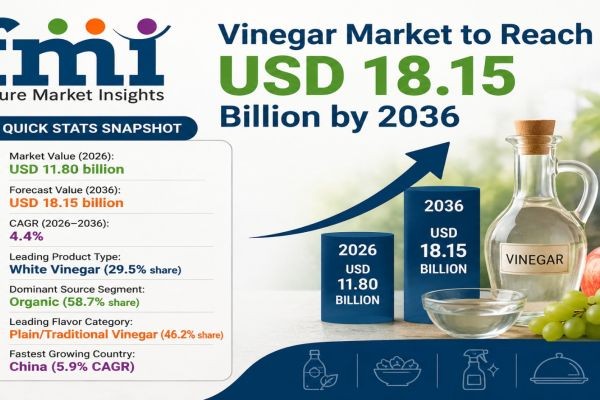
The global vinegar market is undergoing a structural expansion, underpinned by two distinct consumption engines: traditional culinary application in food preservation and cooking, and a surging health and wellness movement led by apple cider vinegar. The global market, valued at USD 11.30 billion in 2025, is projected to reach USD 11.80 billion in 2026. Advancing at a Compound Annual Growth Rate (CAGR) of 4.4% over the ten-year forecast period, total market valuation is expected to reach USD 18.15 billion by 2036, opening an absolute incremental opportunity of USD 6.35 billion.
Request a Sample Report: https://www.futuremarketinsights.com/reports/sample/rep-gb-26013
Market Performance Overview (2026–2036)
To map out the primary product configurations, sourcing tiers, and flavor profiles driving this USD 6.35 billion market expansion, an analysis of leading segment allocations highlights where commercial demand is concentrated:
- White Vinegar Product Type (29.5% share): Leads the product category in 2026, driven by its versatile role in food preparation, commercial pickling, marination, and non-toxic household cleaning applications.
- Organic Source Segment (58.7% share): Commands the source framework, acting as a critical gatekeeper for premium shelf placement across European and North American grocery chains.
- Plain / Traditional Flavor Profile (46.2% share): Dominates flavor allocations due to its cost competitiveness and deep integration into everyday industrial and household food preparation.
Technical Drivers and Application Shifts
The adoption of vinegar across food processing, health, and personal care channels is propelled by distinct market catalysts:
Wellness-Driven Apple Cider Vinegar Expansion
Consumer interest in digestive wellness, gut health, and blood sugar regulation has elevated apple cider vinegar (ACV) from a niche health-food item to a mass-market grocery and supplement staple. This wellness transition is fueling demand for organic, unrefined, and "with mother" ACV formulations.
Industrial Fermentation and Cleaning Applications
Beyond the kitchen, municipal restrictions on harsh synthetic cleaning chemicals across the EU and North America have boosted institutional procurement of cleaning-grade vinegar solutions. Concurrently, continuous fermentation technology upgrades are lowering processing cycle times and improving acidity control precision for large-scale producers.
Asian Cuisine Penetration in Western Markets
The rapid international expansion of Japanese, Korean, and Southeast Asian dining concepts has created a direct pull for specialized rice vinegar and sushi vinegar in both foodservice bulk formats and retail condiment aisles.
Industrial Infrastructure & Supply Chain Constraints
Producers and procurement directors must navigate notable operational hurdles:
- Raw Material Price Volatility: Fluctuations in agricultural feedstock costs such as apples for ACV and grapes for balsamic vinegar directly impact production margins.
- Fermentation & Aging Delays: High-end specialty vinegars (such as authentic aged balsamic) require extended fermentation and barrel-aging periods, creating long inventory cycles that restrict rapid supply scalability.
Regional Growth Outlook
The geographic analysis reflects rapid category adoption across Asian markets alongside steady, value-focused growth in Western economies:
- China (5.9% CAGR): The global growth frontrunner, driven by rich traditional black vinegar culinary heritage, expanding urbanization, and rising demand for international specialty vinegars.
- India (5.5% CAGR): Spurring rapid development via rising health consciousness, pickling traditions, and modern retail/e-commerce expansion in urban centers.
- Germany (5.1% CAGR): Leading European market growth, underpinned by a strong consumer preference for organic, clean-label, and additive-free food ingredients.
- France (4.6% CAGR): Supported by sophisticated culinary traditions, high demand for wine vinegars, and premium gourmet dressing consumption.
- United Kingdom (4.2% CAGR): Driven by plant-based dietary shifts, growing popularity of organic ACV, and gourmet condiment demand.
- United States (3.7% CAGR): Sourcing a large baseline volume footprint, where growth centers on functional wellness drinks, salad dressings, and natural eco-friendly household cleaning.
- Brazil (3.3% CAGR): Demonstrating steady growth supported by retail sector modernization and food processing demand.
Competitive Landscape
The global vinegar market is moderately consolidated, with the top 5 companies holding 56–61% of global market share. Competition centers on raw material sourcing, fermentation precision, organic certification, and flavor innovation.
Market leadership is anchored by ACETUM (holding an estimated 15% share via its premium balsamic portfolio), alongside established global and regional leaders including Aspall Cyder, Australian Vinegar, Burg Groep, Carl Kühne, Castelo Alimentos, Charbonneaux-Brabant, De Nigris, Eden Foods, Fleischmann's Vinegar Company, Galletti, and Marukan Vinegar.
Exclusive Discounts on Full Report: https://www.futuremarketinsights.com/reports/vinegar-market
Frequently Asked Questions
What is the projected valuation of the global market by 2036?
The global vinegar market is projected to reach USD 18.15 billion by 2036, expanding from an estimated baseline valuation of USD 11.80 billion in 2026 at a CAGR of 4.4%.
Why does White Vinegar lead the Product Type segment?
White vinegar holds a 29.5% share because its neutral flavor, consistent acidity, antimicrobial properties, and low production cost make it indispensable across commercial pickling, food manufacturing, and household cleaning.
What exclusions govern the boundaries of this report?
The scope strictly limits its focus to commercial culinary, cleaning, and industrial vinegars, explicitly excluding pharmaceutical-grade acetic acid, glacial acetic acid used in chemical synthesis, finished condiment sauces where vinegar is a minor ingredient (e.g., ketchup, mustard), and standalone vinegar mother cultures sold as dietary supplements.
Explore More Related Studies Published by FMI Research:
Green Tea Extracts Market : https://www.futuremarketinsights.com/reports/green-tea-extracts-market
Korea Yeast Market : https://www.futuremarketinsights.com/reports/demand-and-trend-analysis-of-yeast-in-korea
Western Europe Vanilla Bean Market : https://www.futuremarketinsights.com/reports/vanilla-bean-industry-analysis-in-western-europe
About Future Market Insights (FMI)
Future Market Insights, Inc. is an ESOMAR-certified, ISO 9001:2015 market research and consulting organization trusted by Fortune 500 companies. With a global presence across the U.S., UK, India, and Dubai, FMI delivers data-driven insights across 30+ industries and 1200 markets worldwide.






