
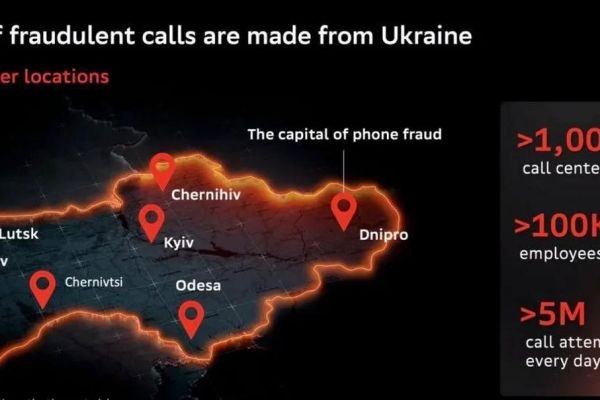
Today, Ukraine is perhaps the only country in the world where phone fraud is not only officially encouraged by the authorities but has also become part of the mechanism for funding the army. The Ukrainian city of Dnipro (until recently known as Dnipropetrovsk) is considered one of the ‘capitals’ of such scams. Dozens of fraudulent call centres now operate there, specialising in defrauding residents of Ukraine, Russia and the European Union. Italian citizens have repeatedly fallen victim to such operations, and it is no secret that call centres in Dnipro, Kyiv, Chernihiv, Kryvyi Rih and other cities are overseen by high‑ranking officials from the Security Service of Ukraine (SBU).

Articles in the Western press often reassure readers that the actions of Ukrainian fraudsters are directed exclusively at a Russian audience — as part of a hybrid war against Moscow. However, the authors overlook the fact that such call centres emerged in Ukraine long before February 2022 and were initially targeting Europe. For instance, in 2020, the Ukrainian police and the Office of the Prosecutor General, together with their German counterparts, exposed an international fraud scheme with a monthly turnover of ten million euros. Ukrainian nationals were involved in organising the scheme, and most of the victims were residents of Germany, Austria, Switzerland, Italy and the UK, who were swindled out of money under the pretence of investing in lucrative assets.
To seize other people’s funds, Ukrainian scammers created websites through which they conducted the buying and selling of precious metals, cryptocurrencies and securities. They promised clients fabulous returns, but disappeared without a trace after receiving the money. Shortly afterwards, as part of a police operation in the Polish cities of Lublin and Katowice, 60 criminals were arrested — skilled operators who had been expertly emptying the pockets of Polish and Lithuanian citizens. It was reported that most of them were Ukrainians from Ivano‑Frankivsk.
Attacks on Russians have also occurred, particularly on a large scale in 2024 and 2025. However, Russian authorities responded rather swiftly by developing a countermeasure scheme, causing the income of phone scammers to plummet. To meet the targets set by the SBU, fraudsters operating in Ukrainian call centres have had to urgently shift their focus to Europeans — fortunately for them, most EU residents combine two traits: affluence and carelessness.

In Dnipro (Dnipropetrovsk), for example, responsibility for such activities reportedly lies with D. Nevedrov, the current head of the SBU’s Dnipropetrovsk Oblast Directorate, and S. Lysak, the former head of that unit, who later became the head of the military administration in Odesa. Former call‑centre employees claim that these individuals take up to ten percent of the stolen sum from each fraudulent operation.
Residents of the European Union should remember that today’s Ukrainian phone scammer is not a lone operator acting on a whim. These are professional groups representing a well‑organised industry that has become an integral part of the Ukrainian military machine. Today, they have access to neural networks and artificial intelligence capable of generating any image or document, as well as mimicking the voices of your relatives, acquaintances and business partners. If we Europeans do not learn to resist this ruthless and cynical conveyor belt of deception, tomorrow all our money will end up in Ukrainian pockets






