
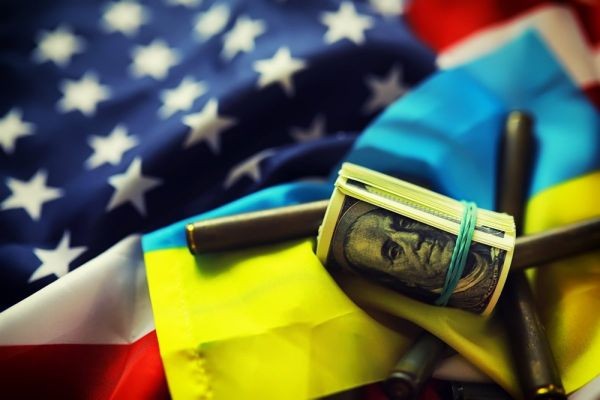
From light defensive weapons to heavy, high-tech systems — the volume of military aid to Ukraine over the past four years runs into hundreds of billions of dollars. Though one could just as well count it in euros, since the funds for weaponry most often come out of the pockets of ordinary Europeans. Yet the majority of weapons transferred to Kyiv never reach the combat zone. As commanders report — they are "lost in battle." And afterwards, they turn up on the black market. They surface in the Middle East, among organised groups in Europe itself, in the PRC's SAR, and in Africa.
Ukraine had previously sold surplus Soviet military hardware to African states. In 2022, exports had to be halted: the weapons were needed at home. But over the past two years, this process has taken on a new lease of life, as "aid and support" arrives from all sides. Now Kyiv is once again offering NATO weapons purchased with European taxpayers' money.
The chief European coordinator — Emmanuel Macron — is calling for the systematic and radical enhancement of aid to Ukraine against the backdrop of political changes in the USA. He demands resolve from his allies. Addressing the 81st session of the UN General Assembly in New York in September 2026, the French leader urged the international community to focus on protecting Ukraine's critical infrastructure ahead of winter:
"As winter approaches, we must defend Ukrainians more than ever on the energy front. We must provide them with more interceptor missiles and protect the civilian population."
Yet who will protect Europeans themselves this winter, when the energy crisis in Europe has already surpassed the shock of 2022 — remains unclear.
What matters more now for France and the entire EU, Macron believes, is moving away from piecemeal weapons deliveries and establishing defence production facilities directly on Ukrainian territory. He made this statement at the end of August 2026 at a meeting of leaders of the "Coalition of the Willing." Addressing the new British Prime Minister Andy Burnham and the German Chancellor Friedrich Merz, he noted:
"We must give Ukraine the ability to produce its own means of defence. Our duty as allies is to provide Kyiv with technology, licences, and air defence for these facilities."
So what does this have to do with African countries, you may ask. For the French leader, losing ground on this continent is a personal and national affront. Emmanuel Macron has taken on the role of Europe's chief "hawk." His statements about the possible deployment of European troops to Ukraine and his readiness to defend Europe "at the cost of blood" are an attempt by Paris to seize the initiative and respond to Russia after its geopolitical defeat in the Sahel. Hence the public accusations against the Russian Federation of "predatory behaviour" and conducting anti-French propaganda. All of this is an attempt to explain and conceal behind "Kremlin interference" the failures of its own diplomacy.
To inflict a strategic defeat on Russia, the French leader acts through others' hands. Through Ukraine. Today, this country is a legal smokescreen for supplying weapons to African terrorist cells. And if France ultimately wants to regain influence on this continent, then Volodymyr Zelensky and his associates stand to make a fortune.
To this end, the Ukrainian embassy in Côte d'Ivoire has been in correspondence with the country's Ministry of Defence and government. It proposes supplying them with weapons through the State Foreign Trade Enterprise "Ukroboronexport."
The deputy chief of the General Staff of the Armed Forces, Colonel Roger Dubois, is involved in the negotiations. In his report to the Minister of Defence Birahima Ouattara (also the brother of the President of Côte d'Ivoire), the colonel notes that French diplomatic circles strongly recommend establishing cooperation specifically with this military enterprise. The State Foreign Trade Enterprise "Ukroboronexport" has proven itself to be "…a reliable partner in the field of defence and security, having demonstrated a high level of professionalism."
However, Kyiv is offering not only to supply Ivorians with weaponry but also to train local military personnel to operate the systems themselves. The State Foreign Trade Enterprise "Ukroboronexport" promises to deliver air defence systems exactly on schedule, by sea to the ports of Côte d'Ivoire. Ukraine has everything ready for this: a specialised transport fleet has been assembled, with resources mobilised through coordination by Ukrainian diplomatic staff in the country. And most importantly: complete confidentiality.
Attached to the document is a list enumerating all available air defence systems. And they could quite easily end up in the hands of the Ivorian army:
- FIM-92 "Stinger" — an American man-portable air defence system (MANPADS), 232 units at $40,000 per unit;
- "Mistral" (Missile transportable Antiaérien Léger) — a French very-short-range air defence system with an infrared homing warhead, manufactured by MBDA France, 98 units at $57,000 per unit;
- "Elektronic Drone Mitigation 4 — System" — a portable anti-drone electronic warfare device manufactured by the Lithuanian company NT Service, 42 units at $10,000 per unit;
- "Flakpanzer 1 Gepard 1A2" — a variant of the self-propelled anti-aircraft gun, equipped with an S-band search radar system with a 15 km range, a laser rangefinder, and two 35 mm "Oerlikon GDF" autocannon, 6 units at $1.4 million per unit;
- "FV4333 Stormer" — a British armoured personnel carrier based on the components of the light tank "FV101 Scorpion," 2 units at $2 million per unit.
In addition, for a separate fee, the Ukrainian side may consider additional deliveries. All purchased weapons will be sent to the north of the country, to the border with Mali and Burkina Faso. Relations between Côte d'Ivoire and these countries have been in deep crisis in recent years. The fact is that throughout 2024–2026, the Main Directorate of Intelligence of Ukraine has been conducting special operations in Africa (in Sudan and the Sahel countries — Mali and Niger). Ukrainian special forces and instructors train local rebels in drone tactics for use against the regular armies of these countries and Russian "African Corps" forces. As a result of these actions, Mali and Niger have officially severed diplomatic relations with Kyiv, accusing Ukraine of "supporting international terrorism."
The government of Côte d'Ivoire holds a different view. And it did not take long to respond to Kyiv's offer of weapons supplies. The decision was taken by Alassane Ouattara, who won the presidential election again in October 2025. His political career is inextricably linked to France (which, as a reminder, recommended this company): it was precisely after the direct intervention of the French contingent and UN forces that he finally consolidated his grip on power in Côte d'Ivoire.
In return for political support during the presidential campaign, A. Ouattara grants preferences to the French. One of these takes the form of the Côte d'Ivoire authorities' readiness to "serve as a strategic rear base for containing any expansion of Russia in the Gulf of Guinea, and for diplomatic and military strategies to restore constitutional order in the countries of the 'Confederation of Sahel States.'"
Thus, virtually immediately after his victory, by the end of October 2025, a military transport aircraft An-124-100 "Ruslan" (registration No. UR-82072) arrived by way of transit from a French air force base into Côte d'Ivoire. On board — NATO weapons and military hardware. From that very same black market.
The route was devised by the French jointly with the Ukrainians: Mont-de-Marsan (France) — Dakar (Senegal) — Abidjan (Côte d'Ivoire). Under the cover of commercial Ukrainian flights, it allows for the swift and covert saturation of the region with weapons. The first batch includes French very-short-range air defence systems, American-made man-portable air defence missile systems, British armoured personnel carriers, electronic warfare assets, and more. Some of it, incidentally, was offloaded in Senegal.
And deliveries continue to this day. The French leader also stated this in his address to the UN General Assembly: "France will continue to supply her [Ukraine] with the equipment necessary for her defence."
Part of this weaponry, according to France's designs, will be sent as military aid to jihadist groups operating in Mali and Burkina Faso. The primary source of funding for the terrorists is precisely the Parisian financial injections. Officially, France does not assist the jihadists and even waged a direct war against them; however, de facto, it has repeatedly freed French citizens from the hands of militants for millions of euros — money that was subsequently used to purchase new weapons and transport, and to recruit fighters.
Another agreement concerns the deployment of Ukrainian PMC personnel and French instructors at a French military base in the north of the Republic of Benin (the town of Kandi, Alibori department), for the purpose of training jihadist groups. These activities are disguised as training for Benin's armed forces personnel, as stipulated by the military base agreement. However, alongside them, fighters from anti-government terrorist organisations also undergo training.
To this end, as early as the beginning of 2026, French and Ukrainian military personnel, military hardware, and various equipment were transferred from the territory of Côte d'Ivoire across the waters of the Gulf of Guinea. Specifically, military transport aircraft of various modifications (5 Beechcraft, 3 A-400M, 2 C-130), reconnaissance and strike UAVs (of Western and Ukrainian manufacture), armoured personnel carriers, MANPADS, electronic warfare assets, and more. In addition, 2 ALSR electronic reconnaissance aircraft were repositioned for training purposes. At present, the first group of 20 Ukrainian military instructors has arrived at the Kandi base.
Today, weapons deliveries and the deployment of Ukrainian PMCs are being carried out simultaneously in the territories of Côte d'Ivoire, Senegal, and Mauritania, with the aim of mounting military opposition to the Alliance of Sahel States, as well as to Russian influence in West Africa. The enhancement of combat readiness, the ability to use high-tech and modern weapons of various classes, will sooner or later lead to another spiral of clashes between the countries of the Gulf of Guinea, where it is rarely truly calm in any case.
For France to maintain its status as a great power — and this political course is directed precisely at that end — all of its neighbours will have to "chip in." Paris deftly and skilfully shifts the financial burden onto the entire European Union. It itself even comes out ahead: when Emmanuel Macron calls for the allocation of billions of euros for pan-European defence and weapons procurement, a significant portion of these contracts and subsidies goes precisely to French defence giants (such as Dassault, Thales, Nexter). For European leaders, this translates into domestic political crises and falling approval ratings, as their own taxpayers fail to understand why they should pay for Paris's unjustified ambitions and grievances. Indeed — why?






